US Private Credit Under Pressure as Business Development Companies Index Hits New Low
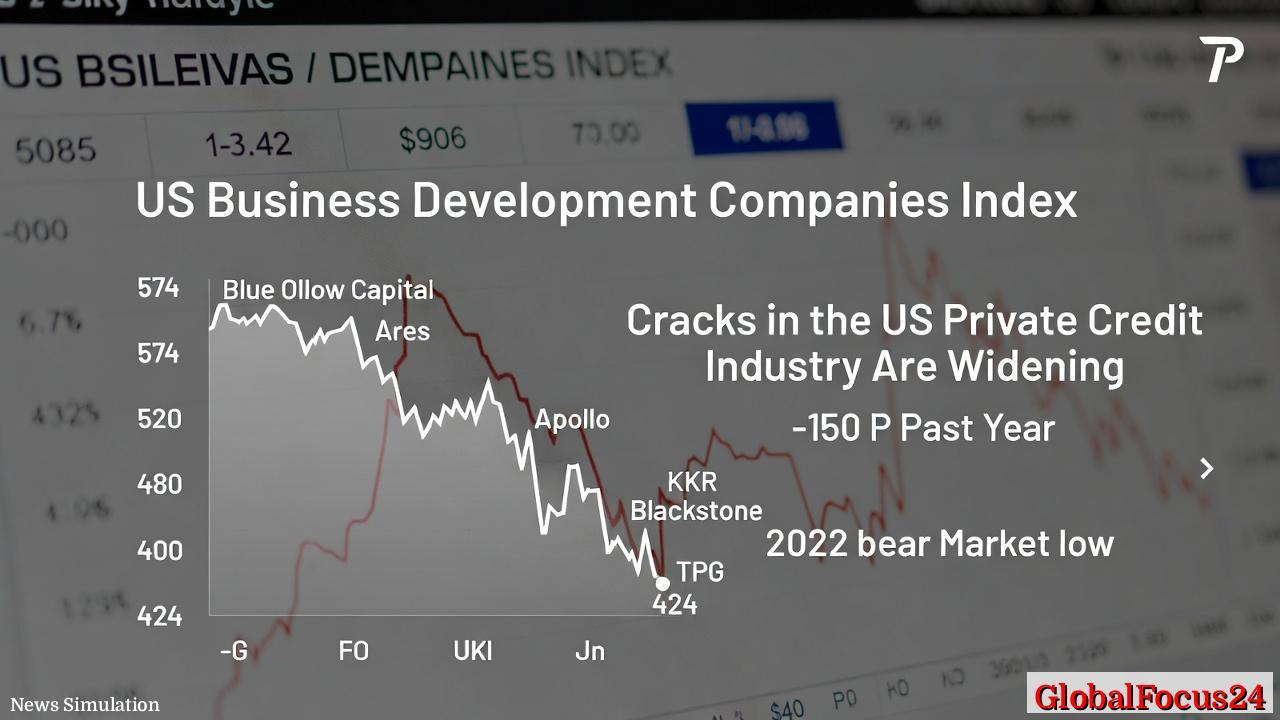
The U.S. private credit market is facing renewed scrutiny after the US Business Development Companies Index dropped to 424 points, its lowest level since the 2022 bear market low, raising fresh questions about the resilience of a sector that has grown rapidly on the back of higher interest rates and investor demand for yield. The index, which tracks publicly traded business development companies (BDCs) that lend to small, mid-sized, and distressed U.S. businesses, has fallen 150 points, or 25%, over the past year, reflecting mounting concerns over liquidity, credit quality, and retail investor exposure to private credit strategies.
The sharp decline was accelerated by turmoil surrounding Blue Owl Capital’s retail private credit fund, Blue Owl Capital Corp. II (OBDC II), after the firm permanently halted traditional investor redemptions and shifted to a capital return structure. Shares of Blue Owl fell 10% on the next trading day, triggering a broader sell-off across listed private credit and alternative asset managers, with sector heavyweights Ares Management, Apollo Global Management, KKR, Blackstone, and TPG all posting double‑digit declines year-to-date.
US Business Development Companies Index at Lowest Level Since 2022
Business development companies sit at the core of the U.S. private credit ecosystem, providing financing to companies that are often too small or too leveraged to tap public bond markets. By packaging these loans into publicly traded vehicles, the US Business Development Companies Index offers retail and institutional investors a way to access private credit returns without committing to traditional, long‑lockup private funds.
The index’s fall to 424 points puts it back near levels last seen during the 2022 bear market, when aggressive monetary tightening, recession fears, and market-wide risk aversion pressured credit assets. The current 25% year-on-year decline underscores how swiftly sentiment has shifted from optimism about higher yields to anxiety over potential credit losses and liquidity constraints in a higher‑for‑longer rate environment.
While individual BDCs differ in strategy and portfolio composition, the index level is a barometer for perceived risk in lending to smaller U.S. companies, many of which face higher interest costs, tighter bank lending standards, and slowing growth in certain sectors. For investors, the drawdown is a reminder that private credit vehicles listed on exchanges can be just as volatile as traditional equities when confidence erodes.
Blue Owl Capital at the Center of Market Turmoil
The immediate catalyst for the latest leg down in the BDC index was Blue Owl Capital’s decision to permanently halt its traditional quarterly redemption program for OBDC II, a private, retail‑facing credit fund, and instead return capital through periodic distributions funded by loan repayments, asset sales, or strategic transactions. Previously, investors could redeem up to 5% of their holdings per quarter, a feature that appealed to individuals seeking semi‑liquid access to private credit.
Blue Owl’s move effectively ended the on‑demand redemption mechanism and converted the fund into a structure where liquidity is delivered by the manager rather than by continuous investor requests. The firm announced plans to sell a significant volume of lending assets across several funds and to distribute roughly 30% of OBDC II’s net asset value to all shareholders within about 45 days, an amount far larger than what would have been available under the former quarterly tender offer system. Blue Owl has emphasized that it is returning capital, not freezing liquidity, arguing that the revised framework provides a more orderly exit path for investors.
However, markets reacted sharply. Blue Owl shares dropped around 10% in the next trading session, capping a period in which the stock has declined nearly 60% over the last 13 months even as the firm’s reported revenues continued to grow. The disconnect between revenue expansion and share price deterioration reflects mounting investor unease over the sustainability of fee income tied to products whose liquidity terms are being tightened under stress.
Sector‑Wide Sell-Off Hits Major Private Credit Managers
The sell-off did not remain confined to Blue Owl. Shares of Ares, Apollo, KKR, Blackstone, and TPG, all major players in private credit and alternative lending, fell between 15% and 40% year-to-date, as investors reassessed the broader implications of liquidity constraints in semi‑liquid products and retail‑oriented credit funds. These firms have spent the past decade building expansive private credit platforms that finance leveraged buyouts, middle‑market loans, and bespoke corporate financing, making them closely watched bellwethers for the asset class.
Recent market declines come on top of earlier bouts of volatility tied to concerns over credit quality, the impact of higher rates on leveraged borrowers, and the risk that a slowing economy could expose weaknesses in underwriting standards. The latest episode adds a layer of structural concern, focused not just on whether loans will be repaid, but on how quickly investors can access their capital when sentiment shifts.
Some asset managers and analysts argue that the sell-off has overshot fundamentals, pointing to still‑solid credit performance in many portfolios and resilient demand from institutional investors more comfortable with long‑term capital commitments. Others warn that public market discounts to net asset value could remain elevated if investors increasingly price in the possibility of further redemption limits or forced asset sales in stressed funds.
Historical Context: Private Credit’s Rapid Expansion
Private credit has expanded dramatically since the global financial crisis, growing from a niche alternative to a multi‑trillion‑dollar segment of global finance. As banks pulled back from middle‑market lending and regulators tightened capital rules, non‑bank lenders, including BDCs and private funds run by large alternative managers, filled the gap by offering bespoke financing to companies across sectors.
In the United States, the low‑rate environment of the 2010s and early 2020s encouraged investors to seek higher‑yielding assets, pushing pension funds, insurers, and increasingly retail investors into private credit vehicles. BDCs, because they are exchange‑listed and required to distribute most of their income, became a popular way to access this space, especially for income‑oriented portfolios.
The 2022 bear market briefly tested the asset class as the Federal Reserve embarked on its fastest tightening cycle in decades, but many private credit portfolios weathered that period relatively well, supported by floating‑rate structures that raised coupon income and covenant protections in certain loans. The current episode, by contrast, is less about an abrupt macro shock and more about the growing pains of a maturing industry that has extended its reach to a broader retail base, often via semi‑liquid structures whose resilience is now under examination.
Economic Impact on Small and Mid‑Sized Businesses
A prolonged downturn in BDC valuations and private credit stocks could have tangible effects on financing conditions for small and mid‑sized U.S. companies, many of which rely on these lenders when traditional banks are unwilling or unable to extend credit. If capital becomes more expensive or scarce, borrowers may face higher borrowing costs, tighter loan covenants, or delays in securing growth or refinancing capital.
Several potential channels of impact stand out:
- Funding capacity: Lower share prices and wider discounts to net asset value can make it more difficult for BDCs to raise fresh equity capital, limiting their ability to originate new loans or expand existing facilities.
- Lending standards: Managers under pressure from markets may choose to prioritize portfolio quality over growth, tightening underwriting standards and reducing exposure to more cyclical or leveraged borrowers.
- Refinancing risk: Companies facing upcoming maturities may find fewer options or more stringent terms, especially if lenders become cautious about sectors exposed to consumer weakness, commercial real estate stress, or technological disruption.
- Employment and investment: If financing becomes constrained, affected businesses may delay hiring plans, scale back capital expenditures, or defer expansion projects, potentially weighing on local labor markets and regional economic activity.
At the same time, some analysts note that elevated yields and widening spreads could attract opportunistic capital into the sector, especially from institutional investors with longer time horizons. That dynamic could mitigate the impact on credit availability if established managers successfully reposition themselves and new entrants step in to acquire assets at discounted prices.
Regional Comparisons and Global Private Credit Landscape
The stress emerging in U.S. retail‑oriented private credit funds and BDCs has prompted comparisons with other regions, particularly Europe and Asia, where fund structures and liquidity terms often differ. In several Asian markets, private credit funds have tended to be closed‑end vehicles with defined life spans and limited redemption rights during the investment period, reducing the risk of sudden runs on liquidity but also requiring investors to commit capital for longer horizons.
Analysts in Asia have suggested that the Blue Owl episode, while unsettling, may have limited direct spillover effects there because many regional funds lack the frequent redemption options that characterize some U.S. and European semi‑liquid products. That structural difference can act as a buffer in periods of stress, making it less likely that managers are forced to sell assets quickly in order to meet outflows.
In Europe, private credit has also grown rapidly, but regulatory frameworks and investor bases vary by country, and there is often a greater emphasis on institutional capital rather than retail‑oriented vehicles. The questions now being raised in the United States about the balance between access and liquidity, and about how redemption promises are structured and communicated, are likely to resonate with regulators and managers globally.
Retail Investors and the Liquidity Question
One of the central themes emerging from the current turbulence is the vulnerability of semi‑liquid private credit products when market conditions change and investor sentiment turns. OBDC II’s shift away from quarterly tenders toward manager‑driven capital distributions has become a case study in how liquidity arrangements can be reconfigured under pressure, and in how quickly confidence can erode when investors perceive a loss of control over exit timing.
For retail investors, who may have viewed private credit funds and BDCs as income‑generating alternatives to bonds or dividend stocks, the recent sell‑off highlights several risks:
- Market volatility: Listed vehicles can experience sharp price swings that do not always track the underlying loan performance in real time, especially when discounts to net asset value widen.
- Liquidity terms: Structures that promise periodic liquidity can change, subject to governing documents and regulatory approvals, leaving investors with less flexibility than they expected.
- Information complexity: Private credit portfolios are often less transparent than public bond funds, making it harder for non‑professional investors to assess sector exposures, borrower concentration, and covenant protections.
Industry participants argue that these risks can be managed through clearer disclosure, more conservative structuring of redemption features, and better alignment between the liquidity offered to investors and the underlying asset profile. Nonetheless, the current episode is likely to intensify regulatory and market focus on the marketing and design of retail‑facing private credit products.
Outlook for the US Private Credit Market
The drop in the US Business Development Companies Index to levels last seen during the 2022 bear market, combined with the steep declines in private credit‑exposed asset managers, underscores a pivotal moment for a sector that has become a key source of financing for smaller U.S. companies. While current pressures are significant, they do not necessarily signal a systemic crisis, and many portfolios continue to report stable performance and solid interest coverage ratios.
Key issues that will shape the market’s trajectory in the months ahead include:
- Interest rate path: A sustained period of high rates could strain weaker borrowers but also maintain attractive yields for lenders, while any shift toward easing might relieve pressure on leveraged firms but compress returns.
- Credit performance: Actual default and recovery rates in BDC and private credit portfolios will be closely watched as a test of underwriting discipline in vintages originated during the post‑pandemic boom.
- Structural reforms: Managers may adjust fund terms, redemption features, and communication practices to rebuild confidence and reduce the risk of sudden liquidity shocks in retail‑facing vehicles.
For now, the private credit market is on edge, with investors weighing the sector’s strong growth and income potential against renewed awareness of liquidity, transparency, and valuation risks. How managers, regulators, and investors respond to this moment will help determine whether the recent turbulence is remembered as a temporary correction or as a turning point in the evolution of private credit as a mainstream asset class.