Platypus Fur Reveals Unique Hollow Pigment Structures Once Thought Exclusive to Birds
A Hidden Color Secret Beneath the Surface of the Platypus
In a groundbreaking discovery that redefines understanding of mammalian pigmentation, researchers have found that the platypus—Australia’s famously enigmatic monotreme—possesses hollow pigment structures within its fur, a feature previously seen only in bird feathers. The finding adds a new dimension to the biology of one of nature’s most unusual mammals and sheds light on how structural color and adaptation can emerge through convergent evolution.
The research, led by biologist Jessica Dobson of Ghent University, examined platypus fur using advanced electron microscopy. What the team observed was entirely unexpected: spherical, hollow melanosomes—tiny organelles responsible for pigment production—filled with melanin pigments chemically similar to those that create dark tones such as brown and black. The discovery marks the first confirmed case of hollow melanosomes in any mammal.
How the Platypus Became a Scientific Enigma
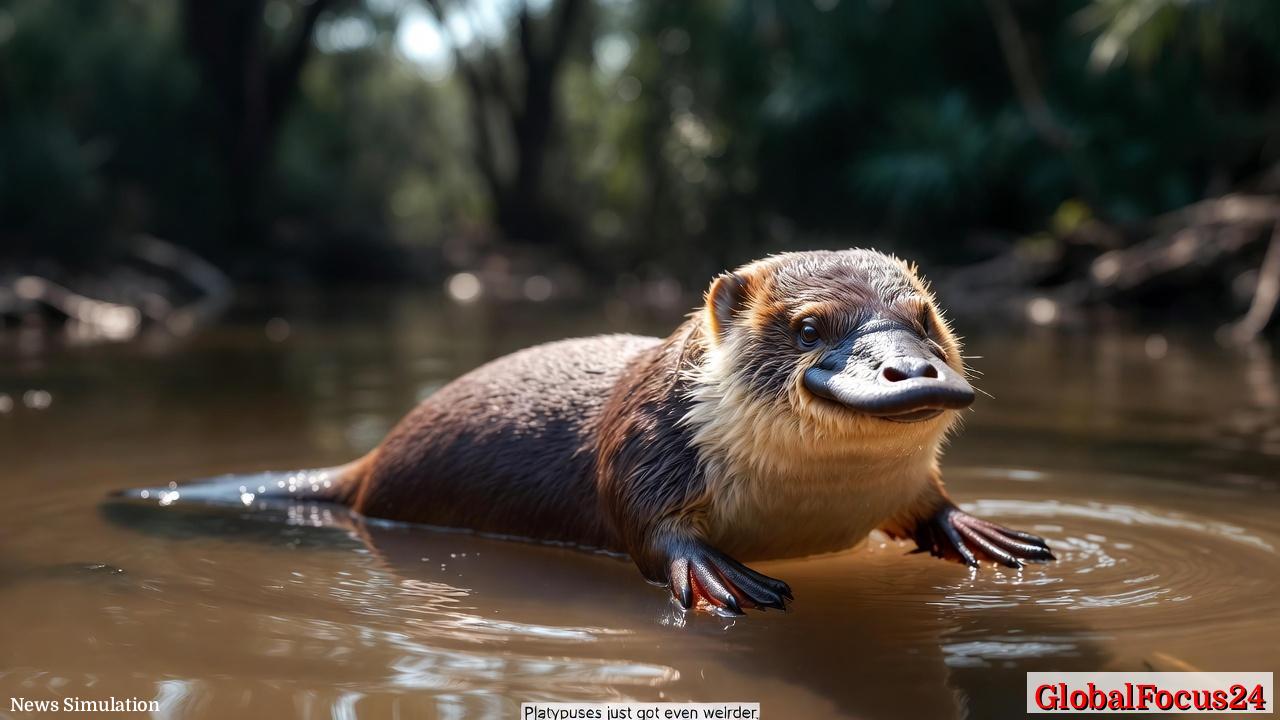
The platypus has puzzled scientists since Europeans first encountered it in the 18th century. With its duck-like bill, webbed feet, beaver-like tail, and egg-laying habits, it seemed almost mythological—a creature stitched together from multiple species. Even today, the platypus stands apart among mammals, with its electroreceptive bill, venomous spurs, and capacity to detect underwater vibrations. Now, its distinctiveness extends to the microscopic level.
Fur in mammals typically contains solid melanosomes—dense pigment granules that absorb light and produce color through chemical pigmentation. In contrast, bird feathers derive much of their brilliant hues from structural coloration, a phenomenon where microscopic architecture affects how light scatters and reflects. Hollow or rod-shaped melanosomes in birds are key to this process, producing the vibrant blues of peacocks or the shimmering green of hummingbirds.
The platypus’s hollow melanosomes differ from those of birds, however. They are spherical rather than elongated and do not appear to create iridescent effects. Instead of producing flamboyant color, they generate shades of brown familiar to anyone who has seen a platypus gliding through a murky Australian stream.
Comparing Species: Platypus vs. Other Mammals
To confirm the peculiarity of these structures, Dobson and her colleagues analyzed hair samples from 12 platypuses and compared them to 126 other mammal species. The dataset included the echidna—its closest living relative—as well as a variety of marsupials like wombats and possums. The comparison revealed that the hollow melanosome structure was unique to platypuses alone. No similar features appeared in any of the other species studied.
This absence in echidnas is particularly striking. Though platypuses and echidnas both belong to the monotreme order, echidnas lead largely terrestrial lives, lacking the platypus’s aquatic habits. The researchers suggest that the hollow melanosomes may represent a specific adaptation related to water—perhaps influencing the fur’s insulative properties, buoyancy, or optical effects underwater. Because the hollow structures do not increase iridescence, their function might hinge less on display and more on survival.
Evolutionary Clues in Animal Coloration
Color in animals serves multiple purposes: camouflage, communication, temperature regulation, and UV protection. In mammals, most coloration arises from chemical pigments, whereas in birds and reptiles, physical structure often plays a larger role. The new findings suggest that nature can reinvent similar microscopic designs under very different evolutionary pressures.
Evolutionary ecologist Tim Caro of the University of Bristol, who was not involved in the research, emphasized the potential adaptive function. “The presence of hollow melanosomes in a semi-aquatic species like the platypus suggests the feature is not decorative but functional,” Caro noted. He proposed that the hollow cores might affect how light penetrates the fur underwater, enhancing concealment or thermal regulation.
These traits could reflect a case of convergent evolution—where unrelated species evolve similar solutions to environmental challenges. Just as birds and butterflies developed hollow melanosomes to manipulate light for signaling, platypuses may have evolved similar structures to manage heat, moisture, or visibility beneath the water’s surface.
Understanding the Microscopic Architecture of Color
Electron microscopy revealed just how unusual these pigment granules are. Each hollow melanosome consists of a spherical shell lined with melanin and enclosing a cavity—an architecture almost never found in mammals. In birds, hollow melanosomes typically appear as elongated rods. The difference in shape indicates that the platypus structure likely arose independently, demonstrating nature’s versatility in achieving novel adaptations.
Further chemical analysis confirmed that the melanin composition was similar to typical eumelanin, responsible for browns and blacks across many species. The uniqueness thus lies not in the pigment itself but in the way it is organized. That subtle change in structure—hollow rather than solid—may dramatically alter the physical properties of the fur.
Researchers now aim to test whether these hollow granules contribute to buoyancy or waterproofing. Because air trapped inside hollow structures can influence how fur interacts with water, such microscopic adaptations might enhance a platypus’s efficiency in its aquatic environment. This hypothesis complements decades of research on how monotremes cope with cold rivers during winter foraging.
The Ecological and Functional Implications
From an ecological standpoint, fur structure is crucial for thermoregulation in semi-aquatic mammals. The platypus relies on dense waterproof fur that traps a layer of air against the body, insulating it from frigid water temperatures in southeastern Australia and Tasmania. Slight differences in pigmentation structure might fine-tune this mechanism.
If hollow melanosomes subtly alter how the fur retains air or absorbs light, they could influence energy conservation or camouflage. Darker, matte coloration can reduce reflectance under water, helping predators avoid detection by prey. In contrast, glossy surfaces may create unwanted glints. By diffusing light through hollow microstructures, the platypus may gain a low-sheen surface that matches its dim, rippling environment.
How This Discovery Alters the Broader Scientific Landscape
The finding has far-reaching consequences for biologists studying the evolution of color. It challenges assumptions that certain pigment architectures are confined to one branch of the animal kingdom. Until this discovery, hollow pigment granules were considered strictly avian traits—a hallmark of feather evolution. Their presence in a mammal expands the known range of pigment diversity.
Such cross-kingdom parallels prompt researchers to reexamine evolutionary pathways in other semi-aquatic species, such as otters or beavers. Could similar microstructures exist but remain undiscovered? The study highlights how much remains to be learned from microscopic anatomy, even in well-known species.
A Landmark for Australian Biodiversity Research
For Australia’s unique fauna, this discovery is another reminder of how evolution on the continent has followed its own path. The platypus, together with the echidna, represents a lineage that diverged from other mammals more than 160 million years ago. This separation allowed monotremes to retain primitive features like egg-laying while developing entirely new ones, such as electroreception.
The finding of hollow melanosomes adds another piece to this evolutionary puzzle. It underscores the platypus’s role as a living relic of ancient mammalian history—one still capable of surprising modern science. For conservationists, such discoveries reinforce the importance of protecting habitats rich with endemic species. Understanding how these animals evolved may inform future strategies for preserving ecosystem diversity in a warming climate.
The Broader Economic and Scientific Impact
Beyond its scientific implications, this type of discovery carries indirect economic value. Australia’s biodiversity research attracts significant international collaboration and funding, from university partnerships to ecological monitoring programs. Each new insight into native species deepens understanding of how environmental pressures shape adaptive traits, informing conservation policy and ecotourism efforts alike.
The platypus has long been an emblem of Australia’s natural heritage. As scientists uncover new layers of its physiology, the species continues to captivate global audiences and stimulate investment in biological research. Breakthroughs like this also have potential applications beyond zoology—materials scientists study natural pigment structures to design heat-resistant or light-manipulating coatings inspired by biological systems.
The Next Questions for Research
Although the discovery answers one mystery, it opens several more. Why did the platypus evolve hollow melanosomes when all other mammals retained solid ones? How do these structures influence its insulation and survival in rivers and streams? Could similar adaptations exist in the fossil record of early mammals? These questions will guide future comparative studies using genetic, optical, and biomechanical approaches.
Dobson’s team plans to apply 3D imaging and spectroscopy to simulate how light travels through platypus fur, testing whether the hollow design affects reflectivity or emissivity. Understanding these interactions could reveal new insights into how microscopic form and environmental function intertwine.
A Modern Icon of Evolutionary Innovation
From a distance, the platypus looks unchanged—an elusive, nocturnal swimmer inhabiting the same cold creeks as its ancestors. Yet under the microscope, it tells a new story: even the most familiar species can harbor secrets that rewrite scientific textbooks. The discovery of hollow melanosomes in platypus fur reminds us that evolution never truly repeats itself—it improvises.
By bridging the microscopic architecture of birds and mammals, this finding underscores the unity of life’s design principles in the natural world. The platypus, once dismissed as a biological oddity, continues to stand at the crossroads of nature’s creativity—proof that even in the well-studied corners of the animal kingdom, there are still wonders waiting to be revealed.