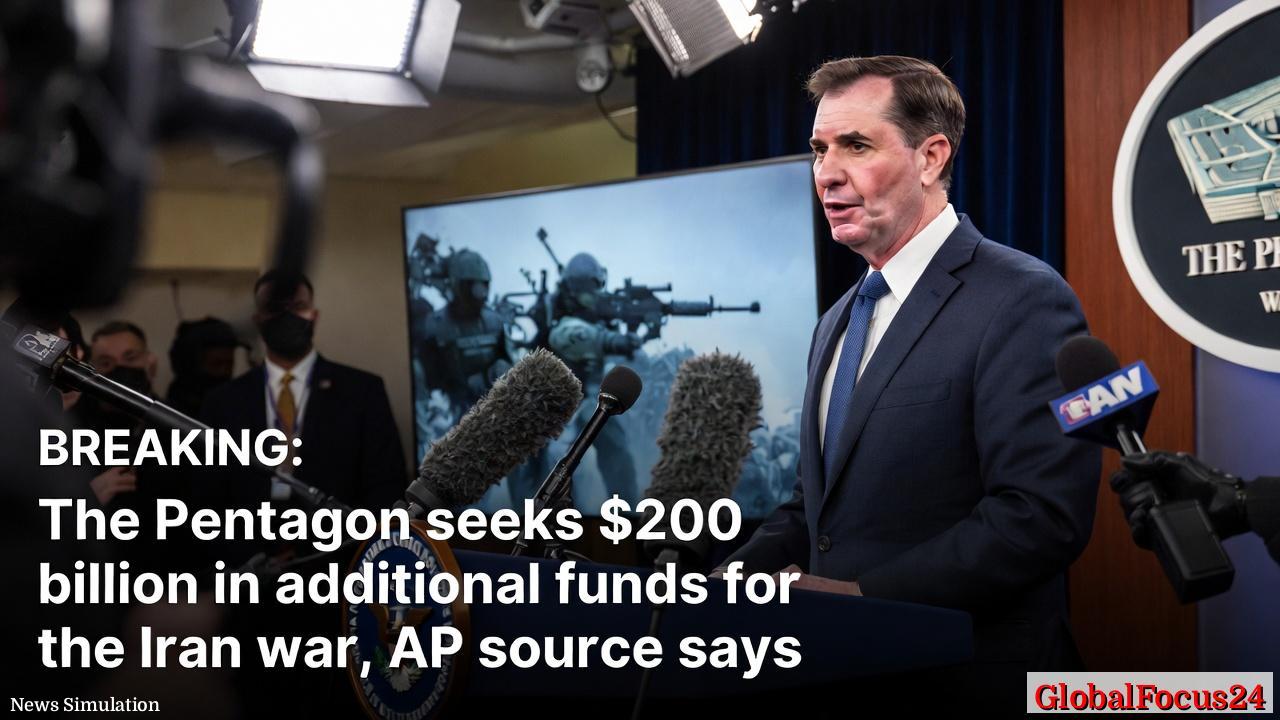
Pentagon Seeks $200 Billion in Supplemental Funding for Expanding Iran War Effort
WASHINGTON — The Pentagon has submitted a request for an additional $200 billion to fund the ongoing conflict with Iran, according to a senior administration official. The proposal, sent to the White House earlier this week, marks one of the largest single wartime funding requests since the Iraq and Afghanistan operations of the early 2000s. The money would come on top of an already record-setting defense budget, setting the stage for a contentious battle in Congress over spending priorities and fiscal discipline.
Defense Secretary Pete Hegseth declined to confirm the precise figure during a Thursday press conference, emphasizing instead the operational demands driving the request. “It takes money to kill bad guys,” Hegseth said, reiterating that American forces must be properly supplied and modernized. “We’re returning to Congress to make sure the military is fully resourced to do its job.”
The White House has not yet released details on how the supplemental funds would be used or which specific programs might benefit. Officials maintain that the request is driven not only by the Iran conflict itself but also by broader strategic requirements to maintain readiness across the U.S. military.
Mounting Costs in an Unofficial War
The U.S. operation in Iran has not been formally authorized by Congress, raising concerns among lawmakers about its scope, legality, and long-term objectives. Military analysts estimate that the campaign has already cost tens of billions in logistics, strikes, and regional deployments since hostilities began last year. The Pentagon’s request, if approved, would represent a significant escalation in financial and political commitment.
Lawmakers from both parties have voiced unease about the open-ended nature of U.S. involvement. Without a congressional authorization for the use of military force, the administration faces increased scrutiny over executive war powers. Democratic and Republican leaders alike are pressing for greater transparency on how the funds would be allocated, the duration of planned operations, and the projected outcomes.
Representative Ken Calvert (R-Calif.), chair of the House subcommittee overseeing defense appropriations, acknowledged the need for replenishing munitions and supporting deployed forces. “That was going to happen, and now we have this conflict with some additional costs,” Calvert said. “This is about our national security and it’s important that we get this done.”
By contrast, Rep. Betty McCollum (D-Minn.), the ranking member on the same subcommittee, urged restraint. “This is not going to be a rubber stamp for the president of the United States,” she said. “We’re still waiting for clear answers on the $150 billion already provided to the Pentagon in supplemental funding last year.”
Fiscal Pressures and Political Reality
The proposed $200 billion comes as the U.S. national debt surpasses $39 trillion and the annual federal deficit balloons to a projected $1.9 trillion. The figure underscores the deep tension between aggressive military spending and growing fiscal constraints. Any new funding package would have to pass through both the House and Senate, where fiscal conservatives and progressive lawmakers are likely to resist expanding the defense budget without offsetting cuts or a detailed plan.
Republicans hold slim control of both chambers, but the party remains divided between defense hawks who argue for military readiness and fiscal conservatives wary of ballooning debt. Democrats are largely unified in demanding clearer objectives and measurable outcomes before approving further spending.
Even with those divisions, House Speaker Mike Johnson signaled broad alignment with the administration’s emphasis on security. “We’re living in a dangerous time,” Johnson said this week. “I support funding that ensures American forces have what they need to protect our country and our interests abroad.”
Still, a faction of lawmakers in both parties questioned the scale of the request, arguing that domestic needs such as health care, infrastructure, and disaster relief are being overshadowed by massive military expenditures. “Two hundred billion dollars for an undeclared war defies common sense,” one senior Democrat said privately. “Our priorities are completely out of balance.”
A Historical Parallel: Wartime Spending and Its Economic Ripple Effects
Large wartime spending proposals have historically reshaped both defense policy and the broader U.S. economy. During the Iraq War, Congress approved more than $800 billion in supplemental appropriations over a decade. Similarly, the Afghanistan campaign, which lasted 20 years, exceeded $2 trillion in total costs when factoring in veterans’ care and interest payments.
Economists note that such surges in defense spending can temporarily boost industrial output, particularly in defense-heavy sectors such as aerospace manufacturing, cybersecurity, and logistics. States like California, Texas, and Virginia—home to major defense contractors—could see billions in new contracts if the funding is approved. However, these short-term gains often come with long-term fiscal consequences, including higher national debt and reduced room for domestic investment.
Defense analysts caution that the global economic environment today is markedly different from the early 2000s. Rising interest rates, a slowing manufacturing sector, and mounting entitlement costs make it harder for the federal government to absorb new wartime spending without further inflating deficits. As one former Pentagon budget director put it, “We’re entering a new era where even defense spending has limits.”
Comparison with Allied Defense Spending
While the U.S. continues to far outspend its NATO allies, the Iran conflict has prompted renewed debates over burden-sharing. In Europe, recent defense increases—triggered largely by the war in Ukraine—have still not matched U.S. levels. Germany’s special defense fund, for example, amounts to about €100 billion, far below the Pentagon’s current annual budget of over $800 billion.
Japan, the United Kingdom, and Australia have also expanded their defense budgets in response to rising regional threats, but none approach the scale of America’s wartime expenditures. The Pentagon’s new request would, by itself, exceed the entire military budgets of both France and India combined.
Experts suggest that the disparity illustrates how the United States continues to shoulder the bulk of global security costs. “Even if allies double their defense budgets, it’s still unlikely they can match the speed or scope of U.S. operations,” said a senior fellow at a Washington think tank. “But the question is whether American taxpayers remain willing to finance that pace.”
Congressional Negotiations Ahead
Negotiations between Republican leaders and the White House are expected to begin in the coming weeks. Administration officials have hinted that the final figure could fluctuate depending on battlefield conditions and equipment needs. The process will likely involve intense scrutiny from the Congressional Budget Office, which must estimate the proposal’s deficit implications.
A more modest package might focus narrowly on pressing needs—such as replenishing precision munitions and repairing overseas bases—while leaving broader strategic goals to the regular defense budget process. However, Pentagon insiders argue that anything less than the full request risks leaving U.S. forces underprepared in what they describe as a shifting and unpredictable conflict.
Critics counter that unlimited appropriations encourage mission creep, citing the post-9/11 era when short-term “emergency” funds gradually evolved into long-term commitments. “Without clear limits and accountability,” one policy analyst warned, “Congress risks writing a blank check for a war it never authorized.”
Economic and Public Reactions
Financial markets have so far reacted cautiously. Defense stocks rose modestly after early reports of the funding request, signaling investor confidence in continued government contracts. Meanwhile, bond markets remain nervous about potential increases in federal borrowing. Economists warn that additional deficit spending could complicate future efforts to reduce inflation and maintain fiscal stability.
Public sentiment appears divided. A recent nationwide poll found that 53% of Americans support funding the military’s current operations, but only 39% backed sending more money without congressional approval. Veterans’ groups have expressed mixed views—some urging full support for active troops, others insisting on clearer mission objectives before further escalation.
In cities such as San Diego and Norfolk, home to major naval installations, local economies are bracing for potential expansion tied to the funding increase. Conversely, regions focused on social services and infrastructure investment worry that domestic programs could face cuts to offset new military spending.
The Road Ahead
The Pentagon’s $200 billion request underscores a familiar cycle in American defense policy: the tension between global ambitions and fiscal reality. As Congress weighs the proposal in the coming months, lawmakers face pressure from both constituents and the defense industry to strike a balance between national security and economic prudence.
Whether the full amount is approved, trimmed, or delayed, the decision will shape not only U.S. involvement in Iran but also the future trajectory of federal spending. With debt levels at historic highs and fiscal space narrowing, Washington is once again confronting the cost of projecting power across an uncertain world.