OpenAI Secures $110 Billion Investment, Valued at $730 Billion in Landmark AI Deal
A Defining Moment in Artificial Intelligence Finance
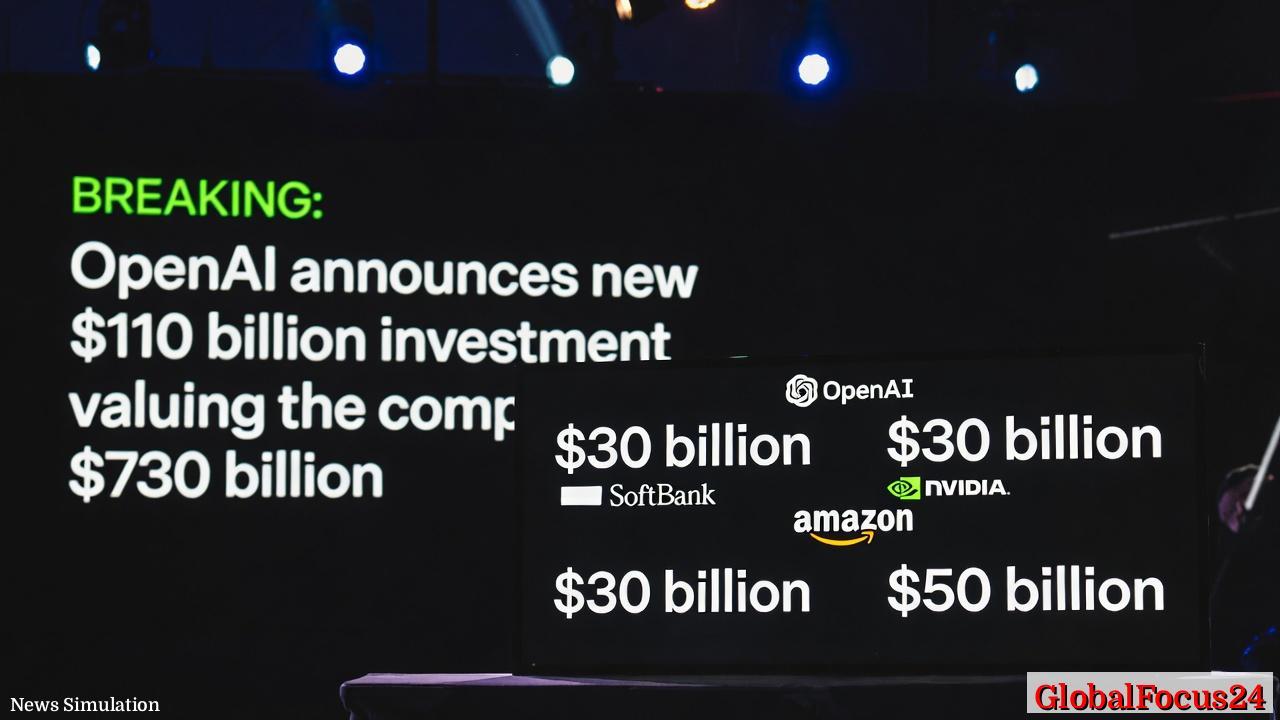
OpenAI has closed a record-breaking $110 billion funding round, catapulting the company’s valuation to an unprecedented $730 billion. The move marks one of the largest private capital raises in technology history and underscores the expanding role of artificial intelligence in reshaping global markets. The funding round, which includes $30 billion each from SoftBank and NVIDIA and a substantial $50 billion contribution from Amazon, signals a new phase of consolidation and strategic cooperation among leading players in cloud computing, semiconductors, and advanced AI research.
The deal positions OpenAI not only as a core innovator in generative AI but also as a central partner for some of the world’s largest technology and investment firms. As industries from healthcare to finance accelerate their use of AI-driven products, this massive influx of capital could mark the beginning of a new era in AI infrastructure and application development.
Strategic Partnerships Shape a New AI Ecosystem
OpenAI’s new investment round goes beyond mere financing—it formalizes a strategic alliance between three of the most influential companies driving the global tech economy. The partnership with Amazon is expected to expand the company’s cloud and distribution capabilities, integrating OpenAI’s large language models into Amazon Web Services (AWS) products and developer platforms. Meanwhile, the compute deal with NVIDIA will give OpenAI privileged access to the hardware underpinning its powerful neural networks, securing long-term access to advanced GPU clusters essential for model training and deployment.
SoftBank’s participation points to broad investor confidence in the AI economy. Having long championed large-scale investments in frontier technologies, SoftBank’s Vision Fund has now placed one of its most significant bets on the expansion of general-purpose AI platforms. Analysts suggest that this coordinated investment creates a triangle of influence—hardware, cloud infrastructure, and foundational AI models—that may define how next-generation computing takes shape.
Positioning in the Global AI Race
Globally, OpenAI’s valuation of $730 billion puts it on par with the world’s most valuable technology companies, rivaling long-established giants in market capitalization. While this number remains a private valuation, not yet tied to public market performance, it reflects investor anticipation of AI’s economic potential and its accelerating adoption across enterprise and consumer markets.
In comparison, other AI-focused companies have seen sharply rising valuations, but none approach the breadth of OpenAI’s reach. Anthropic, its closest U.S.-based rival, was valued near $30 billion in late 2025, while emerging firms in China and Europe continue to scale up amid government-supported AI initiatives. The gulf between OpenAI and its competitors highlights the first-mover advantage of having both globally deployed products and mature infrastructure partnerships with major corporate backers.
Economic Ripples Across Technology and Industry
The ramifications of this transaction extend beyond OpenAI itself. Analysts anticipate ripple effects throughout the semiconductor, cloud computing, and data management industries. NVIDIA’s expanded partnership is particularly notable, as the chipmaker continues to benefit from a global surge in demand for graphics processing units (GPUs), which serve as the backbone for modern AI training.
By securing a compute deal with NVIDIA, OpenAI ensures a dedicated supply of cutting-edge chips at a time when hardware demand often outpaces production. This arrangement could further cement NVIDIA’s dominance in AI hardware, reinforcing its pivotal role in the generative AI boom. The company’s CEO has previously emphasized that partnerships like this enable sustainable growth across the broader AI ecosystem.
The collaboration with Amazon is expected to have equally significant implications. AWS remains one of the leading global cloud providers, and deeper integration with OpenAI’s models could accelerate AI democratization—bringing advanced capabilities to businesses and developers across diverse sectors. AWS already hosts millions of clients globally, and embedding OpenAI technologies directly into that environment could lead to widespread adoption of custom AI assistants, chat interfaces, and data-processing tools.
Historical Context: From Research Lab to Global Powerhouse
OpenAI’s rise from a small research organization founded in 2015 to one of the world’s most valuable companies in 2026 represents one of the most rapid growth trajectories in modern business history. Initially launched as a nonprofit focused on the safe and transparent development of artificial intelligence, the company transitioned to a “capped-profit” model to attract private investment while maintaining its public-benefit mission. This hybrid structure has allowed OpenAI to pursue large-scale innovation while ensuring investor returns remain within agreed limits.
In 2019, Microsoft’s early backing of approximately $1 billion established a precedent for corporate partnerships. The subsequent integration of OpenAI technology into Microsoft’s products, including search, productivity, and cloud infrastructure, demonstrated how commercial collaboration could accelerate research and monetization simultaneously. The current deal with Amazon and NVIDIA evolves that model, transforming OpenAI from an aligned partner to an independent powerhouse coordinating with multiple global stakeholders.
The Broader Economic Context
The $110 billion infusion arrives amid a broader climate of aggressive investment in AI infrastructure. Global spending on AI is projected to exceed $900 billion annually by 2030, covering data centers, software tools, and model training costs. Governments across North America, Europe, and Asia are crafting long-term policy frameworks to support national AI capabilities, while private capital continues to chase growth opportunities in foundational model development and inference efficiency.
In Silicon Valley and beyond, venture capital flows have increasingly concentrated around firms capable of building or licensing large-scale AI systems. OpenAI’s record raise could push a new wave of secondary investments into supporting industries—from data labeling to specialized energy solutions for AI data centers. The economic multiplier effect is already visible: cities such as Austin, Seattle, and Toronto report growing clusters of AI-related startups, mirroring the regional innovation boom once fueled by the internet economy of the late 1990s.
Competitive and Regional Perspectives
While OpenAI leads the U.S. market, other regions are racing to build competitive ecosystems. China continues funding AI development through state-led initiatives, emphasizing domestic models trained on locally curated datasets. In Europe, regulatory guidelines on data privacy and algorithmic accountability have influenced a slower but deliberate approach to AI infrastructure growth. Meanwhile, India has launched national programs to expand AI education and cloud computing capacity, positioning itself as a regional hub for development talent and low-cost compute services.
Against this backdrop, OpenAI’s global partnerships position it as both a technical leader and a diplomatic actor bridging international technology ecosystems. Its collaborations with hardware manufacturers, cloud providers, and software developers form a network of global cooperation rarely seen outside of the semiconductor or aerospace industries. Analysts view this cross-border network as essential to sustaining AI innovation at scale, given the immense costs and expertise required to train advanced large language models.
Market and Investment Reactions
In financial markets, investors and analysts reacted swiftly to OpenAI’s announcement. Although the company remains privately held, shares of affiliated firms—including NVIDIA and Amazon—showed notable gains in after-hours trading following the release of funding details. Semiconductor suppliers and AI infrastructure companies likewise saw increased demand, reflecting investor belief that the new capital injection would accelerate overall AI adoption.
Venture capital observers describe this transaction as a turning point for late-stage private financing. In an environment where rising interest rates have cooled startup funding, the magnitude of OpenAI’s deal suggests that investors are willing to commit extraordinary sums to perceived category leaders. If sustained, this trend could reshape private equity dynamics, favoring large-scale consolidation over the fragmented innovation ecosystem that characterized earlier phases of AI growth.
Industry Implications and Future Outlook
OpenAI’s record-breaking funding round reinforces a clear message: artificial intelligence is no longer an experimental discipline but a structural pillar of the global economy. With strategic backing from three of the world’s most influential technology and investment players, the company now holds the resources to accelerate model development, expand global access, and explore new frontiers in reasoning, multimodal understanding, and automation.
The coming years are expected to bring intensified competition, as rival firms and national research initiatives respond to the scale of OpenAI’s operations. But with dedicated compute access, premier hardware partnerships, and vast distribution through Amazon’s global cloud network, OpenAI appears positioned to retain its technological edge for the foreseeable future.
As the boundaries between research, infrastructure, and enterprise application continue to blur, the latest funding marks more than a corporate milestone—it defines the next chapter of the AI revolution.