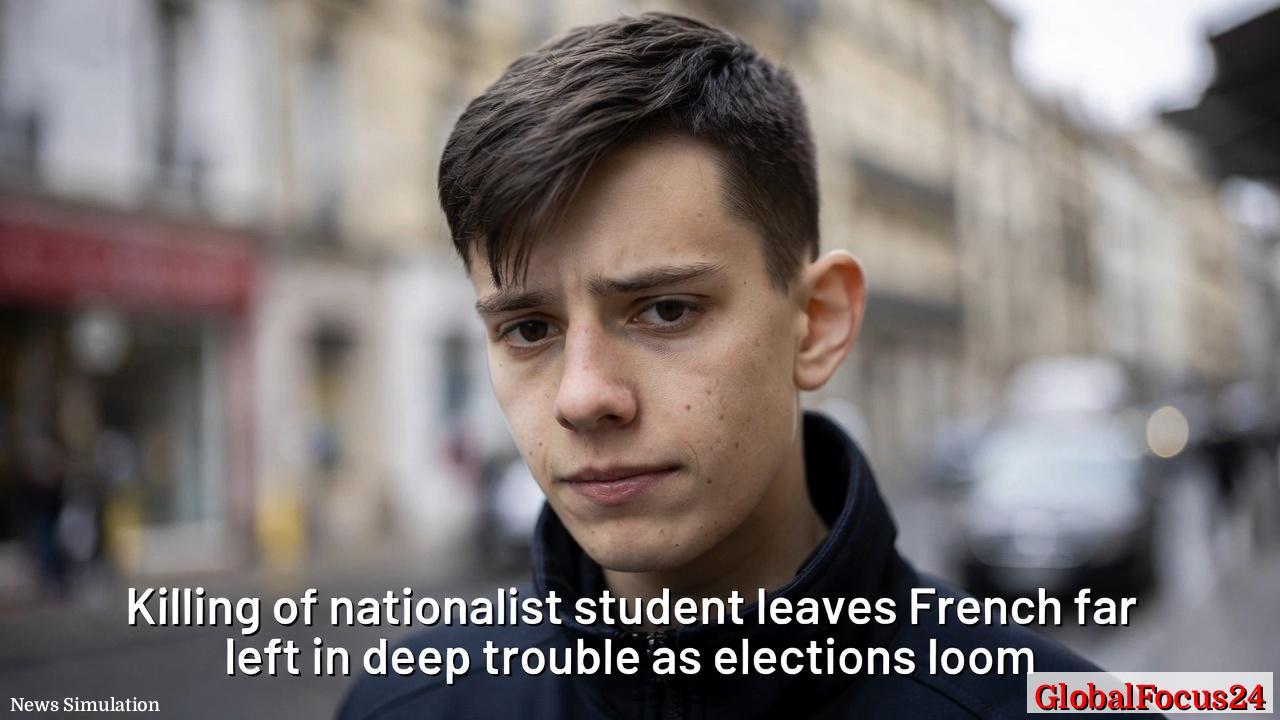
Killing of Nationalist Student Deepens Crisis for France’s Far-Left Ahead of Elections
The fatal stabbing of a young nationalist student in France has ignited a firestorm of political tension, testing the resilience and credibility of the country’s far-left movements just as election season looms. The incident, already charged with social and ideological significance, has become a national flashpoint over political extremism, public security, and the boundaries of activism in modern France.
A Deadly Flashpoint in a Polarized Climate
The victim, a university student known for his nationalist affiliations, was killed following a confrontation reportedly involving left-wing militants. While authorities continue to investigate the circumstances leading to his death, early findings suggest that the attack may have stemmed from tensions between opposing political groups—tensions that have simmered for years and now appear close to boiling over.
The attack occurred in a city that has long been a hub for student activism and ideological clashes. Witnesses described scenes of confusion and fear as police cordoned off the area late into the night, with forensic teams collecting evidence and questioning bystanders. The suspect or suspects, still under investigation, are believed to have links to far-left organizations that have frequently clashed with nationalist groups during demonstrations over social reform and immigration issues.
A Nation Reflects on Rising Political Violence
The student’s death has rapidly evolved into more than just a criminal case—it has become a symbol of France’s growing unease with political radicalization across the spectrum. In recent years, both far-left and far-right movements have been accused of fueling confrontation through inflammatory rhetoric, online mobilization, and physical altercations at protests.
Interior Ministry officials expressed concern that “the boundaries between activism and violence are being dangerously eroded.” The government has reportedly stepped up surveillance of extremist networks on both ends of the political scale, aiming to prevent further escalations that could destabilize the campaign season.
Observers note that this tragedy follows a pattern of intensifying street-level conflict in France. Clashes between nationalist and anti-fascist groups have erupted intermittently for more than a decade, particularly in urban centers where universities serve as incubators for ideological activism. However, the fatal outcome of this confrontation has shocked even seasoned analysts who warn that the consequences for the far-left movement could be historically significant.
The Political Backlash and Public Reaction
Public reaction to the killing has been immediate and polarized. Candlelight vigils have been held in several cities to honor the victim, while nationalist groups have used the moment to call for stricter policing of what they describe as “domestic extremist threats.” At the same time, demonstrations organized by far-left student associations have sought to distance themselves from the violence, insisting that the acts of a few individuals should not define broader movements advocating social and economic justice.
Nevertheless, the incident has placed far-left parties in a precarious position. Leading figures have struggled to strike the right tone—condemning the violence while denying any institutional responsibility. Critics accuse them of fostering an environment that normalizes confrontation, while supporters argue that they are being unfairly scapegoated amid an atmosphere of moral panic.
The murder has also reignited public debate over the role of political ideology in shaping youth identity and street politics. Analysts point out that French campuses have historically been battlegrounds for competing visions of national identity—from the revolutionary fervor of May 1968 to the student protests of the early 2000s. This latest tragedy, however, seems to mark a darker moment: one in which ideological opposition translates directly into lethal conflict.
Historical Context: France’s History of Political Street Violence
France’s political history is steeped in moments where ideological clashes spilled into the streets. From the civil unrest that followed the 1930s Popular Front government to confrontations between communist and fascist militias, the nation has seen cycles of political radicalization intensify during moments of social and economic strain.
During the turbulent mid-twentieth century, political violence was often tied to larger international currents—anti-fascist movements, decolonization struggles, and economic crises that fueled popular discontent. Modern parallels are striking: once again, France is facing sluggish growth, youth unemployment, and widening divisions over immigration and cultural identity. These conditions have created fertile ground for political extremism, where movements on both sides feed off one another’s rhetoric to mobilize supporters.
Political historians warn that when ideological confrontation seeps into personal and community life—as it increasingly has with student groups—the potential for violence becomes self-sustaining. The current episode, they suggest, may signal not just a tragic anomaly but a stage in the reemergence of France’s street-based radicalism.
Electoral Consequences for the Far-Left
As France prepares for elections later this year, far-left parties are contending with the dual challenge of rehabilitating their public image and maintaining internal cohesion. The timing could hardly be worse. Polls taken in the days following the attack show a slight decline in trust among centrist voters toward far-left candidates, with some respondents citing “concerns over stability and security.”
Party strategists are reportedly urging restraint among grassroots activists, fearing that further incidents could alienate moderate supporters. Some figures within the far-left coalition have called for a renewed focus on economic inequality and environmental policy to reframe public attention, but the shadow of the killing looms large.
Analysts note that this crisis recalls previous electoral setbacks suffered by left-wing movements in Europe following episodes of unrest or violence linked—rightly or wrongly—to their fringes. In Italy, Germany, and Spain, such incidents have historically driven voters toward centrist or conservative parties promising order and stability. Should the pattern repeat in France, the consequences could reshape the left’s presence in national politics for years to come.
Economic and Social Undercurrents Driving Polarization
Beyond the immediate political impact, the event underscores the economic and social currents fueling extremism among young people. Despite strong fiscal performance in certain sectors, France continues to grapple with uneven job distribution, high youth unemployment in urban areas, and persistent cost-of-living pressures. For many students, political activism becomes both a vehicle for expression and a search for belonging.
Sociologists caution that this dynamic creates fertile conditions for radicalization. Economic frustration, when coupled with online echo chambers and a combative political climate, can turn ideological commitment into militant certainty. The tragedy of the slain student—seen by some as a victim of this toxic mix—has forced a national reckoning with how the next generation understands citizenship and dissent.
Comparison with Other European Trends
France is not alone in facing rising ideological confrontation. Across Europe, governments have observed similar tensions between nationalist and far-left groups. In Germany, for instance, police have reported an uptick in violent incidents involving extremist activists on both sides. Italy and Spain have seen campus protests occasionally escalate into clashes mirroring those in France.
However, France’s situation stands out due to its historical tradition of street protest as a form of political expression. From the Yellow Vests to pension reform marches, direct action remains deeply embedded in French political culture. This legacy, while signaling civic engagement, can also blur the line between protest and confrontation—particularly when layered atop today’s charged ideological divisions.
Calls for Restraint and Reflection
In the wake of the killing, calls for calm have echoed across the political spectrum. Educators and student associations have urged dialogue, not division, emphasizing the importance of safeguarding universities as spaces for debate rather than battlegrounds. Religious leaders and community figures have joined in urging French youth to reject ideological violence, invoking the nation’s long-standing ideals of fraternity and civic unity.
Law enforcement agencies have announced tighter security around universities and upcoming political rallies. At the same time, government officials have reiterated their commitment to protecting freedom of expression while cracking down on extremist activity—an increasingly delicate balance in a nation still haunted by memories of past unrest.
A Nation at a Crossroads
As the investigation continues, the killing of the nationalist student has become a litmus test for France’s political conscience. For the far left, it is a moment of reckoning that could define their role in the forthcoming elections—and possibly reshape their identity for a generation. For the nation as a whole, it forces a deeper question: how can a democracy that values protest and pluralism prevent those same freedoms from curdling into violence?
The answer, many observers argue, will depend not just on legal accountability but on moral clarity—the willingness of political actors, educators, and citizens alike to confront extremism in all its forms. France, they say, stands at a crossroads between its tradition of passionate activism and a growing need for collective restraint. The direction it chooses in the months ahead could determine not only the outcome of an election, but the tone of its democracy for years to come.