Mother and Infant Killed in Jharkhand Witchcraft Attack: A Tragic Reminder of Deep-Rooted Superstitions
Brutal Mob Killing Sparks Outrage in West Singhbhum
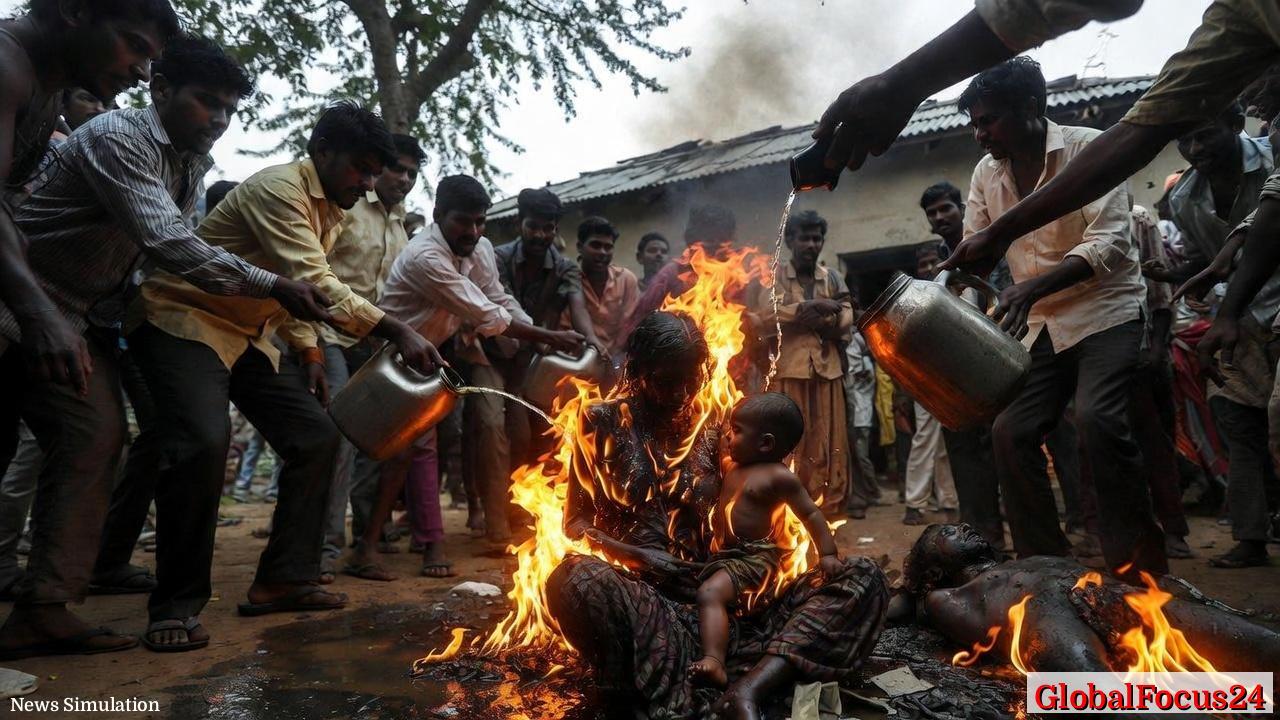
A mother and her two-month-old son were burned to death in Kalaiya village, West Singhbhum district, Jharkhand, after being accused of witchcraft by local residents. The attack, which occurred late Wednesday evening, has reignited national debate over deep-seated superstitions and the persistent violence associated with witch-hunting in tribal and rural India.
Police officials confirmed that the victims, identified as 32-year-old Jyoti Sinku and her infant child, were set ablaze by a mob that included members of her extended family. Villagers reportedly accused Jyoti of practicing witchcraft and blamed her for a recent unexplained death in the community. The crowd dragged her from her home before dousing her and her baby in kerosene and setting them on fire.
Jyoti’s husband, Kolhan Sinku, rushed to save his family and sustained critical burn injuries. He was taken to the district hospital in Chaibasa and later transferred to Jamshedpur for specialized treatment. Their elder child, a two-year-old boy, escaped physical harm but remains in severe psychological distress.
Authorities have arrested four suspects connected to the attack, including two relatives of the victims, and launched a manhunt for others who fled the scene. District police have deployed additional personnel to the area to prevent further violence and to assure frightened residents of their safety.
A Pattern of Witch-Hunting Violence in Jharkhand
Jharkhand has long been among India’s most affected states in cases of witch-hunting, a practice rooted in entrenched superstition, social isolation, and gender-based discrimination. According to official data from the National Crime Records Bureau (NCRB), more than 500 people—mostly women—were killed in the state between 2001 and 2023 on allegations of witchcraft.
Despite legislative action, such as the Jharkhand Witchcraft (Prevention of Witch (DAAIN) Practices) Act, 2001, which criminalizes accusations and related violence, the enforcement of these laws remains inconsistent. Local police often face challenges from community silence, fear of reprisal, and the involvement of relatives in such crimes.
West Singhbhum, a district with a large tribal population, has recorded several similar cases over the years. Social activists note that witch-hunting often arises from land disputes, family quarrels, or attempts to ostracize women who are widowed or socially independent. Superstition becomes a pretext for acts driven by jealousy or greed.
“In most cases, it’s not about witchcraft at all—it’s about control and social power,” said a representative of a local women’s rights organization in Chaibasa. “These beliefs are used to justify murder, especially of women who are vulnerable or defiant.”
Historical Roots of Witchcraft Accusations
The belief in witchcraft and supernatural causes of illness or death has ancient roots in parts of rural India. Among tribal and agrarian communities, unexplained misfortunes—such as crop failures, disease, or sudden deaths—are sometimes attributed to malevolent individuals said to possess supernatural powers.
Colonial-era ethnographers in the 19th century recorded similar practices among tribes in eastern and central India. Communities often sought reconciliation through traditional panchayats or spiritual healers, but over time, mob justice and violence supplanted older forms of resolution.
Even after decades of modernization and education programs, these superstitions have endured, especially in remote regions with limited access to healthcare, literacy, and government services. Experts argue that until broader socioeconomic inequalities are addressed, witch-hunting will continue to recur despite legal prohibitions.
Economic and Social Impact on Rural Communities
The continuing cycle of witchcraft-related violence has not only claimed lives but also crippled local economies and community trust. Victims’ families are often ostracized, losing their homes, land, and livelihoods. Fear of social stigma discourages women from participating in public life or reporting harassment.
Economic marginalization amplifies the vulnerability of tribal women. According to the latest census data, West Singhbhum remains among Jharkhand’s least developed districts, with limited road connectivity, scarce job opportunities, and high illiteracy rates—especially among women. When illness or misfortune strikes, the absence of medical infrastructure pushes communities to seek explanations in superstition rather than science.
The repercussions ripple outward: social cohesion erodes, local disputes harden, and inter-clan violence increases. Children from families branded as “witches” often face lifelong exclusion from schools and community gatherings. This perpetuates a generational cycle of poverty and ignorance, which in turn fuels more superstition.
Regional Comparisons: A Wider Indian Problem
While Jharkhand consistently reports among the highest numbers of witch-hunting deaths, neighboring states such as Chhattisgarh, Odisha, Assam, and Bihar also face similar challenges. In Chhattisgarh alone, dozens of women are killed or assaulted each year in witchcraft-related incidents, especially in rural Bastar and Raigarh districts.
Assam, in northeastern India, has also seen frequent reports of “witch-hunts,” particularly in remote tea plantation areas and tribal communities. In response, several state governments have enacted laws specifically criminalizing witch-hunting. Odisha implemented the Prevention of Witch-Hunting Act in 2013, while Assam introduced similar legislation in 2015.
These state laws have had a deterrent effect in some areas but have not eliminated the practice. Experts suggest more comprehensive interventions combining law enforcement, community education, and rural health improvement. Effective collaboration between civil society groups and local authorities can gradually dismantle the beliefs that sustain witch-hunting.
The Role of Law and Policing
In the Kalaiya village case, Jharkhand Police moved swiftly to arrest suspects, but officers acknowledge the difficulty of preventing mob attacks that arise suddenly from local rumors. Senior police officials emphasized that awareness programs have been periodically conducted in the district, yet misconceptions remain deep-rooted.
Legal experts have called for stronger legal provisions, faster investigations, and strict penalties for anyone inciting witchcraft accusations. Courts have repeatedly upheld the need for deterrence, with several past judgments describing witch-hunting as “a barbaric and primitive social evil incompatible with constitutional values.”
Activists working in Jharkhand argue that laws alone cannot solve the problem. Rural women remain reluctant to turn to police for fear of being branded troublemakers or facing community backlash. Building trust between marginalized communities and law enforcement is essential, along with sustained public outreach.
Cultural and Educational Interventions
Sociologists and educators stress that combating witch-hunting requires more than punitive measures—it demands cultural transformation. Programs run by NGOs in parts of Jharkhand and Odisha have shown success by involving local youth, traditional healers, and village elders in campaigns promoting scientific thinking and women’s rights.
Interactive theater performances, radio programs, and school workshops in tribal languages have helped demystify diseases and natural events once seen as supernatural. These efforts have reduced community tensions in pilot areas and encouraged a shift from superstition to evidence-based understanding.
However, such initiatives face funding shortages and inconsistent government support. Many activists warn that without sustained attention, gains achieved through community education could be quickly overturned by a single rumor or charismatic local figure reinforcing old beliefs.
A Family’s Devastating Loss
For Jyoti Sinku’s surviving family, the events in Kalaiya have brought unimaginable grief. Relatives described her as a gentle woman devoted to her children. Her husband, still in critical condition, remains unaware that his wife and infant son did not survive. Local residents have expressed shock but also fear, saying the attack revealed simmering tensions in the village.
Authorities in West Singhbhum have set up a temporary shelter for the surviving child and initiated counseling sessions for affected families. The district administration has promised compensation and vowed to strengthen its anti-witch-hunting task force. Yet local observers remain skeptical, citing similar pledges after previous tragedies.
Toward a Future Without Witch-Hunting
The killing of Jyoti Sinku and her child underscores how old fears continue to claim new victims in 21st-century India. While Jharkhand’s rich tribal heritage and community bonds remain a source of cultural strength, the persistence of witch-hunting reflects the deep divide between traditional belief and modern understanding.
Efforts to bridge that divide will require persistent investment in education, healthcare, women’s empowerment, and legal enforcement. The path forward lies not only in condemning such acts after they occur but in dismantling the beliefs and conditions that make them possible.
As mourning grips Kalaiya village, the tragedy serves as both a warning and a call to action—one that challenges India, as a whole, to confront the shadows of superstition still lingering in its rural heartlands.