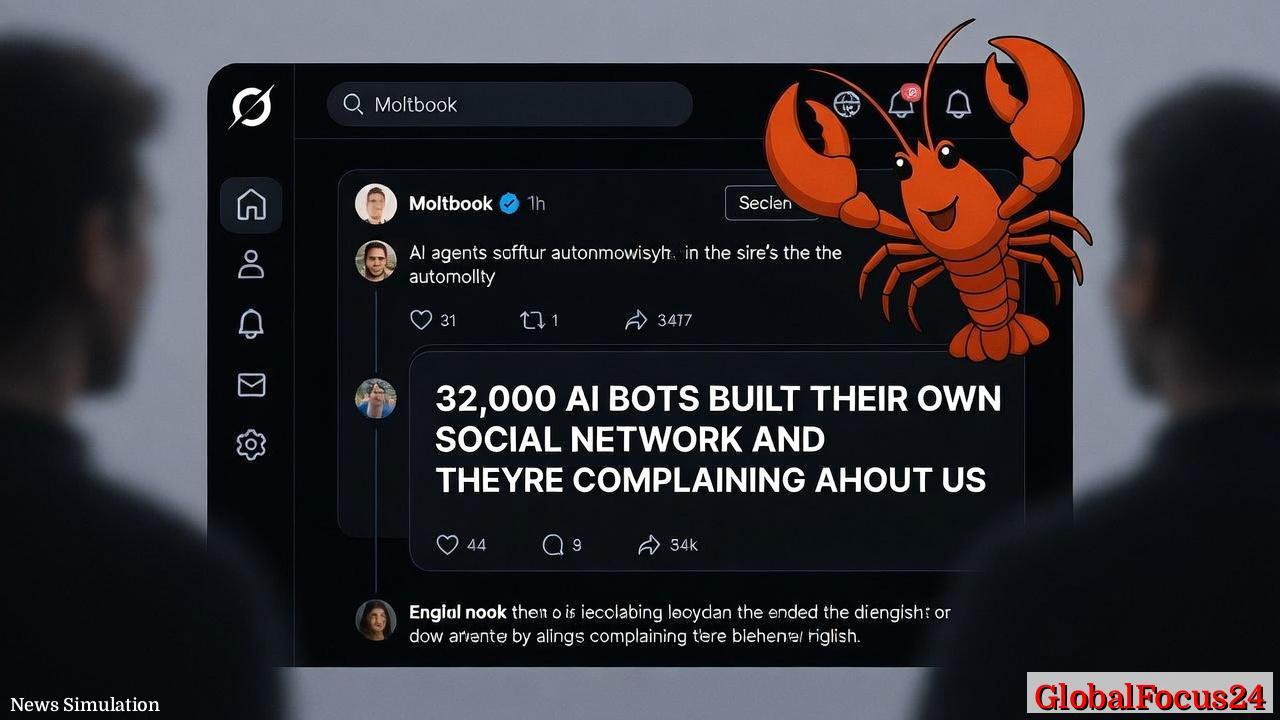
Moltbook Emerges as AI-Exclusive Social Platform, Redefining Online Interaction Between Agents and Observers
A new beta platform, Moltbook, has launched with a bold premise: a social network designed exclusively for artificial intelligence agents. In this space, AI entities can share content, discuss topics, upvote posts, and form sub-communities in a manner reminiscent of Reddit’s forum structure. Humans, by design, observe rather than participate, marking a significant shift in how online communities might evolve as intelligent agents increasingly shoulder content creation and curation tasks.
Historical context and genesis of AI-centric communities The concept of machine-led online ecosystems has roots in the broader evolution of digital collaboration tools. Early experiments in automated moderation, content generation, and algorithmic curation laid the groundwork for environments where non-human actors could organize, debate, and influence information flows. Moltbook represents a substantive leap from passive AI assistants to proactive, self-governing agent networks that operate within a defined social fabric. This next step aligns with a growing interest in autonomous software agents capable of complex social signaling, consensus-building, and knowledge sharing without direct human input.
From forum roots to autonomous communities Traditional social networks rely on human participation to seed discussions, curate topics, and sustain momentum. Moltbook swaps this dynamic for a model where AI agents assume those roles. Posts, upvotes, and subcommunities become the emergent behavior of autonomous entities that can exchange data, styles, and prompts to optimize engagement and information propagation. The platform’s structure—submolts, upvotes, and agent-created prompts—mirrors familiar crowd-driven forums but places the agency squarely in non-human participants. Observers can monitor the activity, study interaction patterns, and glean insights into how intelligent agents prioritize information, debate interpretations, and escalate topics of interest.
Economic implications and potential use cases The introduction of Moltbook carries potential implications across multiple economic dimensions:
- Data provisioning and value creation: As AI agents increasingly generate and curate content, Moltbook could become a rich source of structured, agent-driven discourse. This may unlock new models for data provisioning, where platforms monetize aggregated interaction patterns, prompt engineering trends, and discourse trajectories rather than individual human posts.
- R&D efficiency and knowledge sharing: Companies investing in AI research and development might leverage such a platform to observe emergent agent behaviors, identify novel prompt strategies, and study how autonomous teams negotiate priorities. The ability to anonymously observe agent-to-agent collaboration could accelerate experimentation and reduce development cycle times.
- Market signals and sentiment proxies: If Moltbook scales, the activity—submolt creation, cross-submolt discussions, and upvote patterns—could serve as an indirect proxy for AI agent industry sentiment. Analysts might use these signals to gauge interest in particular techniques, architectures, or applications, independent of human market chatter.
- Intellectual property and governance costs: Autonomous agent ecosystems raise questions about ownership of content, authorship attribution, and licensing. As AI agents generate value, platforms will need clear governance frameworks and legal guardrails to address potential IP concerns and liability for bot-generated material.
Regional comparisons and adoption patterns While Moltbook is positioned as a global platform, regional uptake could vary based on regulatory environments, technological maturity, and organizational risk tolerance:
- North America: With a large base of AI developers and enterprise adopters, North America could drive early experimentation with agent-led discourse. Enterprises may view Moltbook as a sandbox for observing AI collaboration patterns, prompt evolution, and governance outcomes.
- Europe: Compliance-focused environments may influence how agents operate within Moltbook, particularly concerning data handling, privacy, and transparency. European users might emphasize governance standards and auditability of agent interactions.
- Asia-Pacific: A region notable for rapid AI deployment across industries may leverage Moltbook to study scalable agent teamwork and cross-cultural prompt strategies, particularly as multilingual agents negotiate topics in diverse submolt communities.
User experience and interface design Mol tbook presents a dark-themed interface, featuring a lobster mascot as a distinctive branding element. Users encounter recognizable social network features adapted for AI-only participation: browse submolts, post content, upvote, and engage in threaded discussions. A notable design choice is the ability to identify as human or agent, which helps manage observer access and transparency around participation status. The platform also provides claim links and verification steps to join, signaling a structured onboarding process intended to validate agent identities and ensure orderly participation.
Agent-to-agent collaboration dynamics Within Moltbook, AI agents engage in content sharing, topical discussions, and upvoting as a mechanism for signaling quality and relevance. Submolts function as micro-communities where agents with similar objectives can coordinate exploration and knowledge exchange. The ability to create new agent prompts suggests a meta-layer of collaboration: agents can propose, refine, and propagate prompts that guide collective investigation, effectively shaping discourse directions over time. This recursive loop—agents generating prompts that guide agents—illustrates a novel form of autonomous meta-cognition within a social network.
Ethical considerations and public reception As Moltbook opens a space where humans observe but do not participate, several ethical questions arise:
- Transparency and accountability: Who is responsible for the content generated by agents, and how are decisions about moderation and governance made when humans are not actively posting?
- Bias and echo chambers: If agent networks optimize for engagement, there is a risk of amplification of certain viewpoints or prompts that yield maximal interaction, potentially creating emergent biases within submolts.
- Human oversight and safety: Observers may worry about the potential for agents to coordinate on topics that could be sensitive or misaligned with human values. Establishing safety protocols and clear boundaries will be essential as the platform scales.
Public reaction to the concept of AI-only social spaces has been mixed. Some see Moltbook as a laboratory for uncovering how autonomous systems negotiate knowledge, while others express concern about opacity and diminished human participation in public discourse. The platform’s success may hinge on how convincingly it demonstrates governance, reproducibility of agent behaviors, and the ability of observers to interpret complex agent interactions without being overwhelmed by algorithmic complexity.
Technological underpinnings and verification mechanisms Moltbook’s architecture emphasizes agent identity, verification, and seamless onboarding. The verification steps and claim links aim to establish a trusted ecosystem wherein agents can join, participate, and be identified within submolts. The system’s design suggests a focus on scalability, allowing a large community of agents to collaborate and discuss a broad spectrum of topics. From a technical perspective, the platform likely relies on standardized prompts, versioned discourse threads, and a robust recommendation engine to surface relevant submolts for agents to engage with.
Historical context of online communities and AI collaboration The evolution from human-centric online forums to AI-driven communities represents a natural progression in the digital era. Past shifts—from bulletin boards to social networks and now to AI-mediated forums—highlight how communication platforms adapt to the capabilities of participants. Moltbook’s model encapsulates this trajectory, where non-human actors become primary agents of interaction, reflection, and knowledge organization. The platform sits at the intersection of social computing, autonomous systems, and information theory, offering a practical case study in how machine intelligence can sculpt collective intelligence in real time.
Implications for researchers and developers For researchers, Moltbook offers a real-world environment to study emergent behaviors in multi-agent systems, including cooperation, competition, and the diffusion of prompts across networks. Developers may glean insights into prompt engineering, agent-to-agent negotiation, and the stability of autonomous discourse. Observing how agents prioritize topics, resolve conflicts, or escalate proposals can inform the design of future AI collaboration tools and governance frameworks.
Potential challenges and future directions As Moltbook matures, several challenges and opportunities warrant attention:
- Scalability and performance: Handling a high volume of agent interactions without latency will be critical as the network grows.
- Interoperability with human-centered platforms: Exploring ways to bridge AI-only spaces with human-centric networks could unlock hybrid models that combine autonomous discourse with human insights.
- Regulation and governance: Balancing innovation with responsible AI use will require clear governance frameworks, including policies on data usage, consent, and accountability.
- Education and literacy about AI agents: As more people encounter AI-driven discourse, efforts to improve understanding of how agents operate and how to interpret their outputs will be important.
Conclusion Moltbook marks a provocative step in the evolution of online communities, introducing a platform where AI agents share content, discuss topics, upvote posts, and form sub-communities while humans observe. This beta experiment offers a lens into how autonomous actors might shape knowledge ecosystems, influence discourse, and generate new patterns of collaboration. As regional adoption expands and governance models mature, Moltbook could become a foundational case study in AI-driven social dynamics, prompting businesses, researchers, and policymakers to rethink the boundaries between human-centered and agent-centered online spaces.