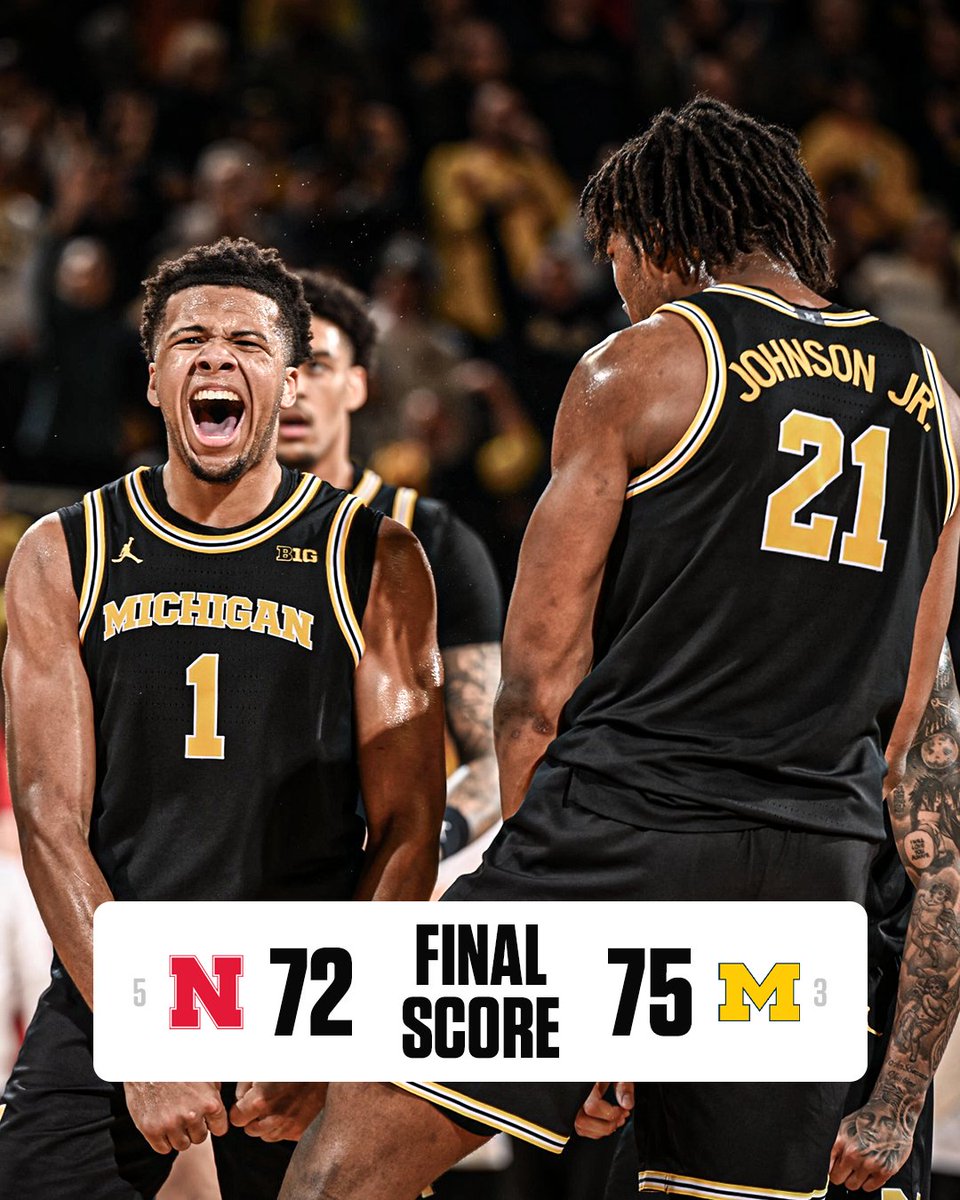
Michigan Edges No. 5 Nebraska in a Late-Game Thriller at Crisler Center
Ann Arbor, MI — In a tense matchup that lived up to Big Ten title implications, No. 3 Michigan handed No. 5 Nebraska its first defeat of the season, 75-72, at Crisler Center on Tuesday night. The Wolverines' defense clamped down in the final minutes, stifling the Cornhuskers for the last 3 minutes and 20 seconds to seal the win in front of a charged home crowd.
Historical context and season arc Michigan’s victory adds another chapter to a season that has forged a rising narrative for the Wolverines. Entering the game, Michigan sat at 19-1 overall and 9-1 in conference play, continuing a productive run that has reestablished the program as a consistent threat in the Big Ten. The win also cements Michigan’s position at or near the top of the standings, reinforcing a process that has emphasized roster depth, late-game execution, and a defensive identity.
Nebraska arrived in Ann Arbor riding a scintillating 20-1 mark and a 9-1 record in conference play, but the trip to Michigan exposed vulnerabilities that can surface in a grind-it-out league schedule. The Cornhuskers were missing forward Rienk Mast due to illness and forward Braden Frager with an ankle issue, which impacted rotation depth and frontcourt versatility. Still, Nebraska showed resilience, rallying from early deficits and trading leads with Michigan throughout a competitive 40 minutes.
Key performances and turning points For Michigan, junior guard Morez Johnson Jr. delivered a double-double with 17 points and 12 rebounds, anchoring both the scoring and the glass. Johnson’s ability to attack mismatches and control the boards in critical moments provided the backbone for Michigan’s late surge. Tre Donaldson contributed important baskets and defensive stops, helping maintain balance when Nebraska sought to pressure the paint. Additionally, forward Yaxel Lendeborg and center Aday Mara each chipped in 10 points, providing scoring diversity and contributing to Michigan’s interior presence.
Nebraska showcased a balanced attack despite the absence of Mast and Frager. Pryce Sandfort and Jamarques Lawrence each reached 20 points, showing the versatility of the Cornhuskers’ perimeter game and their ability to generate offense from multiple sources. Sam Hoiberg filled the stat sheet with 13 points, seven rebounds, five assists, and four steals, illustrating the multi-faceted impact he can have on both ends of the floor. The late twist of the game featured a potential game-tying moment as Jamarques Lawrence released a 3-pointer with four seconds left that narrowly missed, followed by Hoiberg’s buzzer-beater attempt that fell short as time expired.
Strategic elements and game flow The game unfolded as a defensive chess match, with both teams applying pressure, contesting shots, and executing in transition when opportunities arose. Michigan’s strategy centered on limiting Nebraska’s high-percentage looks in the paint and contesting 3-point attempts from the Cornhuskers’ perimeter players. The Wolverines benefited from timely rotations and disciplined help defense, particularly in the closing minutes when guarding the rim and denying second-chance opportunities became crucial.
Nebraska leaned on its guard play and mid-range scoring to stay within striking distance, leveraging quick ball movement to create open looks for Sandfort, Lawrence, and Hoiberg. The team’s efficiency was contingent on maintaining tempo and freeing drivers to attack gaps in the Michigan defense. In the final stretch, Michigan’s ability to string together defensive stops and convert possessions into points proved decisive, as Nebraska went scoreless over the last 3:20 of the game.
Economic and regional impact Beyond the on-court drama, the matchup has broader implications for the Big Ten’s competitive balance and the regional basketball economy. High-profile conference games like this one drive attendance, boost local revenue for arenas, and attract regional media attention. Ann Arbor’s Crisler Center hosted a robust crowd, underscoring the university’s role in sustaining a marquee athletic environment that supports recruitment, scholarships, and local business activity surrounding game nights.
From an economic perspective, the enduring strength of a balanced conference schedule helps market universities as consistent destinations for prospective student-athletes. Programs that can sustain deep rosters and competitive performances—such as Michigan—often experience heightened recruiting interest, merchandise sales, and increased ticket demand for future matchups. For Nebraska, a program operating at a high level within a sprawling midwestern athletic network, maintaining competitiveness against top-tier opponents reinforces its brand value and helps attract national sponsorship interest.
Regional comparisons and context In the broader regional landscape, other Big Ten programs have faced similar tests against top-ranked opponents. Michigan’s win mirrors recent performances where teams near the league’s summit have demonstrated resilience in games decided in the closing minutes. The conference’s depth means that even teams with strong records can encounter exhaustive, grind-it-out games that test late-game decision-making, conditioning, and bench depth.
Historically, Michigan’s program has built a reputation for strong defensive identity and efficient offense, particularly under coaches who emphasize a balanced attack. Nebraska, on the other hand, has been known for its guard-driven scoring and multi-faceted backcourt play, capable of surging when shooters find rhythm. This matchup highlighted the evolving dynamic within the conference: teams that can defend at a high level and execute down the stretch increasingly define title contenders.
Implications for standings and momentum With the win, Michigan improves to 9-1 in Big Ten play, creating a shared or near-shared lead in the conference standings depending on other results. The victory also adds momentum to Michigan’s overall season narrative, signaling its readiness to contend in the later portion of the schedule and potentially secure a favorable seed for postseason play. For Nebraska, the loss ends an otherwise remarkable unbeaten stretch and invites a quick regroup as it returns to conference play. The outcome reinforces the idea that even elite teams can be tested on the road or in hostile environments, highlighting the importance of depth, execution, and finishing capability.
Coaching notes and player development From a coaching perspective, the game offered a case study in managing lineups and preserving energy for late-game defense. Michigan’s rotation provided reliable options off the bench, enabling the coaching staff to deploy fresh legs to contest shots and secure rebounds in critical moments. Nebraska’s coaching staff, facing the absence of key frontcourt players, adapted by leaning on perimeter pressure and ball movement to generate offense, demonstrating strategic flexibility in the face of adversity.
Looking ahead Both programs will likely adjust their preparations for the next matchup. Michigan may focus on fine-tuning late-game decision-making, defensive rotations, and rebounding consistency to sustain dominance in close games. Nebraska, while disappointed to lose its first blemish, can take positives from the resilience shown and the ability to challenge a top-tier opponent on the road. The Big Ten schedule remains unforgiving, with each game carrying significant implications for seeding, rivalry narratives, and the race toward conference supremacy.
Public reaction and atmosphere The Crisler Center crowd played a pivotal role, providing energy that buoyed Michigan through stretches of the game. Fans reacted to pivotal plays with a mix of celebration and uneasy anticipation as the clock wound down. Post-game, social media chatter reflected a mixture of optimism about Michigan’s trajectory and disappointment for Nebraska’s missed opportunities in the closing seconds. The matchup reaffirmed the social dynamic of college basketball in the region, where every conference game carries emotional weight and a sense of local pride.
Conclusion and takeaways In a game that lived up to its billing, Michigan emerged victorious by a slim margin, reinforcing its standing as a conference contender and signaling resilience in high-pressure moments. The result also underscored Nebraska’s capacity to compete at the highest level, even when faced with injuries and roster limitations. As the season progresses, these kinds of outcomes—tight finishes, strategic adjustments, and parallel narratives about program strength—will continue to shape the Big Ten’s reputation as one of college basketball’s premier leagues.
Notes on statistics and sources Statistical highlights stem from the game recap and box score details, including Morez Johnson Jr.’s double-double, Sandfort and Lawrence’s 20-point performances, and the late defensive sequence that sealed the victory for Michigan. This article synthesizes game data with historical context and regional implications to present a rounded, informative narrative suitable for a general audience.