Mexican President Claudia Sheinbaum Threatens Legal Action Against Elon Musk Over Cartel Allegations
A Diplomatic Rift Over Explosive Accusations
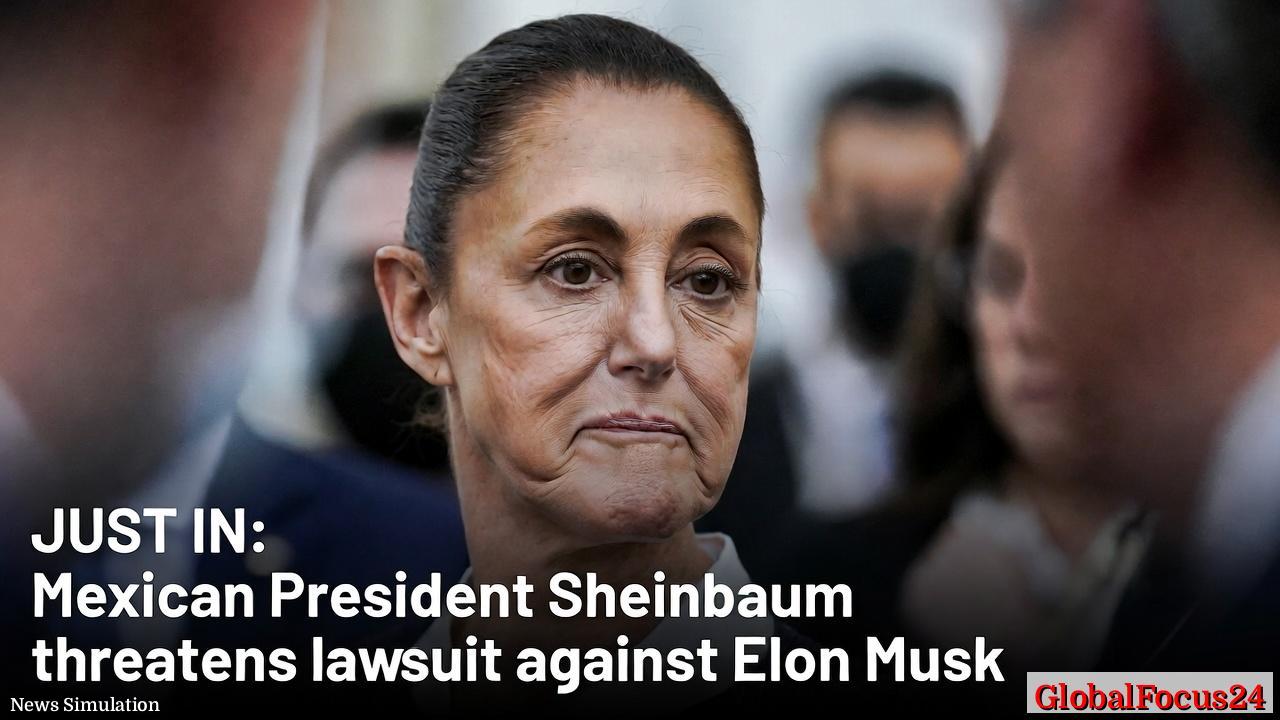
Mexico’s President Claudia Sheinbaum has announced her intent to file a lawsuit against billionaire entrepreneur Elon Musk after he publicly accused her of being influenced by organized crime networks. The statement from Musk, shared on social media to his hundreds of millions of followers, alleged that Sheinbaum’s administration was “a puppet of the cartels,” a claim that quickly reverberated across both sides of the U.S.–Mexico border.
The comments sparked widespread condemnation from Mexican officials, who characterized the remarks as defamatory and irresponsible. In response, Sheinbaum confirmed that her legal team is preparing to pursue action through international and domestic courts to “defend the dignity and sovereignty of Mexico.” The confrontation marks one of the sharpest personal exchanges to date between a sitting world leader and one of the world’s most recognizable tech executives.
Background: A New President Under Global Scrutiny
Sheinbaum, who took office as Mexico’s first female president in late 2024, has faced intense international attention throughout her early months in power. As the successor to Andrés Manuel López Obrador, she has inherited a complex legacy: deep social reforms mixed with ongoing challenges from cartel-related violence and corruption. Musk’s accusation, therefore, cut into one of the most sensitive aspects of Mexican domestic politics — the perception of government complicity in criminal operations.
Her administration has made high-profile moves to signal transparency and reform, including redeploying federal security forces to certain cartel-dominated regions and strengthening collaboration with U.S. anti-narcotics agencies. Yet, skepticism remains among analysts who argue that drug syndicates’ entrenched influence cannot be undone overnight. Against this backdrop, Musk’s sudden comments poured fuel on a volatile debate already brewing inside and outside Mexico.
Elon Musk’s Role and Motivations
While Musk is best known for leading companies like Tesla, SpaceX, and X (formerly Twitter), he has increasingly become a lightning rod for political controversy. His engagement with geopolitical issues on social platforms often provokes intense backlash. In this instance, his cartel-related accusation emerged during an online discussion about cross-border investment and energy projects, where Musk claimed that Mexico’s renewable-energy initiatives were “compromised by criminal interests with political backing.”
The remarks appeared to reference long-standing tensions over lithium mining and electric vehicle supply chains — sectors in which Musk’s companies hold strategic interests. Mexico’s decision under López Obrador, and later reaffirmed by Sheinbaum, to nationalize lithium production has limited opportunities for foreign corporations. Industry experts suggest that this industrial-policy stance may have fueled underlying friction between Musk and Mexican officials, culminating in the current controversy.
Legal Ramifications and International Options
From a legal standpoint, defamation suits between public figures across international jurisdictions present formidable challenges. Mexico’s defamation laws provide avenues for civil liability, particularly when reputational harm affects public confidence in a government office. Sheinbaum’s legal advisers indicated that the suit could be filed both domestically and in the United States, potentially citing damages under libel statutes applicable to online publications.
Legal scholars note, however, that pursuing litigation against a U.S.-based entrepreneur over statements made on a global social platform would require demonstrating “actual malice” — that Musk knowingly spread false information or acted with reckless disregard for the truth. Although high-profile defamation cases of this magnitude are rare, experts point to parallels with past legal conflicts between foreign governments and international media figures, such as those involving sovereign defamation claims in the United Kingdom and the United States.
Political and Economic Implications
Beyond the courtroom, the dispute has implications for Mexico’s economic outlook and its relations with U.S. investors. Musk’s companies have substantial operations in North America, including Tesla’s plans for a “Gigafactory” in the northern state of Nuevo León. Construction on the site has been delayed multiple times, officially due to supply chain optimization and regulatory review, but analysts have suggested that political tensions may be contributing to the slowdown.
If Sheinbaum proceeds with legal action, the move could harden perceptions among foreign investors wary of political volatility in Mexico. At the same time, national pride and the defense of government credibility remain powerful political motivators domestically. Public opinion polls conducted in recent months show growing support for Sheinbaum’s efforts to assert international respect for Mexico’s sovereignty, even as economic uncertainty persists.
In financial markets, the peso experienced modest fluctuations following the news of Musk’s remarks, stabilizing after initial volatility. Analysts noted that while the legal dispute itself is unlikely to have a direct macroeconomic impact, it underscores the fragility of Mexico’s image as a stable destination for high-tech manufacturing and nearshoring investments.
Historical Context: A Legacy of Foreign Accusations
Foreign criticism of Mexican governance and corruption is not new. Throughout the 20th century, international actors — from U.S. intelligence officials to global media outlets — have at times accused Mexican administrations of turning a blind eye to cartel influence. Presidents have frequently rebuked such claims as violations of national sovereignty, citing domestic efforts to combat crime and reduce violence.
In the 1980s, for example, tensions over drug trafficking investigations led to diplomatic rifts following the murder of DEA agent Enrique “Kiki” Camarena. More recently, the trial of former security official Genaro García Luna in the United States reignited debate over cross-border accountability and the complicity of high-ranking figures. Against that historical backdrop, Sheinbaum’s legal threat against Musk evokes longstanding sensitivities about Mexico’s global image and the perception that outsiders oversimplify its internal challenges.
The Reaction Inside Mexico
National reactions to Musk’s accusation have been swift and intense. Members of Sheinbaum’s cabinet decried the remarks as an “affront to the Mexican people,” while major newspapers declared them an unacceptable incursion into domestic affairs. The president’s supporters rallied online under the slogan “Mexico se respeta” — “Mexico deserves respect” — a phrase that trended across platforms within hours of her announcement.
However, opposition leaders and commentators caution that Sheinbaum’s response could distract from more urgent issues, such as rising inflation and security concerns. Some business groups have also expressed concern that escalating the dispute could jeopardize bilateral trade relationships. Still, many ordinary Mexicans view the confrontation as a moment of national pride, framing it as a defense against what they see as uninformed criticism from a foreign billionaire.
U.S.–Mexico Relations in the Balance
The dispute adds complexity to an already delicate phase in U.S.–Mexico relations. Both countries are grappling with intertwined challenges — from migration and fentanyl trafficking to trade cooperation under the United States–Mexico–Canada Agreement (USMCA). While the U.S. government has not formally commented on Musk’s remarks or Sheinbaum’s planned lawsuit, officials privately express concern that such conflicts may overshadow ongoing policy coordination.
Diplomatic analysts argue that, while largely symbolic, the dispute reflects deeper tensions between private wealth and public authority in an era of transnational communication. With influential figures like Musk capable of setting global narratives in real time, political leaders face the constant pressure to defend their reputations on digital battlegrounds where traditional diplomacy offers limited recourse.
The Broader Significance of Sheinbaum’s Response
Sheinbaum’s decision to pursue legal action signifies a growing assertiveness in Mexico’s international posture. Her administration has positioned itself as a defender of national dignity while simultaneously seeking to maintain investor confidence and global partnerships. By confronting Musk’s claim head-on, Sheinbaum underscores a broader political message: Mexico’s leaders will not tolerate external narratives that threaten to undermine institutional authority or national morale.
If the case proceeds, it could establish new precedents for how governments engage with powerful private individuals in the age of social media. Regardless of its legal outcome, the confrontation highlights shifting dynamics between technology moguls and sovereign states — a sign that political power and influence are as likely to clash online as they are across diplomatic tables.
Looking Ahead
As the situation develops, legal filings and public statements are expected in the coming weeks. Both sides face significant reputational stakes: Musk risks further controversy over his unfiltered public persona, while Sheinbaum must balance assertiveness with restraint to avoid perceptions of overreaction. The lawsuit, if filed, would join a growing number of international defamation disputes testing the boundaries of free speech in the digital era.
For Mexico, the moment underscores the broader challenge of defending its global image while navigating complex domestic reforms. For observers across North America, the clash between a head of state and one of the world’s most influential entrepreneurs offers a vivid glimpse into the evolving intersection of business, politics, and the power of words in the twenty-first century.