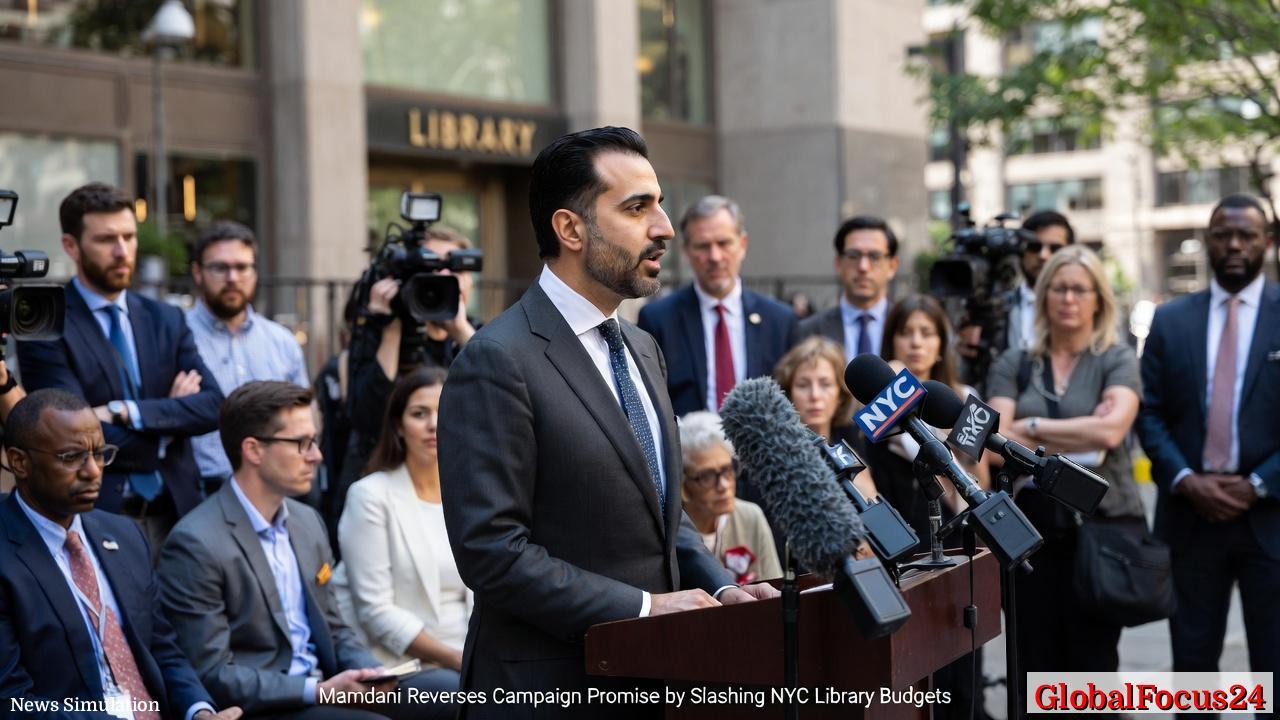
Mamdani Reverses Campaign Promise by Slashing NYC Library Budgets
February 20, 2026
Mayor Zohran Mamdani’s new preliminary budget proposal has ignited widespread debate across New York City. Despite having pledged during his campaign to expand library funding and safeguard public spaces, the $127 billion budget plan unveiled this week includes nearly $30 million in cuts to the city’s public library systems. The move marks a startling reversal for a politician who once condemned similar measures as “cruel” and “shortsighted.”
A Sharp Turn from Campaign Promises
Under the proposed budget, the New York Public Library system—which serves Manhattan, the Bronx, and Staten Island—would lose $11.6 million in operational funding compared to last year’s levels. The Brooklyn Public Library would see a reduction of $8.7 million, while the Queens Public Library faces a $9.2 million cut. In total, these decreases represent some of the most significant retrenchments to library budgets since the pandemic recovery efforts of 2021–2023.
The cuts directly contradict one of Mamdani’s signature campaign promises: to allocate 0.5% of the city’s total budget to its public library systems. The pledge, still displayed on his campaign website as of this week, emphasized libraries as “essential infrastructure for opportunity, learning, and civic connection.” The reversal has drawn dismay from librarians, community advocates, and political observers alike.
During his 2025 campaign, Mamdani sharply criticized former Mayor Eric Adams for proposing similar reductions. When Adams suggested $58 million in cumulative cuts over his term, Mamdani accused him of undermining safe community spaces and hampering immigrant assistance programs. At the time, Mamdani argued that investing in libraries yielded exponential returns for the city’s social and economic ecosystem. Now, his administration faces questions about how such priorities shifted in just over a year.
Budget Crisis Drives Difficult Choices
A spokesperson for the mayor’s office defended the proposal by citing an “inherited budget deficit” and mandatory cost efficiencies across multiple agencies. The city’s financial planners have warned that slowing tax revenue growth, ongoing housing costs, and rising pension obligations have narrowed fiscal flexibility for 2026.
“The city is operating under significant structural constraints,” the mayor’s spokesperson said in a written statement. “Every department has been asked to find savings while protecting essential services. Libraries and parks remain vital, but we must ensure responsible budgeting that balances immediate needs with long-term sustainability.”
The administration maintains that the funding formula is not final and could change after negotiations with the City Council. The new budget also includes $2 million to support Sunday service expansions that were introduced last year, signaling a selective continuation of some recent improvements. Still, for many New Yorkers, the symbolic significance of cutting library funds outweighs the dollar figures themselves.
Impact on Vital Community Services
Beyond the rows of books and quiet study spaces, New York’s public libraries serve as critical community hubs. They offer English language classes, citizenship assistance, elderly outreach programs, technology access, and after-school tutoring. In many neighborhoods, libraries remain the only free public institutions providing these resources at scale.
Library administrators warn that the proposed reductions could disrupt outreach and digital literacy programs, particularly in lower-income communities. Branches that recently extended their hours after pandemic-era closures may once again face scaled-back schedules.
The Brooklyn Public Library’s spokesperson struck a measured tone, acknowledging the financial reality while expressing hope for collaboration with city officials. “We recognize the challenges of this fiscal environment and look forward to working with the administration to ensure libraries remain strong and community-centered,” the statement read.
Similarly, Queens and New York Public Library leaders urged the council to uphold the mayor’s previously stated commitment to reaching the 0.5% funding threshold. “Libraries are not optional services—they are engines of opportunity,” said one senior administrator.
Historical Context of Library Funding
Library budgets in New York City have fluctuated dramatically over the past two decades. During the 2008 financial crisis, the Bloomberg administration proposed deep funding cuts that would have eliminated hundreds of jobs and reduced service hours. Massive public advocacy campaigns and council negotiations eventually restored much of that funding, setting a precedent for public mobilization around library access.
Under Mayor Bill de Blasio, libraries enjoyed relatively stable or increasing budgets, bolstered by a focus on equity and literacy initiatives. However, when pandemic-related shortfalls intensified under the Adams administration, funding again became a point of contention. Adams’ proposed $58 million reduction in 2023 led to temporary weekend closures across multiple branches before public pressure forced a partial restoration later that year.
Mamdani’s position during that period was clear—he denounced any cuts to what he called “the city’s most democratic institutions.” The contrast between that stance and his current proposal has fueled accusations of hypocrisy and raised questions about how campaign rhetoric aligns with governance under fiscal strain.
Economic Significance of Public Libraries
Analysts note that library systems generate measurable returns on investment through workforce development, education, and cultural enrichment. A 2019 study by the Urban Libraries Council estimated that for every dollar spent on library services in major U.S. cities, up to $5 in economic value is returned through increased employment readiness, educational attainment, and small-business creation.
In a city where roughly one in three households lacks reliable broadband access, libraries also serve as a lifeline for digital connectivity. Reducing library hours or staff could ripple through the broader urban economy, lowering access to job applications, government services, and career training programs.
Economists warn that such cuts, though fiscally modest in the context of a $127 billion budget, may have disproportionate social costs. “Libraries function as democratizing spaces,” said one regional policy analyst. “When funding is reduced, inequity grows—particularly in marginalized communities where other public resources are scarce.”
Comparisons with Other Major Cities
New York’s public library systems rank among the most utilized in the world, with more than 16 million annual visitors across 218 branches. By comparison, Chicago and Los Angeles have adopted more protective approaches to library funding in recent years. The Chicago Public Library, for instance, secured a budget increase of 3% in 2025 to expand homework help and technology access. Los Angeles maintained stable funding levels while prioritizing climate-resilient building upgrades and more equitable branch distribution.
While every city faces fiscal pressures, advocates argue that cutting cultural and educational infrastructure sends the wrong message about priorities. “New York’s libraries are part of its social safety net,” noted a longtime library foundation board member. “Choosing to reduce them—even temporarily—signals a troubling willingness to compromise access to opportunity.”
Public and Political Reaction
Reaction to the proposed cuts has been swift. Former Mayor Eric Adams, now a private citizen, publicly highlighted what he called the “stark inconsistency” of Mamdani’s stance. “When I proposed efficiency reviews, I was accused of cruelty,” Adams said. “Now, this administration is doing less with more, and silence replaces outrage.”
Grassroots organizations such as Occupy Wall Street and the Urban Literacy Coalition have amplified criticism on social media, pointing out that even with the $30 million cut, the city’s libraries would still receive less as a share of the budget than they did under Adams. Several community boards have already scheduled public hearings to address the issue before the final budget vote this summer.
Still, some residents remain cautiously optimistic. “If the mayor can work with the council to fulfill his 0.5% commitment, all will be forgiven,” said one Brooklyn resident outside the Greenpoint branch—a site where Mamdani had previously reaffirmed his promise before television cameras just two months ago.
Looking Ahead: Negotiations and Uncertainty
As budget season progresses, the focus will shift to City Council negotiations, which historically play a decisive role in restoring proposed cuts to cultural and educational institutions. Lawmakers sympathetic to library advocacy groups are expected to push for partial or full restoration of the funding.
If history is a guide, public engagement may also shape the outcome. During past budget cycles, organized campaigns under slogans like “Invest in Libraries” successfully mobilized thousands of New Yorkers to petition, rally, and testify on behalf of their local branches. Such efforts could again prove influential in the weeks ahead.
For now, uncertainty defines the outlook. The administration insists that the proposal is a starting point, not a final decree. Yet the tension between campaign idealism and fiscal pragmatism—between promises of expansion and realities of constraint—will continue to echo through every branch reading room in the city.
In a metropolis where libraries double as classrooms, offices, and sanctuaries for millions, the debate over their funding is more than a question of balance sheets. It is a contest over how New York defines public good—and whether the city’s most cherished civic institutions can survive another era of austerity.