Europe Embraces ‘Strategic Autonomy’ as Macron’s Vision Gains New Urgency
A Decade in the Making
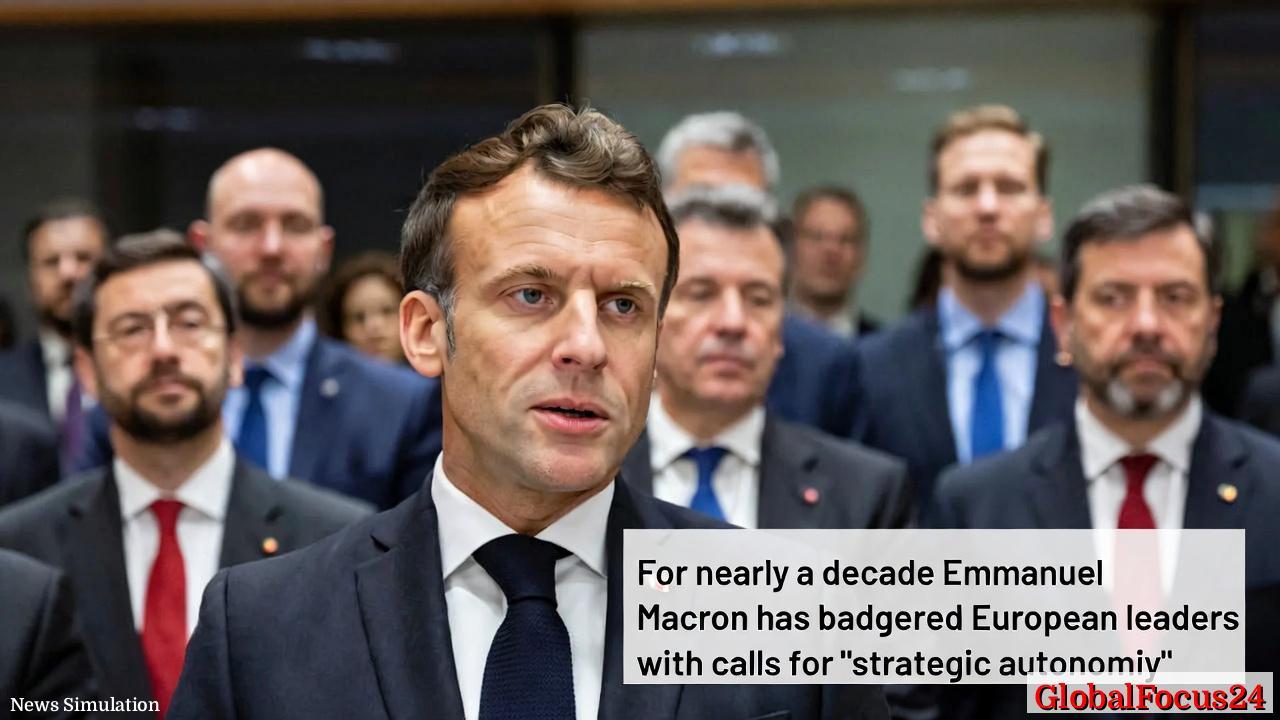
For nearly ten years, Emmanuel Macron’s call for a Europe more capable of standing on its own—militarily, economically, and technologically—was met with polite skepticism. Now, as global realignments accelerate, the notion of “European strategic autonomy” is no longer theoretical. It has become a guiding principle for leaders confronted with the fragility of global supply chains, shifting U.S. priorities, and the mounting costs of geopolitical dependence.
The French president’s insistence that Europe could not indefinitely rely on Washington for defense, Beijing for technology, or Moscow for energy was often viewed as overambitious. Yet, since the late 2010s, successive crises have validated the underlying argument: that Europe’s prosperity and security depend on its ability to act independently when necessary. With conflicts raging at its borders, a volatile international trade environment, and growing competition for critical resources, Europe’s strategic awakening is now well underway.
From Indifference to Alignment
Macron first championed the idea of strategic autonomy shortly after taking office in 2017. At the time, Europe was emerging from economic recovery after the sovereign debt crisis, preoccupied with Brexit negotiations, and still accustomed to NATO’s blanket security guarantee under U.S. leadership. Macron’s calls for a stronger European defense identity—through initiatives like the European Intervention Initiative and the European Defence Fund—were viewed by some leaders as a challenge to NATO unity.
Yet the political weather has changed. The United States’ gradual pivot toward Asia, coupled with domestic uncertainty in American politics, has raised doubts about the reliability of transatlantic commitments. European policymakers increasingly worry about scenarios where U.S. military and economic support may be delayed or reduced. As a result, what was once Macron’s lonely crusade has evolved into mainstream European policy thinking.
Germany, long hesitant to engage in assertive military planning, pledged in 2022 to create a €100 billion fund to modernize its armed forces, marking the most significant shift in its defense policy since the Cold War. The European Union, meanwhile, has begun financing joint weapons procurement and tactical infrastructure using collective funds—steps that were unthinkable a decade ago.
Defense Autonomy Takes Shape
The war in Ukraine has been a defining catalyst for Europe’s newfound urgency. The invasion exposed both the continent’s military dependency on the United States and its logistical vulnerabilities. European armies rapidly depleted ammunition stocks, and their arms industries struggled to replace supplies at scale. Calls for “European defense sovereignty” suddenly gained momentum.
Efforts are now focused on strengthening the European defense base. The EU’s newly established Defense Industrial Reinforcement Through Common Procurement Act aims to streamline acquisitions and boost production capacity across member states. France and Italy have increased investments in missile and naval systems, Poland has launched a record defense spending program, and smaller nations such as the Czech Republic and Finland are contributing to shared defense projects coordinated through the European Defence Agency.
This fragmentation of effort remains a challenge. Disparities in technology, purchasing standards, and military doctrines persist across national lines. Nevertheless, the direction is clear: Europe wants to ensure that it can defend itself without depending entirely on NATO or American logistics. Macron’s vision—once considered idealistic—is now codified in EU policy language, underscoring a fundamental cultural shift within the bloc.
Economic Independence and Industrial Competitiveness
Strategic autonomy extends beyond defense. In the economic sphere, European leaders have begun weaving resilience into every major policy initiative. The pandemic revealed the vulnerabilities of outsourced manufacturing and the scarcity of strategic goods—from semiconductors to medical supplies—when global supply chains collapsed.
The response has been sweeping. The European Commission launched its Chips Act to boost domestic semiconductor production and reduce dependence on Asian suppliers. Industrial policy, once a controversial topic in Brussels, has become central to the EU’s growth strategy. Germany, France, and the Netherlands are investing heavily in next-generation battery manufacturing, green hydrogen, and critical mineral extraction.
Tied to these industrial ambitions is a push to develop a distinct European technological ecosystem capable of competing with American and Chinese giants. Initiatives in artificial intelligence, quantum computing, and cybersecurity are framed not only as economic opportunities but as matters of sovereignty. The continent’s tech champions—such as ASML in the Netherlands and Dassault Systèmes in France—are now pillars of Europe’s bid for technological self-determination.
Shifting Energy Strategies
Energy has perhaps been the most striking lesson in Europe’s dependence dilemma. Before 2022, Russia supplied nearly 40 percent of the EU’s natural gas. The abrupt need to wean off that supply following the invasion of Ukraine triggered the fastest reorientation of Europe’s energy infrastructure in modern history.
Countries rapidly diversified imports, built liquefied natural gas terminals, and accelerated renewable energy deployment. France leveraged its nuclear fleet for stability, while Germany, despite phasing out its reactors, invested heavily in wind, solar, and hydrogen networks. Today, Europe has dramatically reduced its exposure to Russian energy, with Norway, the United States, and Middle Eastern suppliers filling the gap.
This shift, however, has come with trade-offs. Energy prices remain elevated compared with pre-war levels, straining households and manufacturing sectors. Yet the broader outcome aligns with Macron’s argument: long-term independence in energy policy will strengthen Europe’s resilience to external shocks, even if the transition is costly.
Historical Parallels and Regional Divergences
The idea of European self-reliance is not new. After World War II, efforts such as the European Coal and Steel Community were designed to bind nations economically, reducing reliance on outside powers. However, Cold War realities quickly subordinated Europe’s defense to NATO, while globalization later linked its prosperity to the U.S. dollar system and Chinese manufacturing.
Today’s movement toward autonomy can be seen as a revival of those early aspirations, adapted to the realities of multipolar competition. Yet regional differences persist. Eastern European countries, wary of Russian aggression, remain cautious about any move that might dilute the U.S. presence in Europe. Southern states emphasize industrial competitiveness and resilience to climate shocks, while northern economies focus on preserving open trade.
Despite these tensions, the European Council increasingly frames autonomy as complementary to allied cooperation, not a replacement for it. The narrative has evolved from independence from others toward independence to act when necessary—a crucial linguistic and strategic distinction.
Economic Impact Across the Continent
The push for strategic autonomy is reshaping Europe’s economic landscape in several ways:
- Investment Surge: Public and private capital is flowing into defense production, green technology, and advanced manufacturing, creating new industrial clusters across Central and Eastern Europe.
- Labor Demand: High-value sectors such as aerospace, energy storage, and digital security are driving demand for skilled labor, leading to wage growth and training initiatives.
- Inflationary Pressure: Massive public spending on rearmament and infrastructure has contributed to short-term inflation, particularly in construction and raw materials.
- Trade Diversification: The EU’s new trade agreements with Canada, Japan, and Australia reflect a broader effort to reduce dependence on China, securing access to vital minerals and technology-sharing frameworks.
These dynamics point toward a more self-contained European economy—still open to globalization but anchored by homegrown capabilities. Economists note parallels with Japan’s postwar industrial policy, though Europe’s approach operates within the collective framework of the EU’s single market.
Lessons from Other Regions
Comparatively, other global blocs have pursued similar strategies. In Asia, nations such as Japan and South Korea are deepening domestic semiconductor production to limit vulnerability to geopolitical disruptions in Taiwan. The United States has revived industrial policy through its CHIPS and Inflation Reduction Acts, echoing Europe’s dual focus on security and competitiveness.
Latin American countries, too, are exploring strategic autonomy through regional partnerships to reduce dependency on global commodity markets. Europe’s experience, however, is unique in scale and coordination. No other region combines 27 sovereign states into a single economic and regulatory space with shared ambitions for technological, military, and energy independence.
Challenges Ahead
Despite the momentum, Europe’s strategic autonomy still faces hurdles. Divergent fiscal capacities among member states could lead to uneven progress. Smaller economies fear being overshadowed by industrial powerhouses like France and Germany. The EU must also navigate delicate transatlantic relations, assuring Washington that greater autonomy does not imply estrangement.
Moreover, achieving full independence in critical technologies remains elusive. Europe continues to rely on U.S. cloud infrastructure, microchip designs, and defense intelligence. Energy diversification is ongoing but incomplete, and financial systems remain deeply tied to the dollar-based global market.
The challenge, as Macron himself has acknowledged, lies not in breaking alliances but in building the means to choose freely—turning autonomy from rhetoric into reality.
A European Awakening
As Europe steps more confidently into a world defined by competition among great powers, Macron’s vision of a continent capable of defending its interests and values is finding its footing. Strategic autonomy, once an abstract French idea, has become the continent’s pragmatic response to a changing global order.
If history offers any guidance, Europe’s strength has always come from its ability to adapt. Today, that adaptation involves rebalancing interdependence with independence—an evolution not of isolation, but of confidence. And in that transformation, Macron’s long-derided campaign for European self-sufficiency has found its vindication.