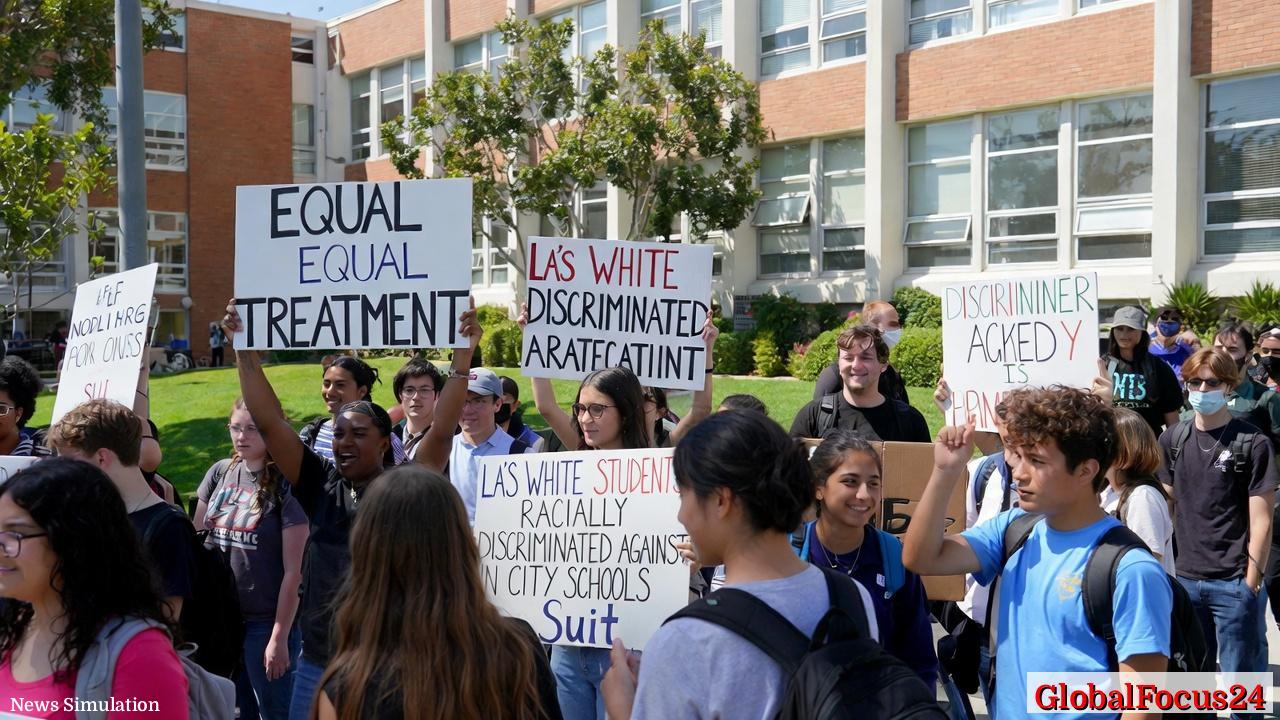
LAUSD PHBAO Policy Faces Legal Challenge Over Perceived Disparities
A prominent conservative nonprofit has filed a lawsuit alleging that Los Angeles public schools discriminate against white and Middle Eastern students through a longstanding desegregation framework designed to bolster resources for predominantly non-Anglo campuses. The case centers on the district’s Predominantly Hispanic, Black, Asian, or Other Non-Anglo (PHBAO) program, established in the 1970s to address persistent inequities and promote desegregation in one of the nation’s largest school systems.
Historical Context: Desegregation Efforts in a Complex District
The PHBAO framework emerged from a historically fraught era of school integration in California, wherein districts sought structured approaches to balance access to resources, facilities, and staffing. In practice, PHBAO designates schools with student populations exceeding a 70 percent threshold of Hispanic, Black, Asian, or other non-Anglo groups to receive enhanced support: smaller class sizes, expanded parental involvement opportunities, additional staff, and targeted programmatic investments. Proponents argue that such targeted support helps counter the effects of residential segregation and resource disparities that can accumulate over years.
Critics, however, contend that race-conscious allocation of resources risks creating parallel systems within a single district. The current lawsuit contends that the program’s ongoing application constitutes reverse discrimination by advantaging some campuses while disadvantaging others, including schools with significant white or Middle Eastern student populations that fail to meet the PHBAO threshold.
Plaintiffs and Legal Questions
The lawsuit is brought by the 1776 Project Foundation, a conservative nonprofit known for challenging policies it views as race- or ethnicity-based favoritism in public institutions. The filing argues that more than 600 LAUSD schools meet the PHBAO criteria, while fewer than 100 fall outside the framework. The core legal question presented is whether the PHBAO policy constitutes lawful, narrowly tailored desegregation-era remedies or whether it infringes on equal protection principles by distributing resources based on race or ethnicity.
The plaintiffs assert that non-PHBAO schools—where students are predominantly white or from other non-minority groups—receive fewer resources and opportunities as a direct result of the district’s policy. They describe the policy as “inferior treatment” and call for a comprehensive reevaluation of how resources are allocated across campuses, arguing that the district’s framework operates as a de facto two-tier system.
Defendants named in the suit include the Los Angeles Unified School District Board of Education, its president, and Superintendent Alberto Carvalho. The filing notes concerns about broader district performance, including recent reports suggesting that a significant portion of third graders are not meeting grade-level reading standards. Critics of the PHBAO framework say that while addressing disparities remains essential, the mechanism should not rely on race-based categorizations to drive funding and staffing decisions.
Economic and Operational Implications
LAUSD serves tens of thousands of students and operates a network of high schools, middle schools, and elementary campuses across a sprawling geographic area. The PHBAO program is designed to concentrate resources where needs are greatest, often translating to lower student-teacher ratios, enhanced teacher support, and extended family engagement initiatives in qualifying schools. The economic impact of such a framework is multifaceted:
- Resource distribution patterns: Proponents argue that redirecting resources to PHBAO campuses can yield measurable improvements in student outcomes, particularly in historically underserved communities. Critics worry about opportunity costs in non-PHBAO schools, where constrained funding might limit expansion of programs, infrastructure upgrades, or staffing.
- Long-term outcomes: If PHBAO-backed strategies contribute to higher graduation rates, college readiness, and workforce preparedness in the targeted districts, the broader local economy could benefit through a more skilled workforce. Conversely, if the policy is found unconstitutional or unsustainable, the district may face funding recalibrations, potential budgetary shifts, or the need to redesign its equity plans.
- Administrative complexity: Managing a race-conscious resource framework adds layers of oversight, data tracking, and accountability. That complexity can entail higher administrative costs but may also improve transparency if paired with robust evaluation metrics.
Regional Comparisons: How Districts Balance Equity
LAUSD is not alone in grappling with how to address historic disparities while maintaining equal protection norms. Several large urban districts have experimented with targeted desegregation or equity-based funding mechanisms. In many cases, districts that have implemented race-conscious allocation policies have also instituted rigorous monitoring and sunset provisions to ensure compliance with evolving legal standards and to adapt to changing student demographics.
- San Francisco Unified School District and other California districts have historically relied on needs-based funding and targeted supports, with a focus on closing achievement gaps while navigating state and federal guidelines.
- Nationwide, some districts have embraced weighted student funding models, which allocate more dollars to students with additional needs (English learners, students with disabilities, low-income families) without tying allocations to race per se. These models aim to achieve equity while avoiding explicit racial classifications.
- Comparisons in capital investment show that facilities upgrades, technology access, and early literacy programs often accompany equity initiatives, irrespective of whether demographics are used as direct qualifiers for funding.
Public Reaction and Education Equity
Community responses to the PHBAO controversy have been mixed. Supporters of targeted desegregation measures often emphasize the moral and social benefits of reducing inequities, improving school safety, and fostering inclusive learning environments. They point to data suggesting that concentrated resources at high-need schools can yield improvements in student engagement, attendance, and academic achievement.
Opponents argue that policies which privilege one group’s access to resources over another’s create a perception of unfairness and risk alienating families in non-PHBAO schools. They contend that equity should be pursued through race-neutral approaches, such as universal funding increases, performance-based incentives, and comprehensive program evaluations that do not rely on racial or ethnic classifications.
Education policy experts note that the discourse around PHBAO reflects a broader national conversation about how to reconcile equity goals with constitutional protections and nondiscrimination principles. The outcome of this lawsuit could influence district-level policy decisions, teacher recruitment strategies, and budget priorities for years to come.
Regional Impacts: Los Angeles and Beyond
Los Angeles stands as a bellwether for urban education policy due to its size, diversity, and the magnitude of its school system. A decision on the PHBAO framework could reverberate through neighboring districts and state-level policy discussions about how to structure desegregation-era remedies in a modern context. If the court upholds the policy or allows a measured reform, LAUSD could refine its equity strategies, maintaining a balance between targeted support and universal access.
Conversely, a ruling that restricts or eliminates PHBAO-style allocations may compel the district to pursue alternative equity mechanisms. Those could include expanding programmatic investments based on objective indicators of student needs—such as poverty level, English learner status, or academic performance—without explicit reliance on race or ethnicity as the qualifying criterion.
Policy and Legal Landscape: Balancing Rights and Remedies
The case sits at the intersection of civil rights, education policy, and administrative law. Courts frequently navigate the tension between remedies designed to correct past injustices and the protections guaranteed by the Equal Protection Clause. The outcome could hinge on interpretations of whether the PHBAO framework constitutes a narrowly tailored, time-bound desegregation effort or if it has evolved into an ongoing racial preference system.
Legal observers will be watching for how the district demonstrates ongoing need, the existence of sunset provisions, and the presence of robust oversight and accountability measures. The plaintiffs’ success may depend on proving that the policy’s current structure no longer aligns with remedial goals or that alternative, race-neutral approaches could achieve similar or better outcomes without invoking racial classifications.
Looking Ahead: What a Decision Could Mean for Public School Funding
Regardless of the final ruling, the case underscores the importance of transparent budgeting, outcome-based evaluation, and adaptive strategies to address persistent inequities in large, urban districts. For LAUSD, the imminent focus will likely include:
- Reassessing resource allocation criteria to ensure clarity, fairness, and compliance with applicable laws.
- Strengthening data-driven evaluation frameworks to measure the impact of targeted supports on student achievement, attendance, and long-term success metrics.
- Engaging with communities to articulate the rationale behind equity initiatives, respond to concerns, and establish avenues for feedback.
- Exploring complementary investments in universal programs that lift all students while preserving targeted supports where appropriate and legally permissible.
Broader Economic and Social Context
The discussion of PHBAO touches on broader economic themes surrounding urban education, including workforce readiness, social mobility, and regional competitiveness. Education systems that successfully reduce achievement gaps can contribute to stronger local economies by increasing high school graduation rates, reducing dropout risk, and expanding access to higher education and skilled employment opportunities. In regions with diverse populations, the ability to tailor interventions to student needs—without entrenching division—remains a central challenge for policymakers, educators, families, and communities.
Conclusion: An Era of Scrutiny and Adaptation
The LAUSD PHBAO lawsuit epitomizes a pivotal moment in urban education policy, where legacy desegregation measures confront contemporary constitutional standards and evolving public expectations. As the case advances, observers will look to the court’s decision for clues about how large, diverse districts can pursue equity in a way that is both effective and legally sustainable. The outcome will shape conversations about resource fairness, accountability, and the best path forward for millions of students whose futures hinge on the quality and equity of public education.