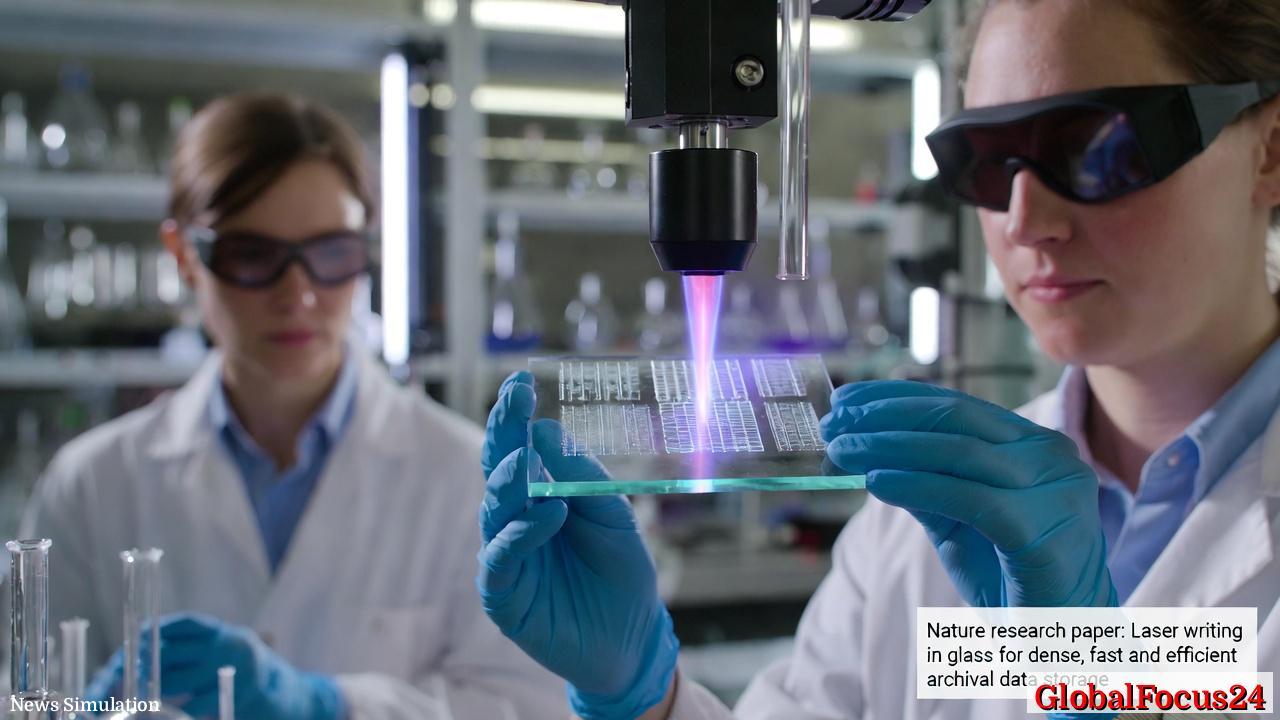
Scientists Pioneer Laser-Based Data Storage in Glass, Promising a Thousand-Year Digital Archive
Breakthrough in Optical Data Storage
A team of researchers has unveiled a revolutionary data storage technique that uses lasers to write information directly into glass, opening the door to ultra-dense, durable, and energy-efficient archival systems capable of preserving data for thousands of years. The method, detailed in a recent research paper in a peer-reviewed journal, represents a major step forward in the quest for long-term digital preservation at a time when global data generation is growing exponentially.
This innovation relies on ultrafast laser pulses that inscribe microscopic patterns—called nanostructures—inside transparent glass materials. Each pattern encodes data in multiple dimensions based on the orientation, size, and position of these structures. The resulting capability allows glass to serve as a near-eternal medium for digital information, with density and endurance far surpassing any existing conventional storage technique.
How the Laser-Writing Process Works
The process uses femtosecond laser pulses, lasting only a quadrillionth of a second, to precisely focus light inside a glass disc or slab. Each pulse creates nanoscopic modifications—so small they are invisible to the naked eye—that can be interpreted by specialized optical systems reading the polarization or phase of light passing through the glass.
Unlike traditional optical media, where data are stored in the surface layer, this approach records information deep within the material. The result is a data storage layer highly resistant to environmental damage, heat, moisture, or magnetic interference. Laboratory tests have shown that such glass-based archives could withstand temperatures exceeding 1,000°C and maintain data integrity for several millennia without degradation.
Storing the World’s Digital Memory
In the modern era, humanity produces more than 120 zettabytes of data annually—a number expected to double by the decade’s end. Yet most digital archives depend on magnetic disks, flash drives, or tape systems that degrade within decades, requiring constant replacement and migration. The result is skyrocketing costs and substantial environmental waste associated with maintaining global data centers.
Glass storage presents a sustainable alternative. The material is chemically stable, abundant, and free from the mechanical failure modes that plague hard drives or SSDs. Once encoded, the data does not need constant cooling or electricity to be preserved, offering an enormous reduction in operational energy use. In large-scale tests, researchers demonstrated that the new method achieved writing speeds up to a million voxels per second, significantly improving the feasibility of applying the technology to industrial-scale archives.
From Crystal Memory to Glass Data: A Century of Evolution
Efforts to create long-lasting data media date back to the early 20th century, when film and microfiche promised century-scale longevity. Later innovations in magnetic tape and optical discs expanded capacity but limited durability. The concept of storing information in glass was first explored in the 1990s, though early attempts were confined by low data density and slow writing speeds.
The breakthrough achieved by modern photonics researchers lies in the combination of ultrafast laser technology, AI-driven optimization, and sub-wavelength precision control. These allow information to be written in three dimensions rather than two, unlocking terabytes of capacity in a piece of glass the size of a credit card. It marks a turning point reminiscent of early semiconductor revolutions—only now, the medium is transparent and nearly immortal.
Economic and Environmental Implications
The economic potential of laser-written glass storage is considerable. Data archiving already represents a multibillion-dollar global industry, driven by enterprises, governments, and research institutions seeking secure and permanent repositories for critical information. Cloud companies spend significant resources duplicating and refreshing their storage arrays every few years. Transitioning even a portion of archival operations to glass-based systems could save billions in maintenance and power costs.
Environmental analysts point to another major advantage: sustainability. Traditional data centers consume vast amounts of energy for cooling and data redundancy. Glass archives, by contrast, require no active power for preservation. Their ability to store data for millennia without cycling through replacement hardware aligns closely with international efforts to build greener digital infrastructure. If adopted at scale, such technology could dramatically reduce the carbon footprint of the digital economy.
Comparison with Regional Research Efforts
Globally, research into advanced optical storage has accelerated over the last decade. In Europe and Japan, national research programs are exploring “five-dimensional” nanostructure encoding, while North American laboratories focus on improving throughput and cost-effectiveness for industrial application.
China, meanwhile, has invested heavily in photon-based computing and optical data systems, seeing them as strategic technologies for long-term digital sovereignty. However, the latest development in laser-written glass storage represents a substantial leap beyond prior implementations, fusing advanced optics with materials engineering to achieve both high speed and unprecedented durability.
This global competition mirrors earlier races in semiconductor development and data networking, with universities and national laboratories vying to secure patents and technology transfers. Experts note that commercial partnerships between photonics startups and major cloud service providers are already under discussion, as the industry seeks a scalable path from laboratory prototypes to mass production.
Potential Applications Beyond Archival Use
Though primarily envisioned for data preservation, the implications of laser-inscribed glass extend far beyond archiving. Potential applications include secure government recordkeeping, deep-space data transmission modules, and long-term repositories for cultural and scientific heritage. A glass data disc could preserve an entire civilization’s history—text, imagery, and even digital simulations—protected from time and environmental adversity.
Museums and universities have expressed interest in the technology as a means to store artifacts of knowledge that must survive not just decades but centuries: genomic databases, linguistic archives, and the vast repositories of human art and literature now living exclusively in digital form. For astronomers and planetary scientists, the near-indestructibility of glass media also makes it ideal for off-world missions, where solar radiation and temperature extremes quickly destroy conventional storage.
Challenges and Path Toward Commercialization
Despite its promise, several hurdles remain before laser-written glass becomes a commercial reality. The precision equipment required for femtosecond laser inscription remains costly, and converting laboratory systems into high-volume manufacturing tools will take time. Reading such multi-dimensional data also requires advanced optical scanners, which must be standardized for interoperability.
However, breakthroughs are closing these gaps rapidly. Recent improvements to laser repetition rates and beam-shaping algorithms have reduced write times dramatically. In parallel, consumer electronics firms are investigating how glass modules could integrate into existing data-center frameworks without major redesigns. Analysts predict that early pilot deployments could begin within the next five years, targeting high-value archival sectors first, such as national archives, financial institutions, and medical record storage.
A New Era of Digital Permanence
The emergence of laser-induced data storage in glass signals a profound shift in humanity’s relationship with information. For decades, the fragility of digital media has imposed an implicit expiration date on nearly all content—from family photographs to scientific papers. The prospect of encoding data into a material that can endure for thousands of years challenges that transience, offering a physical memory that aligns more closely with the durability of stone or metal, yet preserves the complexity of modern information systems.
In a world where data defines progress, memory, and identity, the ability to store knowledge beyond the span of any single civilization could prove transformative. If scientists succeed in refining and scaling this technique, they may deliver not only a technical marvel but a new foundation for digital heritage—one that allows the story of our era to be read far into the distant future, through glass that never forgets.