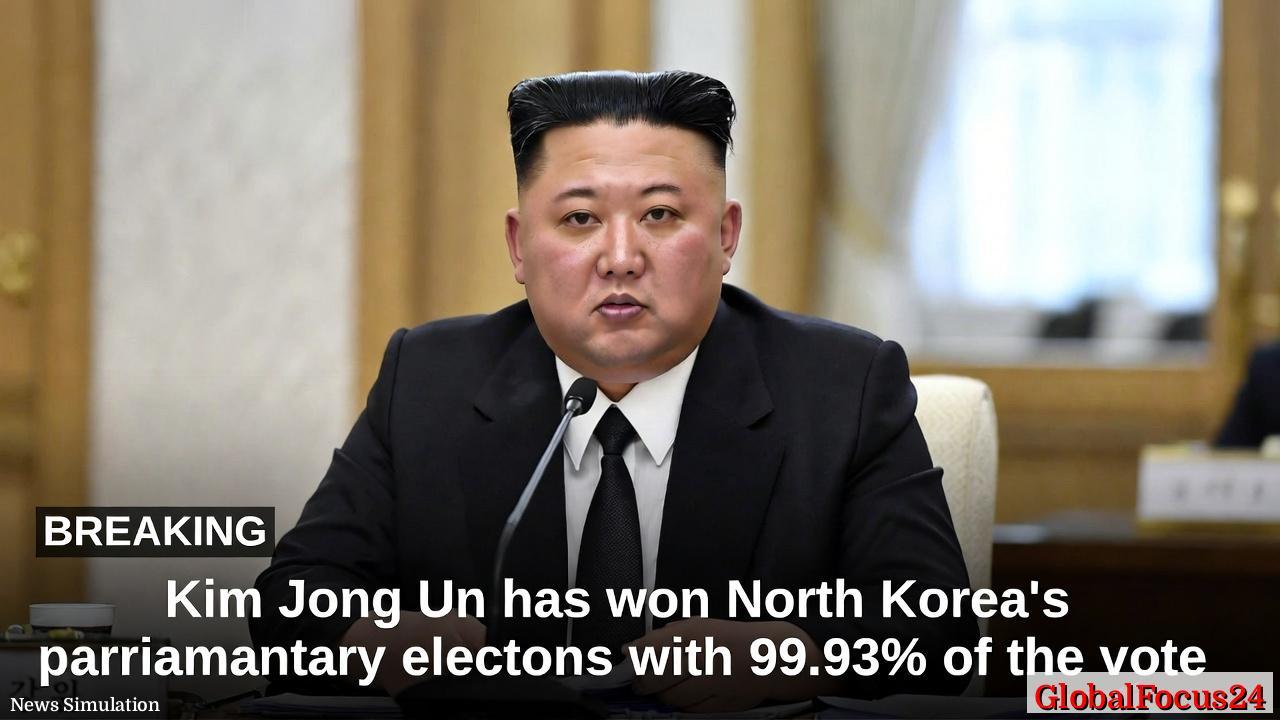
Kim Jong Un Wins North Korean Parliamentary Elections With 99.93 Percent of Vote
North Korean leader Kim Jong Un has secured an overwhelming victory in his nation’s parliamentary elections, winning 99.93 percent of the vote, according to official results released this week. The outcome, which aligns with the country’s long-standing pattern of near-total election turnout and support, reaffirms Kim’s unchallenged control over the Supreme People’s Assembly (SPA), North Korea’s highest legislative body.
A Controlled Election System
The elections to the Supreme People’s Assembly occur every five years and serve as a symbolic reaffirmation of the ruling party’s authority rather than a competitive democratic process. In North Korea, voters are presented with a single approved candidate for each constituency, typically preselected by the ruling Workers’ Party of Korea (WPK). Casting a “no” vote is legally permitted but rare, given the social and political pressures surrounding the event.
State media celebrated the election as a display of “unity between the people and their leader,” emphasizing record-high voter participation across the nation’s provinces. Reports described residents arriving at polling stations in celebratory parades, dressed in traditional Korean attire, and pledging loyalty to Kim Jong Un and the socialist system.
International observers, however, note that the elections serve more as political reaffirmations than as vehicles for policy direction or public input. Independent verification of the results is impossible, as foreign media and observers are not permitted to monitor the voting or counting processes.
Historical Continuity and Political Symbolism
Such election outcomes are deeply rooted in North Korean political practice. Since the country’s founding in 1948 under Kim Il Sung, the first Supreme People’s Assembly elections have followed similar patterns of near-unanimous approval. Kim Jong Il, who succeeded his father, presided over equally lopsided outcomes throughout his decades in power.
The practice underscores the system’s focus on symbolic legitimacy. The overwhelming vote share reflects what North Korean authorities frame as popular solidarity against external pressures, particularly from the United States and South Korea. Inside the country, electoral participation is promoted as an act of patriotism, reinforcing the narrative of unity under the Supreme Leader’s guidance.
Kim Jong Un’s latest victory follows this tradition, coming at a time when the regime faces growing economic challenges and heightened regional tensions. Analysts suggest that the near-total result is designed to project confidence and control, reinforcing the message that domestic support remains unwavering despite external isolation.
The Economic Context
Kim’s latest parliamentary mandate arrives amid a gradual but precarious economic situation. Years of international sanctions imposed over North Korea’s nuclear and missile programs have restricted trade and foreign currency inflows. The closing of borders during the COVID-19 pandemic further strained the economy, cutting off vital sources of imports and humanitarian aid.
In recent months, Pyongyang has cautiously reopened select trade routes with China, its primary ally and economic lifeline. Satellite imagery has shown an uptick in activity at key border crossings, but analysts note that the flow of goods remains limited compared to pre-pandemic levels. Persistent food shortages and limited access to fertilizer and machinery continue to affect agricultural productivity, with the United Nations estimating that millions remain undernourished.
The new Supreme People’s Assembly—expected to convene its first session in the coming weeks—faces the complex task of addressing both economic recovery and technological development goals outlined in Kim’s five-year plan. That plan prioritizes domestic industrial production, energy independence, and modernization of the defense industry, though progress has been constrained by limited resources and ongoing sanctions.
Regional and Global Implications
The timing of the North Korean elections holds symbolic value for the broader region. The Korean Peninsula remains one of the most militarized areas in the world, and Pyongyang’s political messaging often aligns with its strategic posturing. In the months leading up to the vote, North Korea conducted a series of missile tests, including several long-range and tactical weapons demonstrations that drew international concern.
Kim’s renewed mandate could further solidify his stance on national defense, emphasizing continued weapons development as a means of ensuring sovereignty. Officials in Seoul and Washington have closely monitored these moves, interpreting them as signs of North Korea’s intent to maintain deterrence rather than engage in new diplomatic negotiations.
Comparatively, other tightly controlled systems, such as China’s National People’s Congress or Vietnam’s National Assembly, also emphasize consistency and unity. However, unlike those nations, which have implemented gradual economic reforms and opened limited space for local governance, North Korea’s parliamentary process remains rigidly centralized. Decision-making power rests almost entirely with Kim Jong Un and the inner circle of the Workers’ Party, rendering the legislative assembly more of a formal ratification body than a deliberative institution.
The Supreme People’s Assembly: Function and Form
The Supreme People’s Assembly, established shortly after World War II, theoretically serves as the legislative branch of government. It is responsible for approving national budgets, passing laws, and appointing key government officials. In practice, however, the body functions primarily to endorse policies already set by the WPK leadership. Delegates typically meet only once or twice a year for highly choreographed sessions broadcast by state media.
These sessions often highlight major policy themes—such as advancements in science, defense, or rural development—and provide a stage for Kim Jong Un to deliver speeches outlining future directives. The assembly’s overwhelming endorsement of government initiatives is framed domestically as proof of collective consensus rather than an absence of debate.
The latest election reinforces this structure. The newly elected delegates include party officials, military figures, scientists, artists, and labor representatives, reflecting North Korea’s emphasis on unity across sectors of society. Yet each of these categories functions primarily as a symbolic constituency within the framework of Kim’s authority.
Domestic Reaction and Media Coverage
Inside North Korea, state-run outlets described widespread public enthusiasm and participation. Propaganda broadcasts showed citizens lining up early at polling stations, waving national flags and portraits of the ruling Kim family. Reports highlighted record voter turnout, citing “near-universal” participation, although figures such as 99.97 percent turnout have been standard in previous elections.
Ordinary citizens interviewed by domestic media expressed gratitude toward the leadership and pledged to advance socialist construction goals. Such coverage reinforces the narrative that political participation is an expression of loyalty rather than choice.
Despite the celebratory tone within the country, international media and human rights organizations continued to describe the event as a “non-competitive symbolic affirmation.” Without access for foreign journalists or observers, the internal mechanics of the vote counting process remain opaque.
The Broader Message to the World
The election results send a clear message both domestically and internationally: the leadership remains unshaken. As North Korea faces sustained economic sanctions and growing military pressure, the projection of internal stability serves as a cornerstone of regime survival.
For Pyongyang, the optics of unity and near-universal approval carry strategic weight. The regime often contrasts its “cohesive society” with what it depicts as “chaos and divisions” in liberal democracies. This comparison, though rooted in propaganda, serves to bolster internal morale and justify centralized control.
For regional neighbors, the election reaffirms expectations that North Korea’s domestic policy trajectory will remain unchanged. Efforts to reopen dialogue on denuclearization or humanitarian cooperation may face additional challenges in the wake of such a resounding confirmation of leadership.
Looking Ahead
With the election concluded, attention now shifts to the forthcoming assembly session, where Kim Jong Un is likely to outline the government’s priorities for the year. Focus areas are expected to include industrial modernization, defense advancements, agricultural resilience, and the continued pursuit of self-reliance, known domestically as the juche principle.
Observers anticipate that the leadership may use the new mandate to tighten ideological control, ramp up infrastructure projects, and continue refining domestic propaganda campaigns celebrating national independence and technological achievement.
While the precise policy changes that may result are difficult to predict, the overarching narrative remains constant. The near-perfect election outcome underscores a political system built on absolute authority and continuity—a hallmark of North Korea’s governance since its inception.
Conclusion
Kim Jong Un’s 99.93 percent victory in the 2026 Supreme People’s Assembly elections stands as both a political ritual and a display of state power. Within North Korea, it reinforces the image of national unity and resilience. Beyond its borders, it signals the persistence of a regime that continues to prioritize centralized control, strategic autonomy, and ideological conformity above all else.
As the world watches for signs of change on the Korean Peninsula, the outcome of these elections suggests one clear message: the status quo, at least for now, remains firmly in place.