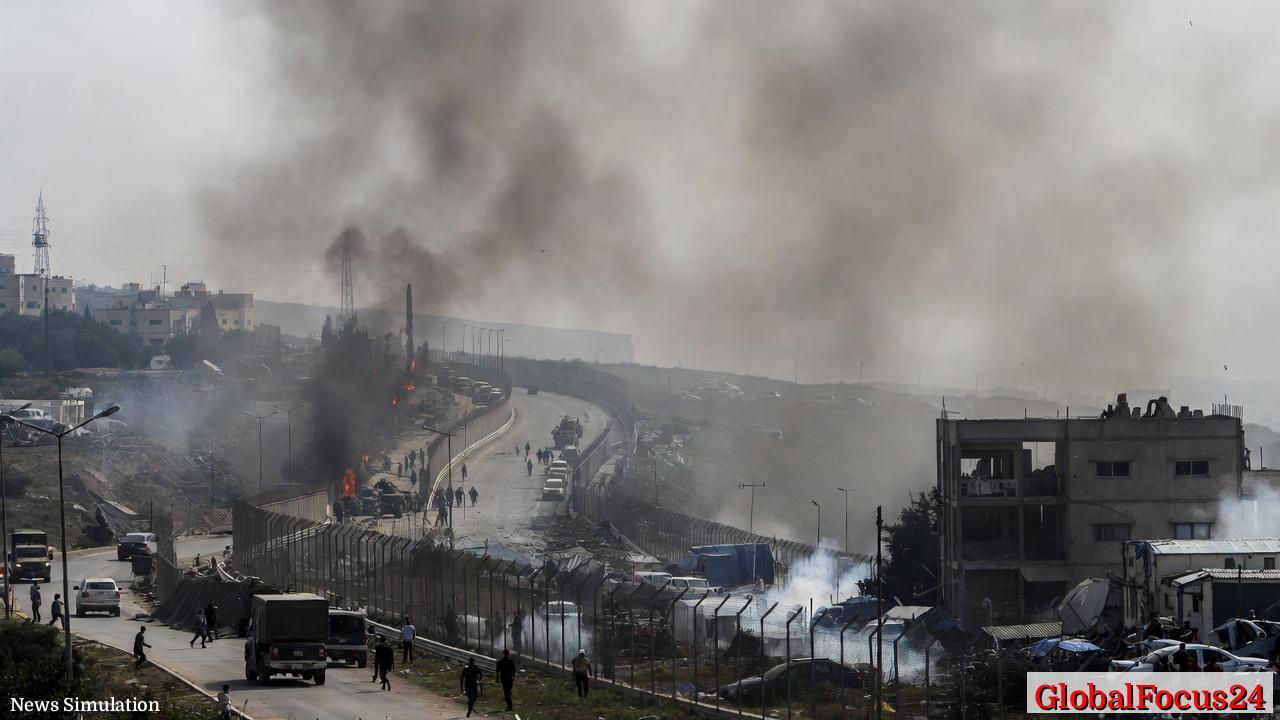
Israel Reportedly Weighing Broader Ground Invasion Against Hizbullah as Border Tensions Escalate
Rising Tensions Along the Northern Border
Israeli defense officials are reportedly deliberating the possibility of launching a broader ground invasion into southern Lebanon in response to mounting clashes with Hizbullah. The Iran-backed militant organization has intensified rocket attacks and cross-border raids in recent weeks, prompting high-level discussions within Israel’s political and military leadership over how to break the group’s operational capabilities.
The latest flare-up along the Israeli-Lebanese border follows months of low-intensity exchanges that have steadily expanded in range and scale. Air strikes, artillery shelling, and cross-border rocket fire have become near-daily occurrences, heightening concerns of a wider war that could destabilize the region. Commanders in the Israel Defense Forces (IDF) reportedly believe that the current window offers the most favorable conditions in years to deliver a decisive blow to Hizbullah’s entrenched military infrastructure.
Officials argue that limited air strikes and targeted raids are unlikely to dismantle the group’s dense network of fortified positions, underground tunnels, and missile launch sites scattered across southern Lebanon. Instead, military planners are evaluating whether a deeper ground incursion, potentially involving multiple divisions, could more effectively degrade Hizbullah’s leadership and logistical chain.
Historical Context of the Israel–Hizbullah Confrontation
The tension between Israel and Hizbullah traces back decades, rooted in the aftermath of Israel’s 1982 invasion of Lebanon during its campaign against Palestinian militants. Hizbullah, emerging from the chaos of Lebanon’s civil war, gained strength through Iranian funding and training, presenting itself as a resistance movement against Israeli occupation.
Following Israel’s withdrawal from southern Lebanon in 2000, Hizbullah claimed victory, using its expanding influence to entrench itself politically and militarily within Lebanon. The 2006 war marked the last major confrontation between the two sides—a 34-day conflict that left more than a thousand people dead, mostly Lebanese civilians, and caused widespread destruction in Beirut and beyond. Despite taking heavy losses, Hizbullah’s survival and subsequent rearmament were seen as a symbolic victory that reshaped the strategic landscape in the region.
Since then, the group has reportedly stockpiled an arsenal estimated at more than 100,000 rockets and missiles of varying ranges, including precision-guided munitions capable of reaching deep into Israeli territory. Its battlefield experience gained during the Syrian civil war has further strengthened its combat capabilities, making any potential Israeli ground operation a formidable challenge.
Strategic Calculations in Jerusalem
Amid escalating border clashes, Israeli security circles are deliberating how to balance the objectives of deterrence and destruction. Air campaigns in recent months have targeted suspected Hizbullah arms depots, command facilities, and convoy routes supplying weapons from Iran through Syria into Lebanon. Yet intelligence assessments suggest that air power alone is insufficient to eliminate the threat posed by Hizbullah’s expansive underground infrastructure.
A ground invasion would represent a significant escalation and carry heavy military and political risks. Israeli defense officials reportedly believe that a carefully timed, multi-pronged incursion could accomplish what air strikes cannot—disrupt command nodes, destroy key weapons caches, and physically dismantle tunnel networks that allow Hizbullah fighters to move undetected.
Still, planners recognize that such an operation could lead to protracted fighting in challenging terrain. Southern Lebanon’s villages, hills, and valleys favor defenders familiar with the landscape, and Hizbullah’s use of civilian areas as shields would complicate efforts to minimize collateral damage. Any significant escalation would likely draw international scrutiny and pressure for restraint.
Civilian Impact and Humanitarian Concerns
In Lebanon’s southern border communities, the atmosphere is one of deep unease. Many residents who remember the devastation of the 2006 war have already fled northward, fearing that renewed hostilities could mirror—or even exceed—the past conflict’s scale. Displacement figures are rising, with local aid organizations reporting growing shortages of food, fuel, and medical supplies in areas cut off by shelling.
For those who remain, life has largely moved underground. Basements and makeshift shelters provide tenuous protection from air raids and artillery strikes. Schools, hospitals, and infrastructure in several towns have sustained damage amid the escalating exchanges.
On the Israeli side, border towns have also faced repeated rocket fire, prompting evacuations and emergency declarations. Local authorities have reinforced shelters and prepared contingency plans for mass displacement should a full-scale conflict erupt. The Israeli government has emphasized the need to protect civilians while maintaining operational secrecy about ongoing military preparations.
Regional Reactions and International Watchfulness
The prospect of a renewed Israeli ground invasion into Lebanon has triggered concern across the Middle East and among Western capitals. Iran, Hizbullah’s primary patron, has warned that any broad offensive would provoke a “regional response,” though analysts doubt Tehran seeks direct confrontation. Still, Iranian-linked militias in Iraq and Syria have stepped up symbolic attacks on U.S. and allied assets, signaling the potential for wider escalation.
The United States and several European nations have publicly urged restraint, emphasizing the need to prevent a repeat of large-scale hostilities that could destabilize already fragile parts of the region. Diplomatic envoys have been shuttling between Jerusalem, Beirut, and Washington, attempting to defuse tensions before they spiral out of control.
In Beirut, Lebanon’s interim government faces immense pressure to avoid becoming dragged into another destructive war. Economic recovery efforts from years of political paralysis and financial collapse would collapse should fighting spread northward. Lebanese officials have condemned both Hizbullah’s provocations and Israel’s retaliatory strikes but wield little authority over the powerful militia, which operates independently of the state’s command.
Economic Costs and Risk of Regional Disruption
A renewed war between Israel and Hizbullah would likely impose steep economic costs on both sides, reverberating across the wider region. For Israel, the last major war in 2006 cost an estimated several billion dollars in military expenditure and damage to northern cities and towns. Another large-scale operation could strain the country’s economy at a time when global markets remain volatile and defense budgets are already stretched by ongoing operations elsewhere.
In Lebanon, any escalation would be catastrophic for an economy still reeling from financial collapse, currency devaluation, and widespread poverty. Key sectors, including tourism and agriculture, would suffer immediate setbacks, while reconstruction costs could dwarf the country’s already unsustainable debt burden.
Neighboring economies, especially in Jordan and Cyprus, fear spillover effects on trade and energy infrastructure. Maritime shipping routes in the eastern Mediterranean could face disruptions if hostilities spread to coastal areas or ports. Foreign investors and insurers are already voicing concerns about regional stability, with energy markets reacting cautiously to the rising threat of conflict near major gas extraction zones.
Comparing Regional Military Strategies
Israel’s current strategic debate mirrors similar calculations undertaken by regional powers when confronting entrenched non-state actors. Over the past two decades, conflicts in Syria, Iraq, and Yemen have illustrated the limited effectiveness of air campaigns against deeply embedded militias. In each case, long-term ground operations proved essential to securing territory and destroying tunnel systems and weapons caches.
Israeli commanders are drawing lessons from those theaters, acknowledging the tactical necessity—but also the dangers—of fighting in civilian-heavy areas where guerrilla tactics negate conventional advantages. Hizbullah’s hybrid warfare model, combining conventional weaponry with asymmetric strategies, continues to set it apart from other militant groups in the region.
This evolving military reality means that any future Israeli ground offensive would not resemble the conventional invasions of past decades. Instead, it would likely consist of targeted, adaptable maneuver operations designed to fragment Hizbullah’s command network without becoming bogged down in long-term occupation.
Prospects for De-Escalation
Despite preparations for possible escalation, diplomatic channels remain open. International mediators, including the United Nations Interim Force in Lebanon (UNIFIL), continue efforts to maintain communication between both sides of the border. Analysts caution that a miscalculation—a rocket hitting deeper into Israeli population centers or an Israeli strike causing mass civilian casualties—could rapidly ignite a conflict neither side truly seeks.
The coming weeks may prove decisive. If deterrence fails and border clashes continue to intensify, Israel may judge that only direct ground intervention can meaningfully reduce the long-term threat from Hizbullah. Yet such a decision would carry enormous costs and uncertainty, both militarily and politically, within a region already brimming with volatility.
For now, southern Lebanon and northern Israel remain on edge, braced for the possibility that the uneasy border—a front line of hostility for over four decades—could once again become the center of the Middle East’s next major war.