Iran’s Expanding Missile Reach Raises Alarms Across Europe
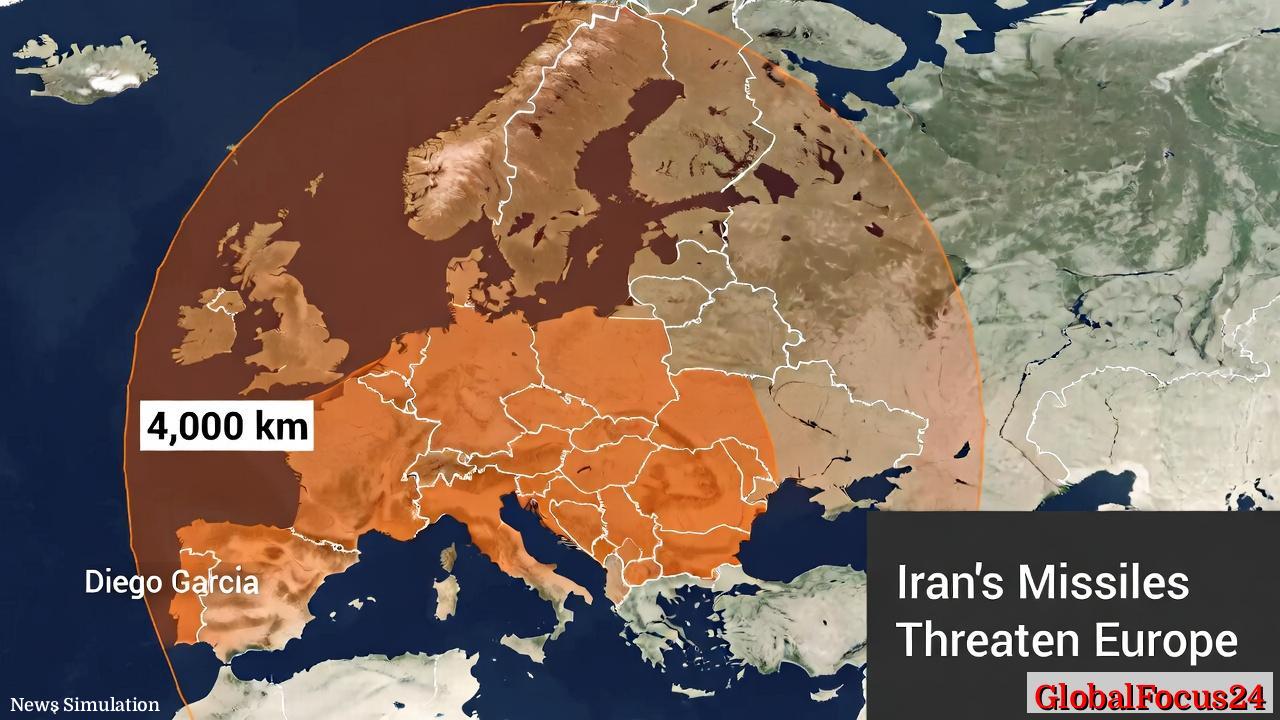
Iran’s latest missile test has drastically shifted perceptions of the country’s long-range strike capability. Following an attempted attack on the Diego Garcia naval base in the Indian Ocean, analysts now believe Iran possesses missiles capable of reaching nearly the entire European continent — with Portugal emerging as the only country likely beyond their current operational range. The test, though unsuccessful in hitting its target, demonstrated a flight distance of roughly 4,000 kilometers, nearly double previous estimates of Iran’s missile range.
A Dramatic Expansion of Capability
Until recently, experts widely agreed that Iran’s ballistic missile arsenal maxed out at about 2,000 kilometers, encompassing targets across the Middle East, parts of Eastern Europe, and sections of South Asia. The attempted strike on Diego Garcia — a remote but strategically vital U.S. military base located far south of India — represents a leap not only in range but also in strategic ambition.
Even though the missile did not reach its intended target, its travel distance alone marks a milestone. At approximately 4,000 kilometers, this new capability positions Tehran alongside a small number of nations able to project missile power at the intercontinental level. Defense analysts say that if this data holds, much of Europe — from Rome to Warsaw to Stockholm — could lie within reach of Iranian missile fire.
Europe on the Edge of Range
With a range approaching 4,000 kilometers, virtually all of mainland Europe would be theoretically vulnerable to Iranian missiles except for Portugal, the westernmost point of the continent. Spain’s eastern coast, France, Germany, and the majority of Scandinavia all fall within the projected reach.
This development is particularly unsettling to European security planners. It represents a potential transformation of Iran from a regional military power into one capable of influencing or threatening targets far beyond its neighborhood. Analysts note that the new range has implications not only for NATO defense planning but also for European Union policy concerning sanctions, arms control, and international security cooperation.
While Iran has not officially confirmed the full technical specifications of the missile involved in the attempted Diego Garcia strike, independent defense experts believe it likely represents an evolution of the country’s Khorramshahr or Sejjil missile systems. These are solid-fuel and liquid-fuel medium-range ballistic missiles that Iran has spent years improving in both accuracy and durability.
Historical Context: From Defense to Deterrence
Iran’s missile program dates back to the 1980–1988 Iran-Iraq War, during which Iraqi ballistic missile attacks on Iranian cities exposed Tehran’s vulnerability. With international arms restrictions limiting its access to advanced weaponry, Iran embarked on a decades-long effort to develop its indigenous missile capability. Initially viewed as a defensive necessity, the program gradually evolved into a key pillar of Iran’s deterrence strategy.
Over the years, Iran has made significant progress. By the 2000s, its arsenal included the Shahab series, with ranges surpassing 1,000 kilometers. In the 2010s, the Sejjil and Ghadr missiles extended those distances, while advancements in guidance systems improved accuracy. But each of these developments still fell below the 2,000-kilometer mark — a threshold Tehran itself once claimed would be its limit.
This self-imposed cap, some analysts believe, was meant to reassure Europe that Iranian missiles were not intended for distant targets beyond the Middle East. The latest test, however, effectively dismantles that assurance and suggests a clear broadening of strategic horizons.
Technical Advances and Strategic Signals
Ballistic missile range depends on several factors — propulsion, payload mass, guidance systems, and trajectory design. The leap from 2,000 to 4,000 kilometers marks a profound engineering achievement, implying advances in fuel efficiency, stage separation, and materials science.
Experts speculate that Iran’s engineers may have adapted a two-stage or even three-stage design, possibly using composite materials to reduce weight and increase speed. Some reports indicate the use of new solid-fuel technologies that shorten launch preparation times, making detection more difficult for adversaries.
Beyond the technical realm, the test also sends a political signal. Iran’s choice of target — Diego Garcia — is symbolic. The island has long served as a forward base for U.S. bombers and surveillance aircraft, representing the projection of American power deep into the Indian Ocean. By attempting to strike it, Tehran demonstrated both capability and intent: a willingness to strike far beyond its traditional theater if it perceives a threat.
Economic and Geopolitical Implications
This expansion of missile range could reshape Iran’s position in global security calculations. For Europe, the risk assessment changes dramatically. A longer-range Iran means greater urgency in developing and coordinating continental missile defenses. NATO’s existing systems — such as the Aegis Ashore sites in Romania and Poland — may now face pressure to enhance their coverage and incorporate additional layers of protection.
Economically, the repercussions may be equally significant. Defense budgets across Europe, particularly in nations east of France, have been rising since 2022 amid renewed geopolitical tensions. This new development will almost certainly fuel further spending. For missile defense contractors and aerospace industries, the demand for radar systems, interceptors, and early-warning technologies is expected to surge.
For Iran, these advancements may serve as leverage in future diplomatic engagements. The country has long used its missile program as both a deterrent and a bargaining tool, particularly under the weight of Western sanctions. Demonstrating the ability to reach European targets bolsters Iran’s posture in any prospective negotiations over nuclear or defense issues.
Yet, such progress comes with economic costs. Developing, testing, and deploying long-range ballistic missiles requires vast industrial and financial resources. Iran’s domestic economy, strained by inflation and limited oil exports under sanctions, could feel pressure if military spending continues to rise.
Regional Comparisons and Strategic Balance
In the broader regional context, Iran’s demonstrated capability brings it closer to the technological tier of countries like India, Israel, and Pakistan — nations that already field medium-to-intercontinental ballistic missiles. For comparison, Israel’s Jericho III reportedly has a range exceeding 4,800 kilometers, while Pakistan’s Shaheen-III is estimated at around 2,750 kilometers.
Iran’s achievement narrows this gap and redefines the security balance in the broader Middle East and Central Asia. It potentially presents new challenges for Arab Gulf neighbors, who already face shorter-range missile threats from Iran and its regional proxies.
Meanwhile, European powers with military assets in the Middle East — including France and the United Kingdom — must now factor in the possibility of missile strikes reaching bases or ships stationed far from Iran’s borders.
Public and Diplomatic Reactions
In Tehran, domestic media outlets have framed the test as a sign of national strength and technological independence. Officials praised the missile’s reach as a “defensive achievement” that underscores Iran’s ability to deter external threats. Internationally, however, the reaction has been markedly different.
European governments have expressed concern, calling the development “destabilizing” and urging restraint. Defense ministries across the continent have convened emergency assessments to evaluate potential adjustments to air-defense systems and strategic partnerships.
The United States and key Asian allies have also monitored the situation closely. Diego Garcia hosts one of the largest U.S. logistics and bomber facilities outside the mainland, serving as a linchpin in Indo-Pacific operations. While Iranian missiles failed to strike the island this time, defense experts note that mere capability changes the calculus of deterrence and escalation for all parties involved.
A New Era in Iranian Missile Policy
This latest test marks not just a technical milestone but a new phase in Iran’s evolving defense strategy. If confirmed, the ability to reach nearly all of Europe signals Tehran’s entry into a domain once reserved for nuclear-armed states and global powers.
The world’s response — whether through diplomacy, deterrence, or defense — will determine whether this leap becomes a destabilizing flashpoint or a stepping stone toward new security arrangements. What is clear is that Iran’s missile trajectory, both literal and political, is now far longer than ever before.