Iranian Missile Strikes Disrupt Gulf Energy Infrastructure, Threatening Global Supply Stability
Widespread Damage to Strategic Energy Assets
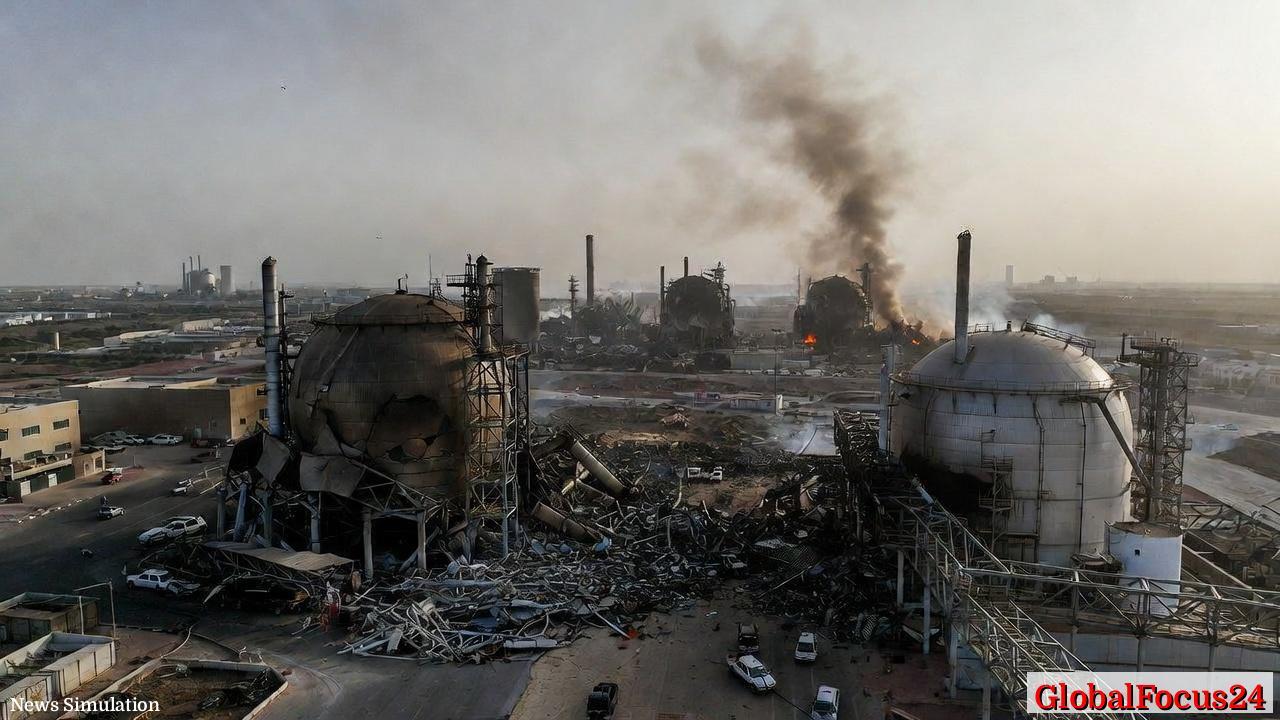
A series of coordinated Iranian missile strikes has severely disrupted major oil and gas facilities across the Gulf region, hitting targets in Qatar, Saudi Arabia, the United Arab Emirates, and Kuwait. The attacks, carried out amid escalating regional warfare involving the United States and Israel, have inflicted significant damage on some of the world’s most valuable energy assets, threatening to reshape global energy trade and drive up prices for months or even years to come.
Among the hardest-hit sites is Qatar’s Pearl gas-to-liquids facility, one of the largest of its kind globally, operated by Shell. The plant sustained critical damage, knocking out one of its two production trains. According to industry officials, full restoration could take a year or more. The nearby Ras Laffan Industrial City, home to the world’s largest liquefied natural gas (LNG) complex, was also struck, disrupting export operations. QatarEnergy, the state-owned company, estimates annual revenue losses of up to $20 billion from the facility alone.
Ripple Effects on Global LNG Markets
The Gulf region supplies nearly one-third of the world’s LNG, and the sudden disruption to Qatari output has sent shockwaves through global markets. QatarEnergy has declared force majeure on long-term supply contracts with key buyers in China, South Korea, Italy, and Belgium, effectively suspending deliveries due to circumstances beyond its control.
Energy analysts warn that the loss of Qatari shipments could reorder global LNG flows. Asian buyers are scrambling to secure additional cargoes from Australia, the United States, and Nigeria, driving up spot market prices. In Europe, where gas storage levels remain below seasonal averages after the winter months, concerns over supply shortages have revived anxiety about energy security.
In financial markets, benchmark Brent crude prices surged above $120 per barrel, while European gas futures spiked nearly 40% in early trading. The turmoil underscores the Gulf’s central role in maintaining global energy supply balance—and how geopolitical shocks in the region can instantly reverberate worldwide.
Strikes Across the Gulf
Beyond Qatar, Iranian projectiles reportedly targeted oil export terminals along Saudi Arabia’s Eastern Province, hitting facilities near Jubail and Ras Tanura. While Saudi Aramco has not released official damage assessments, shipping data indicates temporary port closures and delayed crude loadings. In the United Arab Emirates, missile impacts near Fujairah disrupted storage and transshipment operations, a key logistical hub for global petroleum trade.
Kuwait also reported damage to refining units at Mina Al-Ahmadi, though authorities emphasized that emergency response teams had contained fires and stabilized operations within hours. The coordinated nature of the strikes suggests strategic intent to disrupt both upstream production and downstream export channels.
Historical Context of Energy Tensions
Tensions between Iran and Gulf energy producers have a long historical lineage. Since the 1980s, attacks on oil infrastructure have often coincided with broader military confrontations in the Middle East. During the Iran-Iraq War, the so‑called “Tanker War” saw dozens of strikes on oil-laden vessels transiting Gulf waters. More recently, the 2019 drone assaults on Saudi Aramco’s Abqaiq processing facility temporarily cut off 5% of global crude output, highlighting the vulnerability of centralized energy infrastructure.
The current escalation, however, marks a more expansive and sophisticated wave of strikes, reaching deep into multiple national territories. Defense analysts note that the use of ballistic and long-range precision missiles greatly increases the strategic impact compared to earlier incidents.
Economic Repercussions for the Gulf
For Gulf economies, the immediate impact is stark. Qatar, which has built its extraordinary wealth on LNG exports, faces both operational and reputational challenges. Shell and Exxon Mobil—its top international partners—stand to lose billions in revenue annually, while repair work and insurance claims mount. The outage could delay QatarEnergy’s ambitious North Field expansion projects, a multi‑billion‑dollar effort designed to boost LNG output by 2027.
In Saudi Arabia and the UAE, short-term production losses are less severe, but investors are closely monitoring insurance premiums, security costs, and the potential for further escalation. Ratings agencies have already flagged possible credit outlook revisions for state-owned energy firms, citing heightened geopolitical risk.
The Gulf Cooperation Council’s financial stability could also come under pressure if oil revenues dip amid infrastructure repairs. Governments may draw on sovereign wealth funds to cushion against lost income, but prolonged disruptions would erode fiscal balances and deter foreign investment in new energy ventures.
Global Energy Trade in Flux
Internationally, the strikes threaten to reorder trade patterns developed over decades. For Europe, already navigating an energy transition away from Russian gas, the loss of Qatari volumes reopens vulnerabilities long thought contained after 2022’s energy crisis. Import terminals in Belgium and Italy—key recipients of Qatari LNG—are now operating below capacity, forcing utilities to bid for alternate spot purchases.
Asian economies, particularly China and South Korea, are even more exposed. Both depend heavily on steady Qatari supplies under long-term contracts. Disruptions are likely to push Beijing to deepen its energy ties with Russia and Central Asia, accelerating projects on the Power of Siberia gas pipeline network. Meanwhile, Japan and India have begun exploring emergency reserves and intergovernmental swap arrangements to offset short-term deficits.
For the United States, the crisis presents both risk and opportunity. American LNG exporters—already expanding capacity along the Gulf Coast—stand to benefit from soaring global prices and European demand. Yet Washington also faces pressure to prevent further destabilization in the Gulf, where U.S. military bases play a central role in protecting maritime trade routes.
Partial Price Relief, But Uncertain Outlook
The immediate surge in oil and gas prices has somewhat offset revenue losses for producers still able to operate. Traders describe a global “risk premium” embedded in energy prices, reflecting worries about further attacks or retaliatory strikes. While this temporarily cushions Gulf governments’ finances, the long-term threat of infrastructure vulnerability continues to unsettle markets.
Industry executives note that insurance and security costs will likely rise sharply. Premiums for facilities and maritime cargoes are already climbing, echoing patterns seen after earlier conflicts in the region. Some analysts predict that if tensions persist through the year, global energy prices could remain elevated even if production gradually recovers.
Repair Efforts and Future Resilience
Repairing the damaged facilities will require complex engineering and procurement operations. The Pearl plant’s reconstruction, for example, depends on highly specialized equipment manufactured in Europe and Asia, which may face delays due to shipping bottlenecks or sanctions-related export restrictions.
QatarEnergy officials have indicated that the Ras Laffan complex’s restoration could take between three and five years—a daunting timeline given its scale and technological sophistication. International contractors have been mobilized for preliminary inspections, while temporary production lines are being explored to mitigate losses.
Regional governments are now accelerating plans to decentralize key energy assets, build redundant storage systems, and enhance cyber and aerial defenses. Defense ministries across the Gulf are coordinating with Western partners to bolster anti-missile protection systems around industrial hubs.
Broader Strategic Implications
Beyond the immediate energy and economic toll, the strikes underline the growing overlap between regional security conflicts and global supply chain fragility. The Gulf’s energy systems are deeply intertwined with international markets, and any disruption—intentional or incidental—can have cascading effects that extend far beyond the Middle East.
For global policymakers, the crisis exposes the ongoing tension between energy dependence and geopolitical risk. It reinforces calls in Europe and East Asia to diversify sourcing, invest in renewables, and improve strategic reserves. Yet despite these efforts, fossil fuels from the Gulf remain indispensable to keeping industries, transportation, and power systems running worldwide.
Outlook: Years of Recovery Ahead
The full repair of the Gulf’s damaged energy infrastructure is expected to take years, not months. Industry participants caution that restoring peak output at Ras Laffan and Pearl LNG will require not only rebuilding physical systems but also re-certifying safety standards and renegotiating long-term contracts disrupted by force majeure declarations.
As reconstruction begins under heightened security, global energy markets will continue to absorb the shockwaves. While prices may stabilize once emergency reserves and alternative supply lines expand, the perception of vulnerability will linger. For investors, insurers, and governments alike, the Iranian missile campaign serves as a sharp reminder that the Gulf’s vast energy wealth remains tethered to a volatile geopolitical landscape—where a single barrage can alter the balance of global energy security overnight.