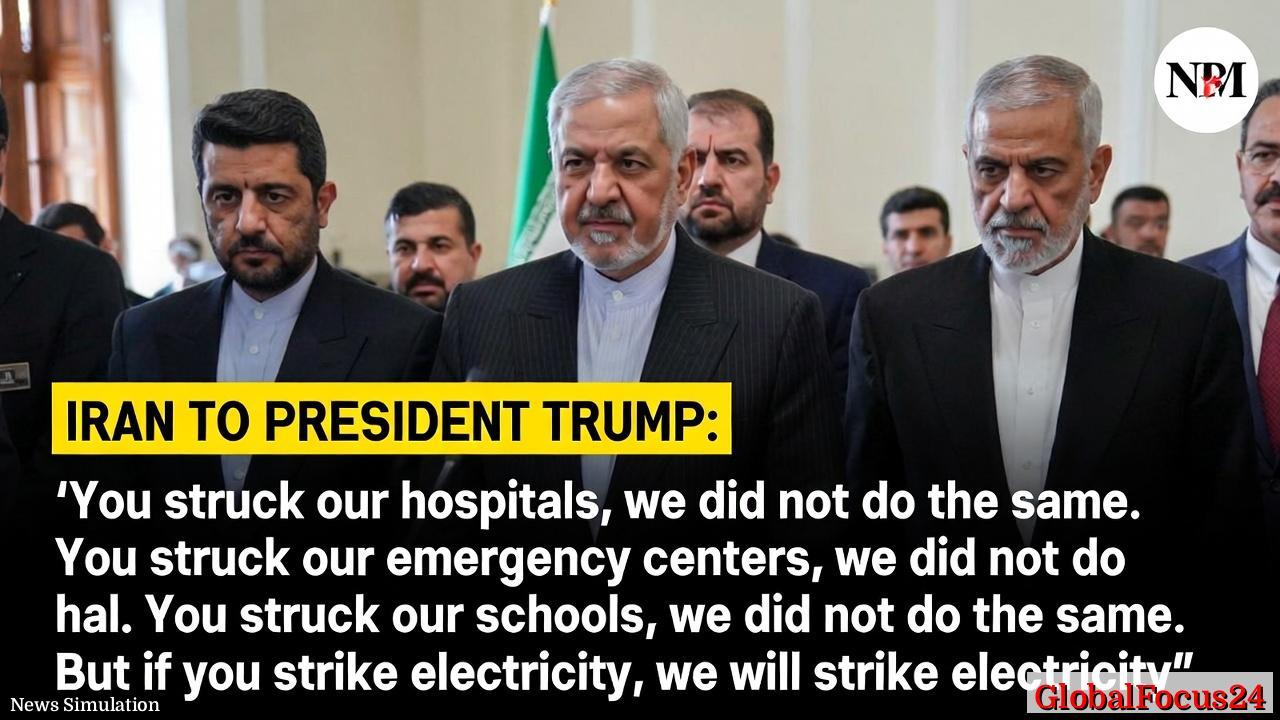
Iran Issues Warning to President Trump on Potential Strikes Against Electricity Infrastructure
Tehran has issued a stark warning to former U.S. President Donald Trump, drawing a clear line over potential attacks on civilian electricity infrastructure. The statement, released through Iranian state-affiliated channels, declared that while Iran has refrained from targeting civilian sectors despite recent escalations, it will respond directly and proportionally if its power grid or energy systems are attacked. The message underscores the rising tension between Washington and Tehran, signaling that both nations are testing the boundaries of conventional warfare, cyber operations, and deterrence strategies in a period of heightened volatility across the Middle East.
Growing Tensions Amid Ongoing Conflict
The statement—translated and circulated widely on Middle Eastern media—reads: “You struck our hospitals, we did not do the same. You struck our emergency centers, we did not do the same. You struck our schools, we did not do the same. But if you strike electricity, we will strike electricity.” This language evokes both a warning and a moral justification for retaliation, suggesting Tehran seeks to maintain a deterrent posture while avoiding a direct descent into unrestricted warfare.
In recent months, Iran has faced escalating confrontation in multiple regional arenas, notably Iraq, Syria, and the Persian Gulf, amid renewed hostilities involving U.S.-aligned forces. Analysts see this latest rhetoric not as an abrupt shift, but as a continuation of Iran’s longstanding strategy: to communicate limits on acceptable wartime conduct while asserting its own capacity to retaliate in kind. By naming electricity infrastructure specifically, Iran is signaling that such an escalation would cross a line that directly affects civilian life and the basic functioning of its cities and industries.
Historical Context of Infrastructure as a Red Line
Throughout modern warfare, electricity networks have represented a critical vulnerability. From NATO’s interventions in the Balkans during the 1990s to the U.S.-led campaigns in Iraq in 1991 and 2003, power grids were often targeted early in conflict to disrupt communications, water systems, and industrial production. For Iran, the memory of infrastructure strikes dates back to the Iran-Iraq War (1980–1988), when key refineries and power plants were repeatedly bombed, causing widespread blackouts and humanitarian strain.
That historical trauma continues to shape Iranian defense rhetoric. The current warning to the U.S. is rooted not only in strategic deterrence but in the symbolic weight the Iranian government places on preserving public systems that sustain everyday life. Civilian electricity facilities are also central to Iran’s technological and economic resilience, making them a red line that merges military calculus with domestic legitimacy.
Economic Stakes of Power Grid Vulnerability
Iran’s energy infrastructure is among the most developed in the Middle East, although it faces chronic pressure from sanctions, aging facilities, and cyber threats. The country’s electricity network powers its petrochemical complexes, steel plants, and residential grids that together account for roughly 3 percent of global electricity consumption. Disruption to this network would have devastating economic consequences, both for Iran’s internal stability and for regional energy markets.
Power shortages could cripple industrial exports, limit refining capacity, and disrupt the functioning of water desalination systems that support cities across the arid Iranian plateau. Moreover, in an economy already constrained by international sanctions, the cost of repairing high-voltage substations and rebuilding damaged lines could escalate into billions of dollars, further straining government resources and potentially destabilizing local industries reliant on consistent supply.
The Cyber Dimension: A Growing Battleground
Iran’s reference to “striking electricity” may not solely pertain to physical attacks. Over the past decade, both Western and Iranian cyber units have engaged in covert operations targeting power systems. The Stuxnet worm, discovered in 2010, famously sabotaged Iranian nuclear centrifuges through digital intrusion—an event that redefined modern cyberwarfare. Since then, Tehran has invested heavily in strengthening its cyber capabilities, developing defensive firewalls and offensive units under the Islamic Revolutionary Guard Corps (IRGC).
In this context, Iran’s warning could imply a willingness to retaliate through cyber means, should its own grid come under digital assault. Potential targets could include regional electricity distribution networks, oil pipelines, or data centers in Gulf Cooperation Council states allied with the United States. Such operations carry the risk of collateral disruption beyond intended military targets, further heightening the stakes of escalation in cyberspace.
International Reactions and Regional Impact
Reactions across the international community have been cautious. European governments have urged de-escalation, emphasizing the humanitarian implications of targeting civilian infrastructure. Gulf states, some of which host U.S. military installations, have quietly reinforced their domestic energy cybersecurity measures. Within Iran, state media have framed the warning as a prudent defense of sovereignty rather than a step toward aggression.
Regional observers note that this rhetorical escalation comes during a period of fragile deterrence. Over the past year, multiple incidents—ranging from drone strikes to tanker sabotage—have underscored how quickly isolated skirmishes can disrupt trade routes and energy supplies through the Strait of Hormuz, one of the world’s key chokepoints for oil and liquefied natural gas transport. If electricity networks are brought into the conflict as targets, economic reverberations could extend far beyond Iran’s borders, potentially inflating energy prices and straining already volatile global markets.
Comparisons With Other Regional Flashpoints
Similar patterns of infrastructure threats have appeared elsewhere in the region. During conflicts in Iraq and Syria, competing factions routinely targeted power stations to weaken local governance or control population centers. Yemen’s civil war has also seen recurrent strikes on power lines and fuel depots, causing prolonged blackouts that compound humanitarian crises. By warning explicitly against such actions, Iran may be positioning itself as upholding wartime restraint—a message intended for both domestic and international audiences.
In contrast, Israel’s recent statements on proportional response have emphasized technological precision and the minimization of collateral damage, reflecting a gradual convergence toward cyber and infrastructure competition rather than outright battlefield confrontation. However, as history shows, proportionality in rhetoric does not always prevent escalation in practice.
The Role of Deterrence in Tehran’s Strategy
Iran’s strategic communications often serve dual functions: signaling restraint to global powers while reinforcing internal narratives of resistance and sovereignty. The current warning fits that pattern. It asserts Iran’s right to defend its critical infrastructure, but frames potential retaliation as conditional—triggered only by U.S. escalation. This calibrated tone suggests Tehran remains aware of the consequences that a spiral of retaliatory strikes could bring, especially given its vulnerability to extended energy disruptions.
From a broader perspective, such warnings can also be seen as part of Iran’s psychological deterrence architecture. Public declarations create uncertainty in foreign decision-making circles, complicating the calculus of any potential U.S. strike planners who must weigh the possibility of symmetrical retaliation.
The Broader Energy and Security Implications
Power infrastructure forms the nervous system of modern economies. Beyond Iran and the U.S., any prolonged disruption could ripple through global supply chains. Oil exporters dependent on regional electrical grids could face operational halts, while investors may reassess risk premiums across the Middle East. The interdependence between energy security and political stability means that even the threat of retaliatory strikes against electricity facilities can move markets and shape diplomatic posture.
Meanwhile, the rise of cyberattacks targeting power grids worldwide—from Ukraine in 2015 to South Africa in 2023—underscores a new vulnerability shared by all technologically advanced states. Iran’s warning, therefore, is not only a reflection of bilateral tension but also a symptom of a broader shift in how nations perceive national security through the lens of energy and information infrastructure.
Looking Ahead
As of late March 2026, no confirmed attacks on Iranian electricity systems have been reported. However, monitoring agencies note an uptick in cyber probing attempts across Iranian and U.S.-linked energy networks. The general mood in Tehran, as reported by local correspondents, is one of wary vigilance rather than panic. Citizens recall previous confrontations, particularly those following the U.S. withdrawal from the nuclear agreement, yet remain accustomed to cycles of high-stakes diplomacy and brinkmanship.
Whether this warning serves as a prelude to further confrontation or successfully deters it will depend on how both sides interpret mutual red lines in the days ahead. For now, Tehran’s message is unambiguous: attacks on hospitals, schools, or emergency centers have not triggered symmetrical retaliation—but energy infrastructure marks the threshold beyond which restraint ends.