U.S. War in Iran Strains Military Readiness Across Asia-Pacific
Mounting Pressure on U.S. Forces
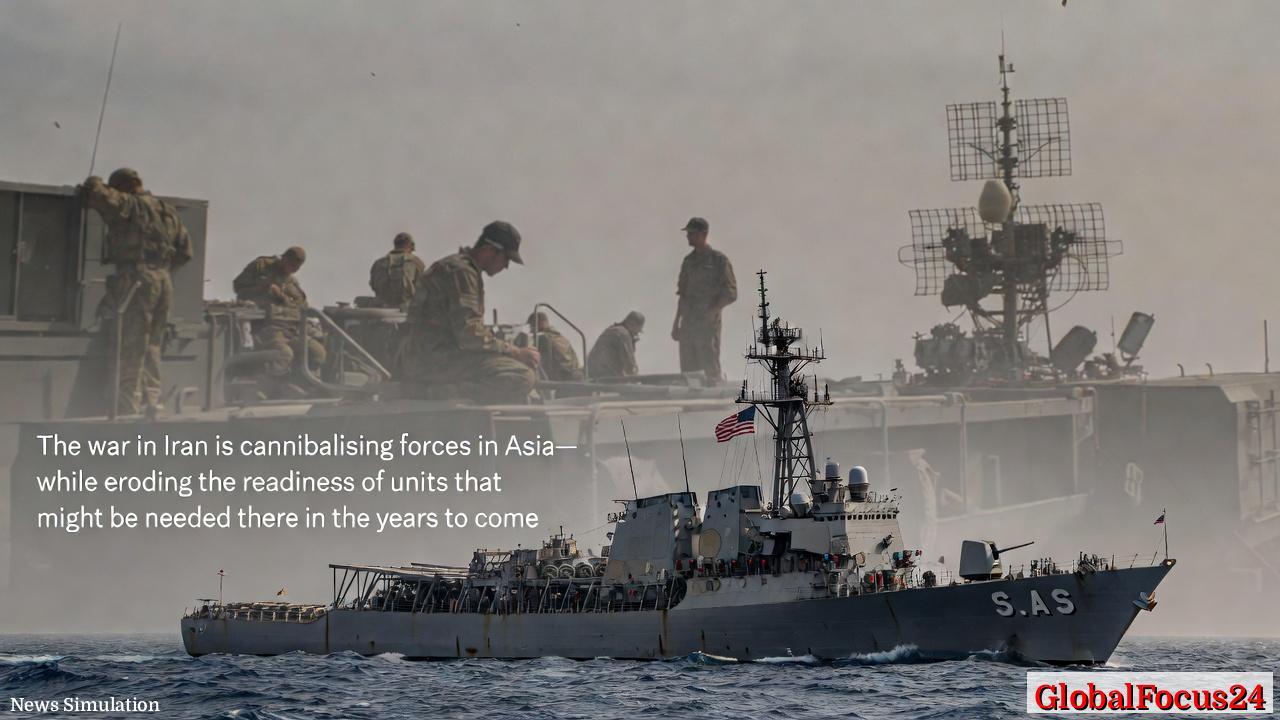
The ongoing American military campaign in Iran has triggered growing concern among defense analysts and regional partners, as critical U.S. military assets are being diverted from Asia to sustain combat operations in the Middle East. The resource-heavy conflict—now extending into its second year—is consuming munitions, manpower, and naval capacity at a rate far exceeding projections, leaving parts of the U.S. Indo-Pacific Command facing reduced readiness levels.
Officials familiar with operational logistics describe a “compounding readiness crisis,” where forces originally postured to deter aggression in the Pacific are now being stretched thin by sustained operations in Iran and its surrounding territories. This redeployment of critical air defense units, carrier strike groups, and logistics aircraft has forced the Pentagon to make difficult trade-offs in global force allocation—decisions that could shape the strategic landscape in Asia for years to come.
Erosion of Combat Readiness and Stockpiles
The most striking consequence of the Iran campaign is the acceleration of weapons depletion. Analysts point to the rapid expenditure of precision-guided munitions, cruise missiles, and air-defense interceptors—key assets that would also be essential in any high-intensity conflict in East Asia. Despite increased production in U.S. factories, supply chain shortfalls and limited manufacturing capacity are slowing replenishment rates.
According to senior defense officials, certain categories of long-range munitions are being produced at less than one-third the rate needed to maintain current consumption levels. This mismatch has forced military planners to ration the use of critical systems and prioritize immediate operations over long-term preparedness. The effects ripple through the force structure: fighter and bomber squadrons now face constrained training hours, naval units encounter delayed maintenance cycles, and reserve munitions stockpiles for Asian contingencies have fallen well below target thresholds.
Historical Patterns of Overstretch
The strain echoes earlier periods in American military history, particularly during the height of operations in Iraq and Afghanistan. Then, as now, the U.S. found itself fighting prolonged conventional and counterinsurgency campaigns while seeking to maintain a global deterrence posture. By 2010, for instance, sustained overseas operations had produced a major backlog in aircraft maintenance, delayed ship refits, and worn-down troop readiness across multiple branches.
Defense scholars note that the U.S. military’s “two-war” doctrine—its long-standing ability to conduct two major simultaneous combat operations—has eroded over time due to budget flattening, manpower caps, and changing geopolitical demands. The war in Iran now brings this limitation into sharp relief. With simultaneous theaters of potential conflict in Eastern Europe, the Middle East, and East Asia, Washington faces the difficult reality that it cannot sustain maximal commitments in all three regions indefinitely.
The Asia-Pacific Impact
The greatest strategic concern lies in the Asia-Pacific, where the U.S. maintains an extensive network of bases, alliances, and forward-deployed forces. For decades, the region has served as the centerpiece of American deterrence policy against an increasingly assertive China and a nuclear-armed North Korea. But with air-defense interceptors, carrier groups, and logistics assets being redirected to the Persian Gulf, key Pacific defenses are being left under-resourced.
Air-defense systems in particular are facing stress. With global demand for interceptors exceeding monthly production, commanders in the Indo-Pacific have been forced to reduce live-fire exercises and limit the availability of advanced surface-to-air missile systems. Similarly, several naval vessels originally slated for rotational deployment to the South China Sea have been reassigned to escort and strike duties in the Arabian Sea. The result is a thinning of presence operations that could embolden rival powers to test U.S. resolve in the region.
Regional partners have taken notice. Japan and South Korea—both reliant on extensive U.S. security guarantees—have initiated independent reviews of their own defense strategies. Australian defense officials have likewise raised concerns about delayed intelligence-sharing and slower joint training schedules. Together, these developments suggest a perceptible if unintended shift in the balance of deterrence in Asia.
Economic and Industrial Constraints
The operational strain coincides with persistent industrial challenges. U.S. defense manufacturers, already under pressure from global supply disruptions and workforce shortages, are struggling to ramp up production of high-demand items like Stinger and Patriot missiles, long-range strike munitions, and naval components. Even with emergency contracts and increased funding allocations, these systems require months—if not years—to produce and deploy.
Economists warn that the dual pressures of wartime expenditure and industrial scarcity risk creating a “defense inflation” effect, where rising costs and procurement delays further erode the ability to replenish key stockpiles. The ripple effects extend well beyond the military sphere. Communities tied to defense supply chains, such as shipbuilding hubs on the Gulf Coast and aerospace manufacturing centers in California and Missouri, are facing unstable workloads and uncertain revenue outlooks.
This domestic strain dovetails with global economic consequences. Shipping routes through the Strait of Hormuz remain volatile due to hostilities, tightening global energy markets. For Asia’s export-driven economies—especially Japan, South Korea, and Singapore—the combination of rising oil prices and reduced maritime security has led to heightened economic anxiety.
Strategic Rebalancing and Possible Responses
Pentagon planners are now reexamining how to restore balance between immediate operational needs and longer-term global deterrence. Several proposals are under consideration, including accelerating the production of certain munitions under the Defense Production Act, repositioning rotational forces back to the Pacific by late next year, and deepening security cooperation with regional allies to offset capability shortfalls.
The U.S. is also exploring increased joint exercises and logistical sharing within the Quadrilateral Security Dialogue (Quad)—comprising the United States, Japan, India, and Australia—to reinforce stability across the Indo-Pacific. Yet these measures may take time to yield results. Analysts caution that rebuilding readiness, particularly for naval and air-defense assets, is a multi-year process requiring consistent political will, stable funding, and industrial alignment.
Lessons from Regional Comparisons
In contrast, regional powers such as China have continued expanding their defense-industrial base with broad state coordination, reducing dependency on imports and shortening production timelines for missiles, drones, and naval platforms. This comparative advantage gives Beijing greater strategic flexibility during protracted crises. By comparison, the U.S. relies heavily on private-sector manufacturers and congressional appropriations cycles, which can introduce delays.
Similarly, South Korea’s defense sector has seen rapid growth in both production capacity and export levels, positioning it as a regional arms supplier. Its recent record-high defense budget—combined with large-scale weapons sales to Poland and Southeast Asia—reflects a strategic effort to capitalize on global demand for munitions that the U.S. and European producers currently struggle to meet.
These examples underscore a shifting defense-industrial landscape in Asia—one increasingly characterized by local capacity and self-reliance, as Washington contends with overstretch abroad.
A Prolonged Recovery Ahead
Rebuilding U.S. readiness after prolonged combat operations historically requires years of sustained investment. Following the Iraq and Afghanistan wars, readiness recovery spanned nearly a decade, complicated by budget sequestration and shifting priorities. Defense experts warn the same dynamic could unfold again. Even with heightened funding, restoring depleted munitions, retraining forces, and rejuvenating maintenance cycles are complex undertakings.
If current trends continue, analysts forecast that the United States may face a “capability lag” well into the early 2030s—in which its capacity to respond rapidly to crises in Asia lags behind its strategic commitments. In this sense, the war in Iran represents not only a Middle Eastern conflict but also a global stress test of U.S. power projection.
The Strategic Outlook
Washington now faces a delicate balancing act. Allowing readiness in the Indo-Pacific to erode risks emboldening regional adversaries and undermining deterrence. Yet prematurely scaling back operations in Iran could jeopardize ongoing missions and broader Middle East stability. Defense policymakers contend that maintaining equilibrium between these theaters will require more than temporary fixes—it demands a fundamental reassessment of force structure, production capacity, and strategic priorities.
For now, America’s military finds itself fighting on multiple fronts: in the deserts of Iran, in the corridors of Congress, and in the factories and shipyards racing to keep pace with conflict. The outcome of this struggle will not only shape the course of the Iran war but also define America’s role in the Indo-Pacific in the decisive years ahead.