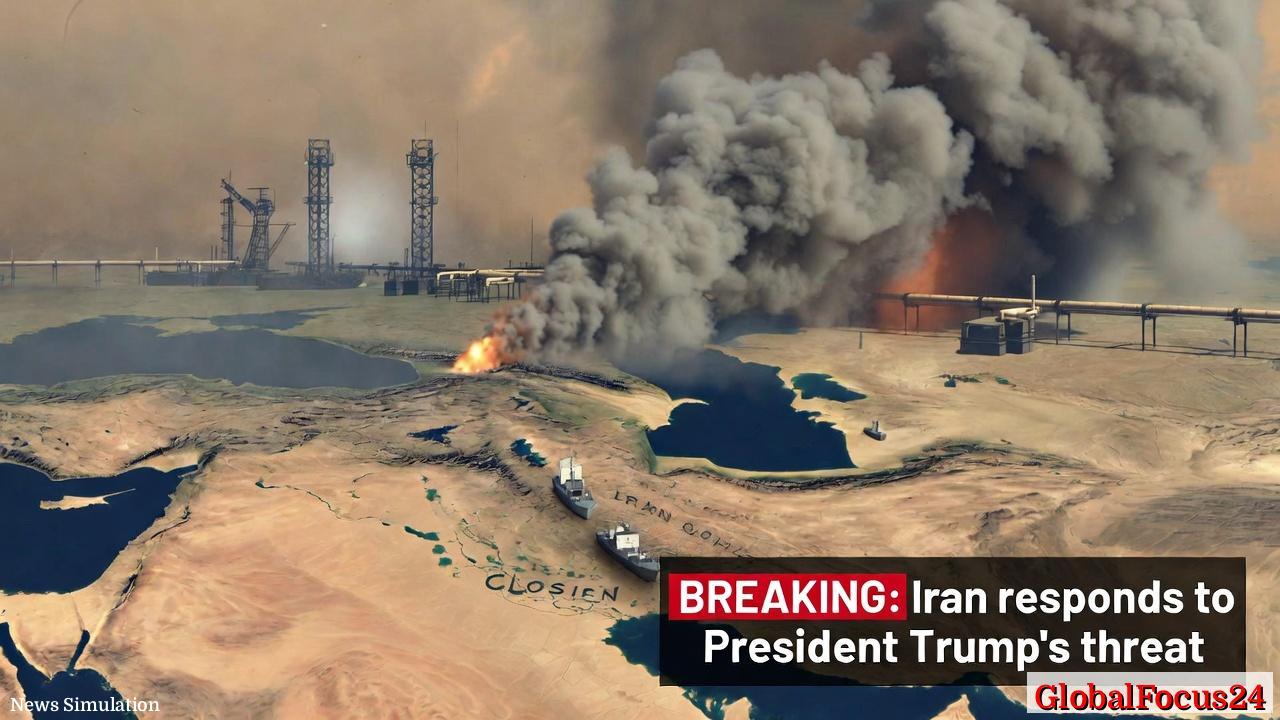
Iran Moves to Close Strait of Hormuz as Regional Tensions Escalate Over U.S. Threats
Iran's Message to the Region: Escalation Over Strategy
Iran has declared the complete closure of the Strait of Hormuz and announced plans to strike critical infrastructure across the Middle East following new threats from U.S. President Donald Trump. The move represents a severe escalation in one of the world’s most volatile waterways, heightening fears of a broader conflict that could disrupt global energy supplies and strain international markets.
In a televised statement, Iranian officials confirmed that the military’s doctrine has shifted “from defensive to offensive,” signaling a bold new posture aimed at deterrence through the threat of direct retaliation. Commanders vowed to target “energy facilities, IT hubs, and water desalination plants” across the region, framing these attacks as proportional measures intended to compromise the economic and logistical capabilities of perceived adversaries.
At the heart of this confrontation lies the Strait of Hormuz, a narrow channel between the Persian Gulf and the Gulf of Oman through which an estimated one-fifth of the world’s traded oil flows daily. Iran’s decision to close the passage marks one of the rarest and most provocative acts in modern maritime history — one that immediately sent crude oil futures soaring and regional governments scrambling to assess the implications of a potential trade chokehold.
A Calculated Gamble With Global Consequences
The Strait of Hormuz has long functioned as Iran’s most potent geopolitical lever. Since the 1980s, Tehran has repeatedly threatened to restrict access to the waterway during periods of sanctions or confrontation, but this is the first time the government has declared a full closure. The timing suggests a carefully calibrated response — designed to project strength, test U.S. resolve, and rally domestic support amid mounting economic pressure.
Oil markets reacted sharply in early Asia-Pacific trading hours, with Brent crude jumping more than 11% to above $115 per barrel. Energy analysts warned that a prolonged shutdown could push prices to historic highs, potentially exceeding the surges witnessed during the Gulf War or the Arab oil embargo of the 1970s. The U.S., Saudi Arabia, and the United Arab Emirates have already begun assessing emergency contingencies to maintain supply through alternate maritime routes and strategic reserves.
Economic analysts note that the closure comes at a challenging moment for global energy markets, which remain sensitive to supply shocks due to tight production capacity and fluctuating demand in the wake of post-pandemic recovery. Europe, heavily reliant on Gulf oil imports, faces particular exposure, as does East Asia — with Japan and South Korea importing over 60% of their crude from the Persian Gulf region.
U.S. Ultimatum Raises Risk of Military Confrontation
President Trump’s ultimatum — a 48-hour deadline for Iran to reopen the Strait or face “obliteration” of its power grid and energy infrastructure — has amplified fears of a direct clash between the United States and Iran. As of Monday, 33 hours remain before Washington’s deadline expires, leaving little room for diplomatic maneuvering.
The U.S. Navy’s Fifth Fleet, based in Bahrain, reportedly placed several carrier strike groups and missile defense assets on high alert. Military analysts view this as a preemptive measure against retaliatory Iranian attacks on American bases, shipping convoys, or regional energy installations. Unconfirmed reports from the region suggest that radar and satellite surveillance over the Gulf has intensified as both sides brace for potential escalation.
While neither Washington nor Tehran appears eager for a full-scale war, both have demonstrated a willingness to engage in tactical brinkmanship. Iran’s leadership, under pressure from sanctions and domestic unrest, likely views confrontation as a unifying force — a chance to portray the nation as standing firm against foreign coercion. For the United States, the standoff underscores Trump’s long-held commitment to projecting power and protecting maritime freedom in international waters.
Historical Context: The Strait as a Flashpoint
The Strait of Hormuz has been the theater of several crisis points over the past four decades. During the Iran-Iraq War of the 1980s, the so-called “Tanker War” saw Iranian and Iraqi forces exchange attacks on each other’s oil shipments, prompting U.S. naval intervention. In 2019, Iranian forces seized several commercial tankers amid worsening tensions following Washington’s withdrawal from the nuclear agreement.
Historically, such incidents have spurred short-term price shocks and military skirmishes but were resolved before escalating into open confrontation. Today, however, the scale of Iran’s announced closure and the explicit threat of regional strikes suggest an unprecedented level of commitment that could outlast previous crises. Analysts warn that any miscalculation — even a single attack on a U.S. vessel or Gulf infrastructure — could trigger a chain reaction leading to major regional conflict.
Economic Ripples Across the Middle East
The economic stakes of Iran’s move extend far beyond its borders. Gulf nations including Saudi Arabia, Kuwait, and the United Arab Emirates depend heavily on uninterrupted maritime shipping for both crude export and the import of essential goods. A closure of the Strait could impair billions in daily trade volume and raise insurance premiums for commercial shipping by up to 40%, dramatically increasing operating costs for international carriers.
Iran, meanwhile, claims it has secured self-sufficiency in essential goods, stating that national reserves can sustain the population for up to one year. While this assertion may be partly aimed at easing public anxiety, it reflects Tehran’s long-standing policy of preparing for sanctions-induced isolation. The country has gradually diversified its trade through land routes to Central Asia and China, though such connections cannot fully replace maritime commerce.
Domestically, Tehran faces a delicate balance between projecting power and preserving economic stability. Closed seaways could hurt Iran’s own oil exports and undermine revenues already constrained by sanctions. Yet officials seem willing to absorb these costs in exchange for the strategic advantage of high-stakes deterrence — betting that mounting global pressure will prompt diplomatic concessions from Washington.
Regional Reactions and Emerging Fault Lines
Across the Middle East, governments and markets reacted with a mix of alarm and strategic calculation. Saudi Arabia condemned the closure as “an act of aggression against international trade,” pledging to coordinate with allies to secure alternative export corridors via the Red Sea. The United Arab Emirates heightened maritime security along the Fujairah coast, a critical outlet for oil pipelines designed to bypass the Strait altogether.
Israel placed its defense infrastructure on high alert, warning of potential cyberattacks or missile strikes on its energy network. Meanwhile, Iraq and Qatar adopted a cautious tone, calling for “restraint and dialogue” to prevent regional escalation. Turkey and Oman, which maintain open channels with both Washington and Tehran, are rumored to be preparing to mediate, though neither has publicly confirmed such efforts.
The United Nations Security Council is scheduled to convene an emergency session within 24 hours to address the crisis. Early drafts of a joint resolution call for “immediate de-escalation and the restoration of navigational freedom,” but mutual distrust between the U.S., Russia, and China mayIran Closes Strait of Hormuz, Threatens Regional Infrastructure as Tensions with U.S. Escalate
Rising Crisis in the World’s Most Strategic Waterway
In a dramatic escalation of regional tensions, Iran announced on Sunday that it has completely closed the Strait of Hormuz, one of the world’s most critical maritime chokepoints for global energy supplies. The move came in direct response to warnings from U.S. President Donald Trump, who declared that Iranian power plants would be targeted if the waterway was not reopened within 48 hours. As of early Monday, the deadline stands at 33 hours, heightening fears of conflict across the Middle East and injecting new uncertainty into global oil markets.
The Strait of Hormuz—narrowly separating Iran from Oman—handles roughly one-fifth of the world’s total petroleum consumption. Its closure marks the most severe disruption in the region’s energy trade in over four decades, alarming capitals from Washington to Riyadh to Beijing. Iranian officials framed the decision as a necessary measure of “national defense and deterrence,” though a senior commander confirmed that the nation’s military posture has formally shifted from defense to offense.
From Tensions to Confrontation: A Turning Point in U.S.–Iran Relations
Relations between Tehran and Washington have remained tense for years, strained by nuclear negotiations, sanctions, and proxy conflicts. The latest confrontation appears to be the culmination of weeks of escalating threats between the two nations. According to statements aired on Iranian state television, Tehran’s leadership decided to close the Strait following “direct threats to national sovereignty” and “unlawful intimidation” from the United States.
The confrontation echoes the pattern of past flashpoints, most notably the 1980s “Tanker War,” when oil shipments through the Strait became targets amid the Iran–Iraq conflict. But unlike that limited engagement, this episode carries broader economic and strategic implications. Today, global supply chains are far more interconnected, and the region’s dependence on uninterrupted maritime traffic through Hormuz is vastly greater.
Iran’s Offensive Shift and Regional Threats
In statements broadcast by Iranian military spokespeople, Tehran warned that it will not confine its actions to naval operations. The country is poised to strike what it describes as “vital nodes of economic stability,” specifically mentioning energy infrastructure, desalination plants, and information technology centers across neighboring states. Such targets—responsible for powering and sustaining regional economies—suggest that Iran’s new strategy could extend well beyond its borders.
This declaration marks a rare public acknowledgment of Iran’s offensive doctrine. Analysts note that the shift signals a willingness to pursue pre-emptive or retaliatory attacks, leveraging both conventional and cyber capabilities. Military experts also point to Iran’s arsenal of ballistic missiles and drones, which have previously been used in regional conflicts, as key components of any future strikes.
Economic Fallout and Market Reaction
The immediate reaction from global markets has been swift and severe. Crude oil futures spiked more than 15% in early trading, reaching their highest levels since mid-2022. Major carriers and energy firms have suspended tanker routes through the Persian Gulf, diverting vessels via alternative paths where possible, though none can replicate the scale or efficiency of the Strait of Hormuz.
The International Energy Agency (IEA) issued a statement urging restraint and pledging to coordinate emergency releases from strategic reserves if necessary. Economists warn that a prolonged closure could trigger sharp rises in fuel prices worldwide, reigniting inflationary pressures in both emerging and developed economies.
For countries deeply reliant on Gulf oil exports—such as Japan, South Korea, and India—the disruption presents an immediate supply risk. European energy markets, already weakened by volatility in natural gas supply chains since 2022, face renewed challenges in maintaining affordability and stability.
Historical Context: The Strait as a Pressure Point
The strategic significance of the Strait of Hormuz has long served as a geopolitical barometer for the Middle East. Stretching just 21 miles at its narrowest point, the waterway links the Persian Gulf to the Arabian Sea, handling roughly 18 million barrels of oil daily. Throughout modern history, its closure has been threatened but never fully realized for more than brief periods.
In the late 1970s and 1980s, Iran used the possibility of closing the Strait as leverage during regional conflicts. The U.S. Navy has consistently maintained a strong presence to ensure maritime security in the area, leading to several confrontations over the decades. Today’s full closure—if sustained—would mark an unprecedented scenario, one that risks drawing multiple nations into a larger military standoff.
The current crisis also mirrors elements of earlier nuclear-era tension, when the mere threat of blocking the Strait was enough to rattle global markets. Yet, given the modern world’s intense dependence on stable energy flow, analysts warn that this time the economic reverberations could be far more severe.
Regional Reactions and Strategic Alliances
Across the Gulf, regional powers are now on high alert. Saudi Arabia and the United Arab Emirates have activated emergency coordination cells to safeguard their export terminals and undersea data cables. Both nations possess significant oil and gas infrastructure close to the Strait’s mouth, including desalination plants that supply fresh water to millions.
In Iraq and Qatar, officials voiced concern over the potential spillover of conflict. Kuwait has reportedly increased its readiness level at major onshore facilities. Oman, which borders the southern side of the Strait, called for “immediate de-escalation” and offered to mediate dialogue between the two sides.
Meanwhile, Israel and Turkey have increased intelligence surveillance across the Red Sea and Eastern Mediterranean corridors, fearing possible disruption to digital or maritime trade infrastructure. China and India, two of the largest buyers of Gulf oil, urged restraint and stressed that “energy security must not become a weapon of policy.”
Iran’s Domestic Calculations and Preparedness
Inside Iran, the government sought to project confidence and self-sufficiency as international pressure mounted. Officials announced that the country holds enough reserves of vital commodities—including wheat, rice, and fuel—to sustain domestic needs for up to one year. This assertion seems aimed at reassuring the public while deterring potential U.S.-led economic measures or naval blockades.
Iranian media outlets emphasized unity in the face of what they characterized as “foreign aggression.” Reports from Tehran described an atmosphere of vigilance but no public panic, with markets open and transportation systems operating normally. However, international observers remain cautious, noting that prolonged isolation from global energy trade could strain Iran’s economy despite its strategic reserves.
Global Diplomatic Responses
The United Nations Security Council has scheduled an emergency session to address the escalating crisis, amid calls from several European nations for diplomatic mediation. The U.S. State Department reaffirmed that the closure of the Strait constitutes an “unacceptable act of aggression” and demanded its immediate reopening.
Russia voiced opposition to the use of force in the Gulf, calling for “collective security measures.” Meanwhile, the European Union and Japan expressed concern that a direct confrontation could destabilize not only energy markets but also global trade at large. Marine insurers have already raised premiums sharply for ships entering the region, adding further pressure on logistics networks.
Efforts by neutral states to broker talks between Tehran and Washington have yet to show progress. Analysts suggest that both nations may now be locked in a high-stakes test of resolve, where concessions risk appearing as weakness on either side.
Strategic and Economic Outlook
If the Strait remains closed beyond the next several days, economists predict that the global oil price could breach levels unseen since the 2008 financial crisis. The shock would ripple across transportation, manufacturing, and agriculture, all deeply tied to fuel costs. Inflation, which had begun to cool in 2025, could rapidly accelerate again.
Alternative supply routes, such as the Saudi East-West pipeline or the Emirati Habshan–Fujairah network, can reroute only a fraction of Gulf exports. Additional capacity through the Suez Canal and pipelines across Iraq faces logistical and political constraints. The result is a fragile web of contingency measures, none equal to the scale of disruption now underway.
For the United States, maintaining credibility after President Trump’s ultimatum poses both diplomatic and military challenges. For Iran, sustaining leverage through closure brings equal risks—economic strain, possible regional isolation, and the potential for direct confrontation with global powers.
A Region on the Edge
As the clock ticks down toward Washington’s 48-hour deadline, the Gulf stands at a perilous crossroads. Naval forces from multiple nations have reportedly repositioned within the Arabian Sea, while satellite imagery indicates a buildup of Iranian missile units near coastal installations. Civil aviation routes have already begun diverting around the affected area.
Whether through diplomacy, deterrence, or escalation, the next two days are likely to determine the trajectory of Middle Eastern stability for years to come. The Strait of Hormuz, long a symbol of both connection and confrontation, now serves once again as the fulcrum upon which global energy security and geopolitical balance precariously rest.