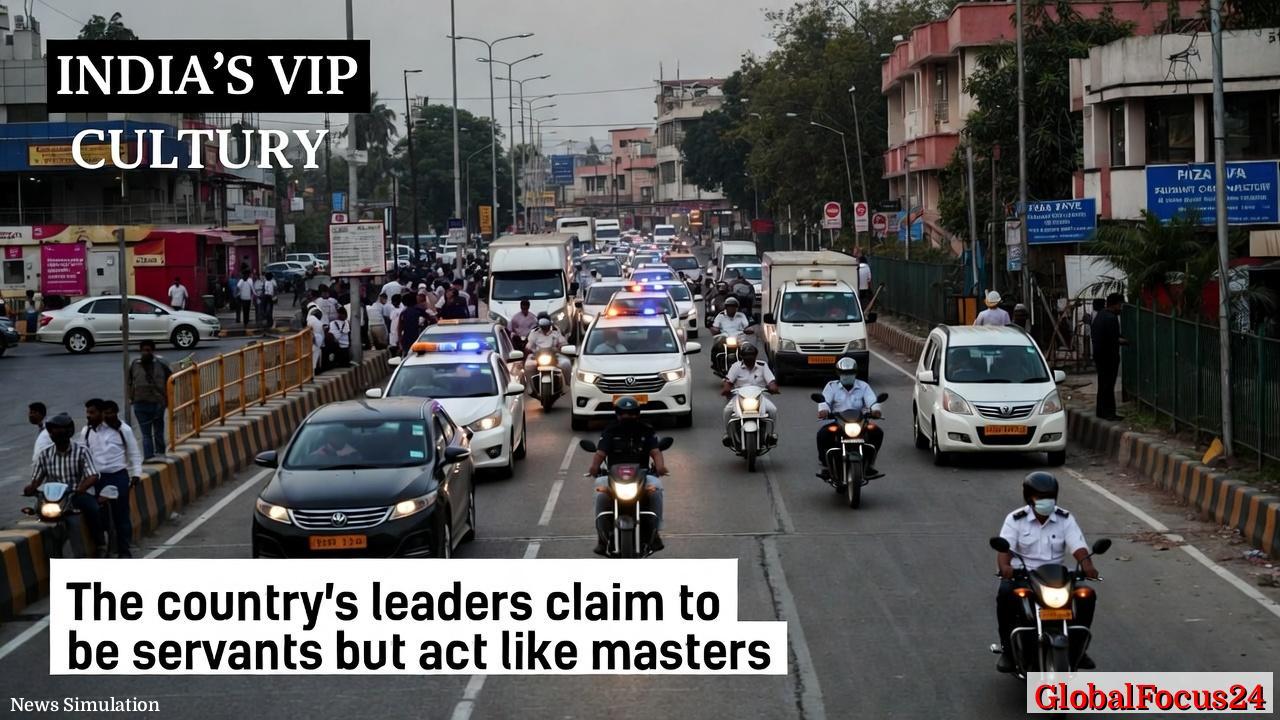
India’s VIP Culture: A Growing Challenge for Governance, Economy, and Public Trust
The phenomenon of VIP culture in India—where public officials and politicians enjoy a package of privileges, from motorcades and priority airport access to restricted public spaces—continues to shape daily life, policy priorities, and the broader trajectory of the country’s democratic experiment. As the world’s largest democracy, India has long prided itself on mechanisms designed to balance power and accountability. Yet observers say that the routine privileging of officials over ordinary citizens undercuts those ideals, raises questions about efficiency and fairness, and has tangible economic and social consequences. This article examines the origins, the current state, and the multi-faceted impact of India’s VIP culture, with historical context, economic considerations, and regional comparisons to shed light on why this issue persists and what reforms might yield measurable improvements.
Historical context: a lineage of privilege and power To understand VIP culture, it helps to trace its roots through India’s modern political and administrative history. The post-independence period established a civil service ethos and a tradition of bureaucrats serving a constitutional republic. Yet political leaders also relied on visible displays of authority—state-backed ceremonial prerogatives, security arrangements, and the use of public space to symbolize the state’s reach. Over the decades, as India’s economy liberalized and urbanized, the infrastructure needed to support rapid mobility and dense population centers expanded dramatically. Alongside this growth, the culture around political power—how it is exercised, who benefits, and how decisions are communicated—became more performative. The result is a system in which power has both formal and informal channels, with privilege often codified in practice rather than law.
The modernization era of the late 20th and early 21st centuries intensified the visibility of VIP privileges. High-profile motorcades, police escorts, dedicated lanes, and priority access to airports and events emerged as standard operating procedures. While these measures can streamline governance processes and protect officials in dangerous environments, they also create practical friction for everyday citizens and for commercial activity. The tension between necessary security and the unintended consequences of privilege has become a recurring theme in contemporary public discourse.
Economic impact: efficiency, opportunity costs, and markets VIP culture affects the economy in several ways, ranging from operational efficiency to opportunity costs and public perception. The most direct economic effect is the disruption caused by motorcades and security protocols that can paralyze traffic, delay logistics, and raise the cost of doing business in congested urban corridors. For freight, delivery windows, and commuter travel, even small delays can have cascading effects on supply chains, inventory management, and customer satisfaction. In the manufacturing and service sectors, time is a resource as valuable as capital or labor; frequent road closures or restricted access to important sites can reduce productivity and raise the price of goods and services for consumers.
Beyond immediate inefficiencies, VIP culture signals an implicit preference for proximity to power. Firms and individuals who offer access or align with political centers may gain outsized advantages in licensing, regulatory approvals, or government contracts. While this dynamic is not unique to India, its visibility in major urban centers and during peak policy-making periods can distort competitive markets. Small and medium-sized enterprises, startups, and non-governmental organizations may face higher barriers to entry when navigating corridors where privilege translates into faster or smoother approvals. The cumulative effect is a mixed picture: on one hand, political figures may facilitate project implementation in some cases; on the other, the predictable advantages tied to proximity can dampen entrepreneurial risk-taking and undermine merit-based competition.
Public finance considerations also play a role. Security and protocol requirements, while essential for safeguarding officials, come with budgetary costs that must be funded through government spending. When resources are allocated to VIP-related logistics—such as secure convoy fleets, dedicated routes, or exclusive facilities—these funds divert attention from essential public services like healthcare, education, and rural development. The opportunity cost is a critical lens through which economists and policymakers view VIP privileges: what is the societal return on investment when funds tied to privilege could otherwise enhance universal access to essential services?
Regional comparisons: how VIP culture unfolds across major Indian cities Across India’s diverse regions, VIP practices manifest in nuanced ways, reflecting local governance culture, security concerns, and infrastructural realities. In the capital region around New Delhi, for example, the presence of a high concentration of national-level officials and a dense web of critical infrastructure amplifies the visibility of VIP convoys and related disruptions. In financial hubs like Mumbai and Bengaluru, the intersection of corporate interests, political connections, and traffic management creates a setting in which elite privileges can intersect with commercial activity in complex ways. In tier-2 and tier-3 cities, VIP practices may take different shapes—fewer grand motorcades, but persistent access controls at state-level events, district headquarters, and ceremonial functions that still privilege officials over ordinary citizens.
Alongside these variations, regional governance systems influence how reforms take hold. States with strong administrative traditions and robust anti-corruption bodies may implement stricter oversight of VIP movements and public-space allocations. Conversely, in areas where governance capacity is stretched, the same privileges may be more deeply embedded as routine practice. In all cases, the public’s experience of VIP culture—whether in the form of delayed flights, redirected traffic, or restricted access to public spaces—tends to shape perceptions of accountability and legitimacy at the local level and can influence voter sentiment and policy expectations in subsequent elections.
Societal impact: public perception, trust, and everyday life Public reaction to VIP culture is a key barometer of social trust. When ordinary citizens repeatedly encounter scenes of priority access and special treatment, the contrast with everyday constraints can foster frustration, cynicism, and disengagement from the political process. Conversely, visible efforts to cap privileges or improve transparency can rebuild faith in governance. Civil society groups, journalists, and watchdog organizations have played a role in highlighting abuses and proposing practical reforms—ranging from stricter enforcement of traffic rules affecting VIP convoys to the deployment of AI-based traffic management systems that minimize disruption while preserving security.
Media coverage and public discourse often emphasize the human dimension of VIP culture: the altered rhythms of city life, the inconvenience faced by commuters, and the symbolic power that such behavior conveys. These narratives matter because they frame how citizens interpret the legitimacy of their leaders. When reforms are discussed, the emphasis tends to be on concrete, implementable measures—such as decoupling security from ceremonial privileges, creating transparent road-closure schedules, or digitizing permit processes to reduce discretionary power. In this way, the conversation shifts from moral judgments about privilege to practical strategies for more inclusive governance.
Policy responses and reform pathways Experts suggest a mix of policy interventions to curb excesses while preserving essential security and ceremonial functions. Among the most cited reform pathways are:
- Transparent scheduling and public accessibility: Requiring advance publication of road-closure plans and official movement calendars to minimize unpredictability for commuters and businesses.
- Security-civilian separation: Distinguishing between security needs and ceremonial privileges, with clear guidelines on when and where VIP security resources can be deployed.
- Uniform access criteria: Implementing standardized, objective criteria for special access to airports, government facilities, and public events to reduce discretionary gatekeeping.
- Technology-enabled traffic management: Deploying intelligent traffic systems, real-time alerts, and bus/priority lanes designed to minimize disruption while maintaining safety.
- Independent oversight: Strengthening anti-corruption bodies or parliamentary committees with real enforcement teeth to monitor VIP-related expenditures and practices.
- Public accountability mechanisms: Establishing channels for redress when ordinary citizens are adversely affected by VIP movements, including formal grievance procedures and independent ombudsman review.
Economic and social benefits of reform Reforming VIP practices can yield tangible benefits beyond fairness and trust. Reduced congestion improves productivity and lowers logistics costs for businesses. Streamlined processes for approvals and permits can accelerate infrastructure projects, boost private investment, and enhance regional competitiveness. A public image of equitable governance can attract talent, encourage entrepreneurship, and foster social cohesion—factors that support inclusive growth. In regions where VIP practices are most deeply ingrained, visible reforms can signal a recommitment to democratic norms, strengthening the social contract between citizens and government.
Conclusion: steering toward a more accountable governance model VIP culture in India sits at the intersection of history, security, administration, and public life. It reflects the enduring challenge of balancing necessary protection and ceremonial functions with the democratic imperative of equal treatment under the law. As urbanization intensifies and the economy evolves, the pressure for reform will likely intensify as well. The path forward involves clear rules, transparent processes, and a robust public conversation about what constitutes responsible governance in a modern democracy. By aligning privileges with accountability, India can preserve the efficiency needed for governance while reinforcing the principle that public service serves all citizens—not a privileged few. Public trust depends on that balance, and the pace of reform will shape how future generations experience democracy in action.