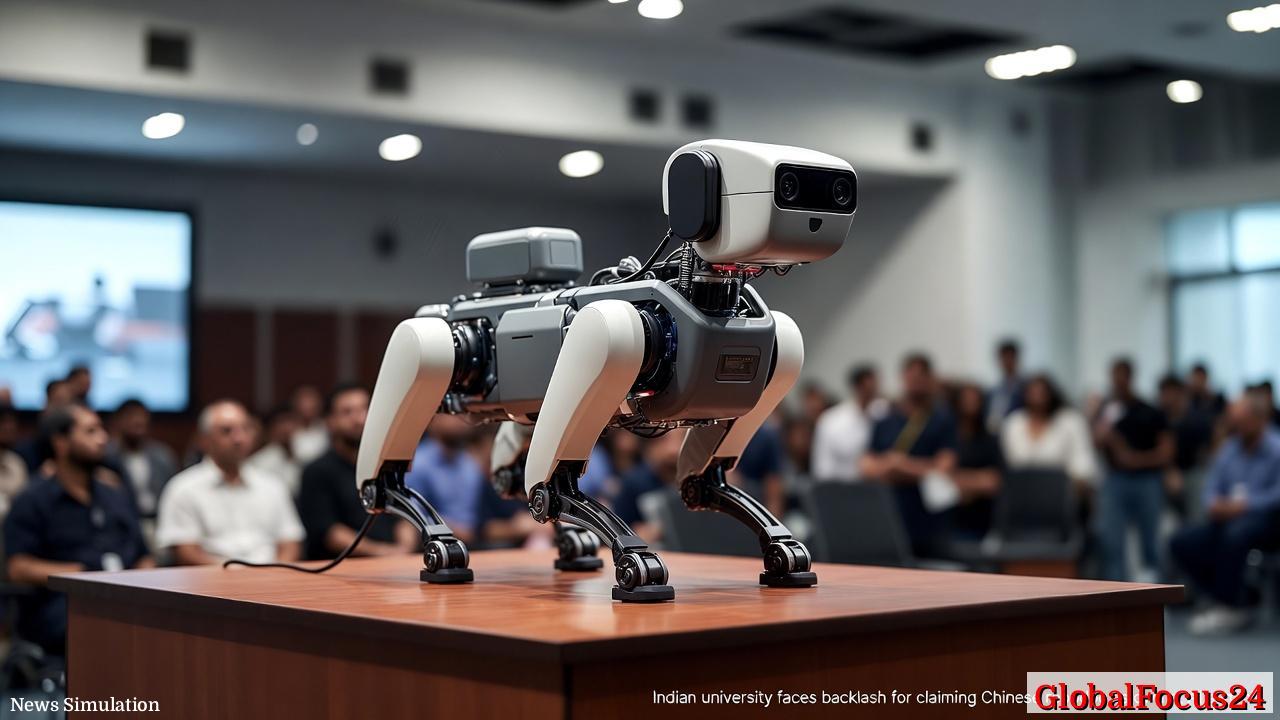
Indian University Faces Backlash Over Misrepresented ‘Homegrown’ Robotic Dog at AI Summit
A Controversy Unfolds at a High-Profile Tech Event
A leading private university in India, Galgotias University, has drawn widespread criticism after presenting a Chinese-made robot dog as its own creation during a recent artificial intelligence summit. The incident, which unfolded last week in Noida, Uttar Pradesh, has sparked debates across academic and technology circles about research transparency, ethical practices in innovation, and India’s pursuit of technological self-reliance.
The robot dog, introduced on stage as a “locally developed AI quadruped,” was showcased as a milestone achievement by the university’s engineering department. However, attendees and online observers quickly recognized striking similarities between the robot and widely marketed Chinese models, particularly those developed by Unitree Robotics — a well-known robotics company based in Hangzhou, China.
Within hours, videos and images from the summit went viral on social media, prompting accusations that the demonstration misrepresented imported technology as an indigenous invention. University officials initially described the event as a “demonstration of AI integration,” but later faced mounting pressure to address claims of academic dishonesty.
Identification of the Chinese Model
According to robotics experts who reviewed footage from the event, the unit displayed by Galgotias University appeared identical to the Unitree Go1 — a four-legged robotic system capable of dynamic walking, obstacle avoidance, and limited user interaction through an AI-driven control system. Key physical features, such as joint placement, housing design, sensor configuration, and the control application interface, matched existing images of Unitree’s product line.
Tech analysts pointed out that even the interface on the accompanying tablet seen in videos mirrored that of the Unitree platform, which is commercially available in India through authorized distributors.
This close resemblance left little doubt that the robot showcased was not an indigenous prototype, but rather a commercially purchased or imported device — potentially with modifications to its software or casing.
University Response and Public Reaction
Galgotias University released a brief statement following the uproar, emphasizing that the demonstration aimed to highlight the “integration of artificial intelligence frameworks” with robotics hardware rather than to claim ownership of the physical design. Still, the lack of clarity in the university’s initial presentation fueled criticism from academics and students who saw the move as misleading.
Social media reactions were swift and often unforgiving. Students at other engineering institutions across India expressed frustration, arguing that such misrepresentation undermines the credibility of genuine homegrown research. On X (formerly Twitter), hashtags like #RobodogScandal and #GalgotiasAI trended briefly, drawing attention from industry voices and education policymakers.
A Broader Concern About Research Integrity
The incident has reignited concerns about academic ethics and verification standards in India’s expanding network of private institutions. Over the past decade, India has made substantial investments to position itself as a global technology hub, with government initiatives promoting domestic innovation in robotics, artificial intelligence, and smart automation.
However, experts warn that such goals require strong safeguards against plagiarism and misrepresentation. “When academic institutions misrepresent imported technology as their own, it damages public trust,” said an AI researcher at the Indian Institute of Technology Delhi. “It also discourages genuine innovators who are developing solutions under far more limited funding.”
Historically, similar controversies have surfaced across Asia, where rapid competition among universities for visibility has at times led to exaggerated claims of innovation. Instances such as mislabeled prototypes or recycled foreign designs presented as local breakthroughs can slow progress by diverting attention from authentic research efforts.
India’s Push for Indigenous Robotics Development
India’s robotics and AI sectors have accelerated rapidly in recent years, driven by public and private investment in automation technologies. Educational institutions have been encouraged to partner with industry stakeholders to advance domestic capabilities in machine learning, robotics systems integration, and AI ethics.
The government’s “Make in India” initiative, launched in 2014, has emphasized local manufacturing and technological innovation to reduce dependence on imports. Within that framework, universities and startups have received incentives to develop indigenous robotic systems, particularly for industrial, defense, and healthcare applications.
Given this national focus, the Galgotias controversy struck a particularly sensitive chord. The perception that a university claimed credit for foreign technology runs counter to the narrative of self-reliance at the heart of India’s current technological ambitions.
Economic Context: The Cost of Shortcuts in Innovation
The economic stakes behind such incidents are significant. Robotics and AI-related industries are projected to contribute billions of dollars to India’s economy over the next decade. According to industry estimates, the market for service robotics alone may surpass USD 1 billion by 2030 as domestic adoption spreads across logistics, agriculture, and defense sectors.
In this context, showcasing unoriginal technology as a “homegrown” breakthrough risks more than reputational harm. It may undermine investor confidence and slow the flow of funding into legitimate research programs. Universities that demonstrate transparency and verifiable innovation are far more likely to attract partnerships with global tech firms and funding from government technology missions.
Economists also highlight the indirect costs of such controversies. Misdirection of attention and funds toward publicity gestures can weaken the innovation pipeline, where student researchers and faculty need sustained support to achieve true breakthroughs.
Regional Comparison: Lessons from Technology Hubs
A comparison with other Asian technology centers illustrates how integrity and validation frameworks shape innovation ecosystems. In South Korea, for example, strict government and university-level verification processes ensure that prototypes showcased publicly undergo independent review before being promoted as original. In Japan, collaboration between universities and corporate partners often includes clear IP-sharing agreements that prevent false claims of authorship.
China, the likely origin of the robot in question, has itself become a heavyweight in robotics manufacturing. Companies like Unitree, DeepRobotics, and Xiaomi’s CyberDog division have positioned the country as a leader in affordable quadruped robotics — products that are actively exported to both research institutions and hobbyists worldwide.
For Indian universities seeking to develop competitive products, experts say transparency about using imported platforms is critical. “There is nothing wrong with utilizing foreign robotics hardware as a foundation for AI research,” explained a robotics entrepreneur based in Bengaluru. “But it must be clearly communicated that the work focuses on software innovation or AI learning layers, not the physical device.”
The Path Forward: Rebuilding Trust Through Transparency
As public scrutiny continues, Galgotias University faces the challenge of restoring confidence among students, peers, and research partners. Analysts suggest that a clear statement acknowledging the origin of the robot, along with a commitment to ethical publishing and proper academic attribution, would be an important first step.
Some educators are calling for broader reforms. Suggestions include establishing independent review boards for university tech demonstrations, mandating disclosure of source technologies, and creating collaborative research registries that document whether imported components are used in institution-led projects.
Such measures could help ensure that technological progress in India remains credible and measurable, allowing universities to build innovation reputations grounded in verifiable accomplishment rather than marketing showmanship.
A Moment of Reflection for India’s AI and Robotics Landscape
The controversy surrounding Galgotias University’s alleged misrepresentation serves as a cautionary episode at a pivotal moment for India's technology education sector. As the country accelerates toward deeper integration of AI and robotics across industrial and academic frontiers, authenticity and accountability have become essential components of progress.
Observers agree that the incident, while damaging in the short term, may ultimately prompt greater scrutiny and foster stronger ethics frameworks in the long term — potentially benefiting the broader AI community. If universities embrace this episode as a moment of introspection rather than defensiveness, it could reinforce a culture of transparency and integrity vital for India’s standing in the global tech landscape.
For now, the spotlight remains on Galgotias University to provide clarity about the origins and purpose of its robotic dog demonstration — and, in doing so, demonstrate that honesty in innovation remains a core principle of the country’s scientific future.