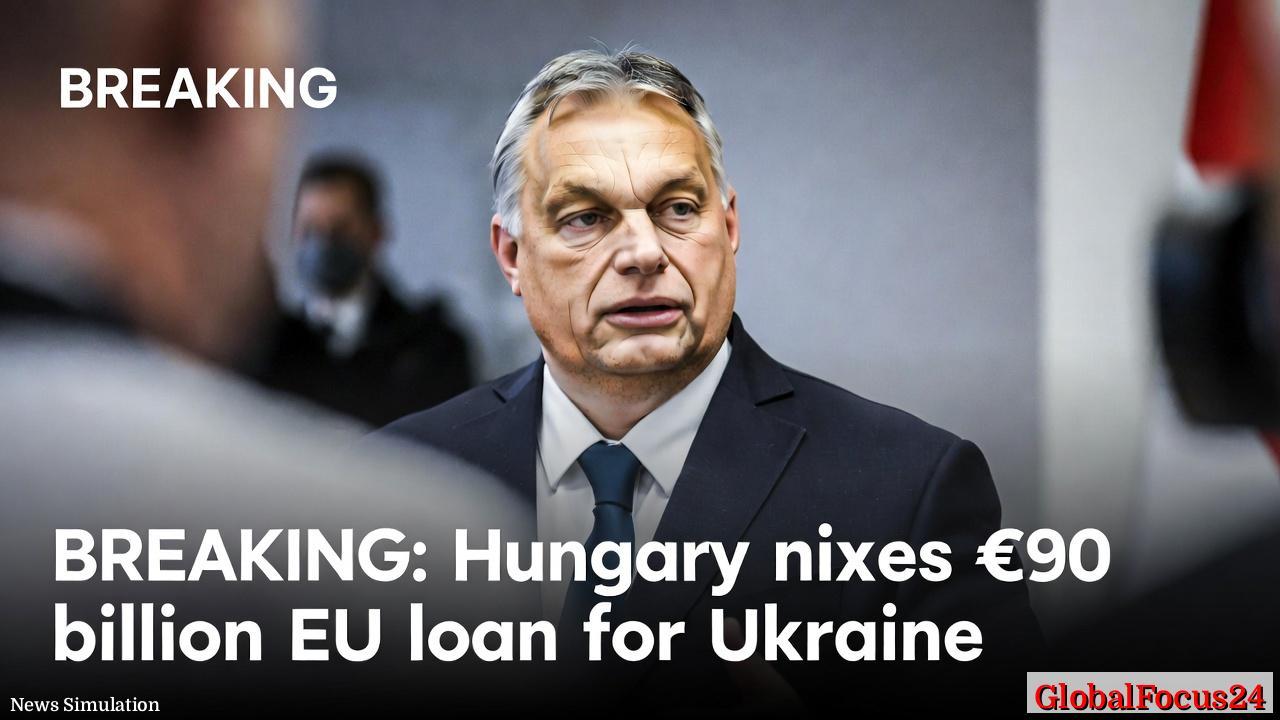
UNANIMOUS STASTE: HUNGARY BLOCKS €90 BILLION EU LOAN PACKAGE FOR UKRAINE
In a move that reshapes the contours of European financial aid, Hungary’s government blocked a proposed €90 billion European Union loan package intended to support Ukraine’s finances amid an ongoing, multifaceted crisis. The decision, which required unanimity among EU member states, means the measure did not advance to formal approval and disbursement. The veto underscores the high-stakes diplomacy, the interconnected economics of the region, and the uncertain path of international support for Ukraine in the coming months.
Historical context: a century of European financial cooperation under strain To understand the significance of Hungary’s veto, it helps to situate the moment within a longer arc of European financial coordination. Since the postwar era, the European Union has relied on coordinated financial instruments to stabilize economies, ease transitions, and respond to security shocks. Ukraine’s fiscal needs, amplified by conflict and reconstruction requirements, have repeatedly drawn on this shared resource framework. The proposed loan package represents a continuation of a long-standing pattern: relief funded by a coalition of receptive members, contingent on consensus, and deployed through a network of institutions that include the European Commission and the European Investment Bank.
Hungary’s decision, while specific in its veto, reflects a broader tradition of national priorities influencing continental finance. Budapest has emphasized national sovereignty in economic decision-making and has at times voiced concerns about the potential geopolitical and macroeconomic spillovers of large-scale EU financial commitments. The current stand-off therefore sits at the intersection of domestic political pressures and international economic strategy, illustrating how regional politics can shape a broader humanitarian and stabilizing effort.
Economic impact: implications for Ukraine, the EU, and the broader region The blocked loan package carried implications on several levels—Ukraine’s budgetary stability, the financing of ongoing defense and reconstruction needs, and the broader signaling effect for international financial support.
Ukraine’s budget stability and liquidity
- The EU loan was designed to ease pressure on Ukraine’s public finances, allowing for continuity of essential services, energy subsidies, and social protection programs, while freeing domestic resources for urgent reconstruction and military needs.
- Without access to this capital infusion, Ukraine’s government faced tighter liquidity conditions. The risk of delayed payrolls, interrupted public services, and slower procurement for critical infrastructure projects increases as fiscal gaps widen.
- In the near term, alternative financing arrangements would have to be mobilized, potentially at higher costs, to cover existing commitments and unfunded expenditures. The absence of the EU package could amplify borrowing costs and widen financing gaps if other international lenders seek higher risk premia.
European Union cohesion and policy signaling
- The veto sends a cautious signal about the pace and terms of large-scale EU financial commitments. While the Union remains broadly supportive of Ukraine, the unanimity requirement means that any single member can alter the trajectory.
- For EU member states, the episode reinforces the importance of joint policy alignment on geopolitical and economic risk management. The decision also highlights how domestic political climates in member countries can influence collective responses to regional crises.
- The decision may prompt a recalibration of risk-sharing mechanisms and contingency planning across EU institutions, with increased emphasis on bilateral or alternative multilateral channels to ensure continuity of support should consensus falter again.
Regional comparisons: how this moment echoes or differs from similar episodes
- In neighboring regions, several countries have grappled with balancing domestic political concerns and international obligations. Some have pressed for more conditionality or stricter oversight on disbursements, while others have advocated for more rapid, streamlined funding to accelerate stabilization.
- Compared with past EU stabilization efforts, the current episode underscores the enduring tension between rapid humanitarian assistance and the political economy of member state consensus. It also reflects a recurring pattern where large-scale financial instruments require not only technical approval but also diplomatic alignment among diverse national interests.
Potential knock-on effects for international financial programs
- The International Monetary Fund and other lenders often coordinate with EU-backed initiatives to maximize impact and ensure macroeconomic stability. A delay or derailment of the EU loan could complicate the financing landscape, requiring readjustments in IMF programs or re-baselining of Ukraine’s budget projections.
- Private sector expectations, including contractors and suppliers tied to reconstruction projects, may experience uncertainty. Confidence in the speed and reliability of international aid can influence investment plans, import decisions, and the pace of rebuilding activity.
- For donor nations and institutions, the episode could prompt a reexamination of risk-sharing frameworks and the design of future packages to incorporate clearer benchmarks, governance standards, and exit strategies that reduce the chance of future stalemates.
Public reaction and the information environment
- Public sentiment in Europe toward Ukraine aid has historically tracked with broader concerns about national budgets, security, and domestic priorities. In many capitals, supporters view the package through the lens of regional security and long-term stability, while critics focus on cost, conditionality, and the potential for domestic displacement of resources.
- The veto adds another layer to the public discourse, potentially sharpening debates about strategic commitments, the speed of aid delivery, and the responsibilities of EU institutions to act decisively in times of crisis.
- Media coverage generally emphasizes the humanitarian and strategic dimensions, while also reporting on the domestic political narratives that shape votes and positions within member states.
What this means for Ukraine going forward
- For Ukraine, the immediate takeaway is a pause rather than a terminal setback. The country remains eligible for other forms of international support, including ongoing IMF programs, bilateral aid, and alternative multilateral financing arrangements. However, the absence of the EU loan package necessitates contingency planning and may require a reprioritization of funded projects.
- Ukraine’s resilience will hinge on its ability to secure diversified funding streams, maintain disciplined macroeconomic management, and sustain international cooperation across multiple platforms. The longer the funding gap persists, the greater the risk of fiscal pressure and potential delays in critical programs.
What comes next: pathways to resolution and continuity
- Reengagement within the EU framework: Negotiations and compromises among member states could pave the way for a revised loan package or alternative financing modalities. The process will likely involve enhanced conditionality, governance reforms, or phased disbursements aligned with measurable milestones.
- Parallel financing channels: Ukraine could seek to bolster financing through the IMF, regional development banks, or bilateral arrangements, potentially supplementing any shortfalls with private sector financing under risk-sharing guarantees.
- Domestic reform and governance: Across Europe and Ukraine alike, governance reforms and transparency measures can bolster confidence among partners and donors. Clear benchmarks, independent oversight, and measurable outcomes can help reassure skeptics while preserving the humanitarian and stabilizing aims of aid.
Key distinctions for regional policymakers
- Unanimity risk: The EU’s consensus requirement means that one country can block a package, making robust, proactive diplomacy crucial in crisis response planning.
- Conditionality dynamics: Donor countries increasingly emphasize governance, anti-corruption, and fiscal prudence as prerequisites for large injections. Ukraine’s reform trajectory will influence not just performance in the near term but the shape of future aid.
- Economic ripple effects: Large international loans affect currency valuations, inflation expectations, and public sector wage dynamics. Policymakers must balance short-term stabilization with long-term growth and structural reform.
Conclusion: a pivotal moment in European financial coordination The Hungarian veto on the €90 billion EU loan package for Ukraine marks a significant moment in European financial diplomacy. It highlights how domestic political considerations can shape regional emergency responses, illustrating both the fragility and resilience of international cooperation in times of crisis. While the immediate disbursement has stalled, the underlying objective of stabilizing Ukraine’s finances remains central to the broader European security and economic framework. As EU member states reassess strategies and regional actors recalibrate expectations, the coming months will reveal whether a reconfigured package, a different financing approach, or a renewed round of negotiations will restore momentum. The outcome will influence not only Ukraine’s fiscal health but also the credibility and cohesion of European financial commitments in an era defined by complexity and interdependence.