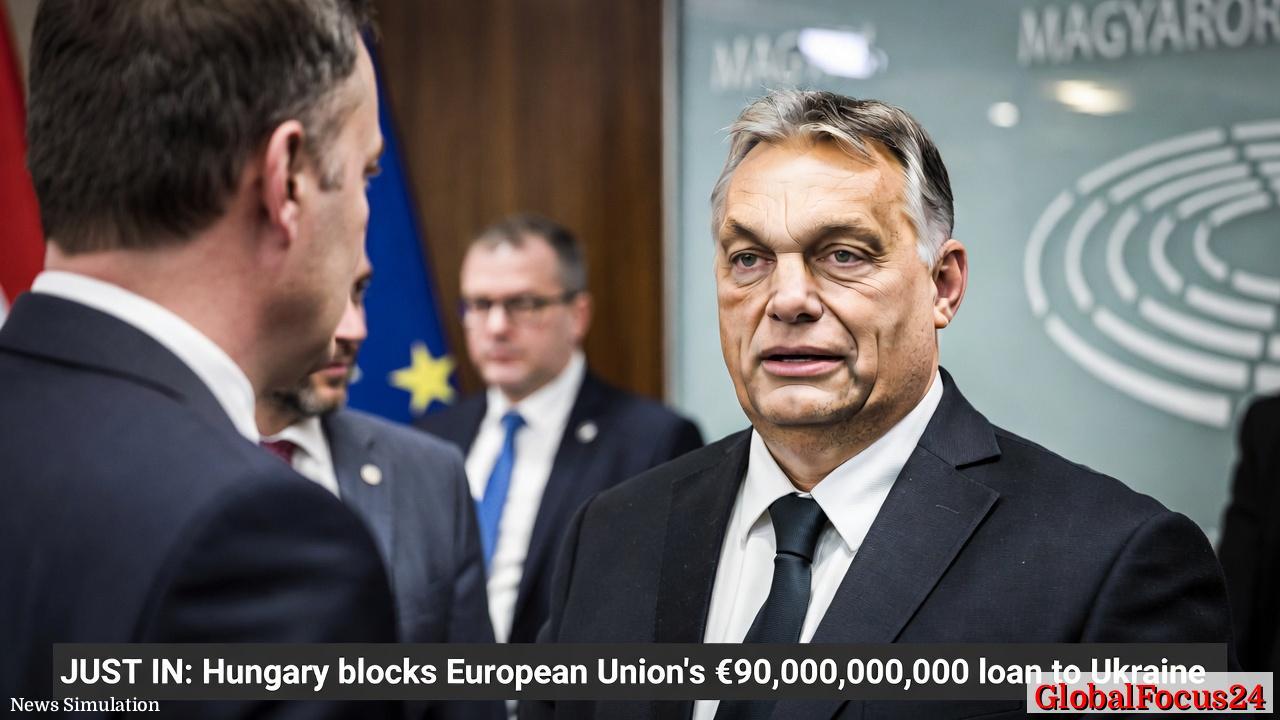
Hungary Blocks EU’s €90 Billion Aid Package to Ukraine Amid Energy Dispute
Budapest’s Decision Deepens Rift Over Ukraine Support
Hungary has blocked the European Union’s proposed €90 billion financial assistance package to Ukraine, escalating tensions between Budapest and its European partners at a crucial moment in the bloc’s support for Kyiv. Prime Minister Viktor Orbán announced that the decision stems from what he described as Ukraine’s politically motivated blocking of the Druzhba oil pipeline, a key energy route that delivers Russian crude to Hungary and Slovakia.
Orbán asserted that the pipeline remains technically functional, dismissing Kyiv’s justification for the blockage as political rather than logistical. In response, he declared that Hungary will neither supply diesel fuel to Ukraine nor approve the EU loan package, and warned that Budapest could suspend electricity exports to Ukraine if the standoff continues.
The move underscores Hungary’s increasingly independent stance within the European Union, particularly regarding sanctions, energy security, and the financing of Ukraine’s war effort. It also places renewed strain on the bloc’s collective efforts to maintain unity on both economic and geopolitical fronts.
The Druzhba Pipeline: A Lifeline and a Flashpoint
At the center of this diplomatic rupture lies the Druzhba oil pipeline, one of the world’s largest and oldest oil transportation systems. Constructed during the Soviet era in the 1960s, the Druzhba (“Friendship”) pipeline carries Russian crude across Ukraine, Belarus, and Poland into Central Europe. For Hungary and Slovakia—countries without access to seaports—the pipeline remains vital to their energy stability.
Ukraine recently limited the flow of crude oil through Druzhba, citing compliance and safety concerns. However, Hungary argues that such measures are politically driven, intended to pressure Budapest for its non-aligned position toward Kyiv. Orbán stated that “the pipeline is working, so this is not a technical issue. This is a political blockade.”
The episode highlights the enduring role of Soviet-built energy infrastructure in shaping modern European politics. While most EU nations have moved toward cutting dependence on Russian hydrocarbons since the 2022 invasion, Hungary has remained one of Moscow’s key energy clients, relying on long-term contracts with Russian energy giant Rosneft through the Druzhba network.
European Union Faces Unified Front Challenges
Hungary’s veto has immediate and far-reaching implications for the European Union’s financial strategy toward Ukraine. The €90 billion loan package was designed to stabilize the Ukrainian economy, sustain government operations, and provide investment in reconstruction efforts amid the ongoing war.
Under EU rules, financial aid packages of this magnitude require unanimous approval from all member states. Hungary’s decision therefore effectively halts the initiative, leaving other EU capitals scrambling for alternative mechanisms to deliver assistance. Brussels officials have indicated that they may explore “coalition-of-the-willing” options to bypass the full consensus requirement, but such measures would take months to implement and could face legal complexities.
Orbán has positioned Hungary as a dissenting voice within the EU over multiple Ukraine-related policies, from sanctions on Russian energy companies to arms deliveries. His government argues that EU measures have often prioritized punitive goals over pragmatic energy security, leaving smaller Central European economies to shoulder disproportionate costs.
Economic Impact on Hungary and the Region
Energy analysts say Budapest’s stance reflects both domestic and economic considerations. Hungary’s energy reliance on Russia has long been a central component of its national strategy, allowing it to maintain lower fuel prices and stable domestic supplies while insulating itself from volatility in global energy markets. However, this approach has also tethered Hungary’s economy to fluctuating geopolitical currents between Moscow and the West.
Blocking the EU loan may bolster Budapest’s appeal among Hungarian voters who favor national sovereignty and oppose financial commitments perceived as burdensome. Yet it also risks isolating Hungary from regional economic and political cooperation. Slovakia, for instance, remains dependent on the same Druzhba pipeline but has shown more willingness to coordinate with EU energy diversification programs.
Economists warn that Hungary’s decision could have spillover effects for the Central and Eastern European energy landscape. Investment uncertainty, potential disruptions in cross-border electricity flows, and the possibility of retaliatory measures from Kyiv could all weigh on growth projections for the region. While Hungary’s economy has shown resilience through energy subsidies and foreign investment in manufacturing, its defiance on EU unity measures may deter future funding allocations.
EU’s Balancing Act Between Unity and Sovereignty
Brussels faces a difficult balancing act: upholding member state sovereignty while preserving unity in its collective response to Russian aggression. Since the start of the war, the EU has mobilized hundreds of billions in aid packages for Ukraine, ranging from humanitarian relief to military financing. However, the need for unanimity in key decisions has repeatedly exposed institutional fault lines.
Previous impasses over sanctions and budgetary mechanisms have foreshadowed this moment. In late 2023, Hungary had temporarily withheld approval on an earlier tranche of financial support before reaching a compromise that tied disbursements to safeguards on transparency and governance. This latest veto, however, appears driven more by bilateral grievances—specifically, Ukraine’s actions affecting Hungary’s fuel supply—than by procedural disputes over aid oversight.
European leaders expressed frustration at the stalemate, emphasizing the urgency of continued funding for Ukraine’s defense and reconstruction. Yet despite diplomatic pressure, Orbán made clear that his government “will not bow to pressure” and that Hungary’s interests “cannot be subordinated to political blackmail.”
Ukraine’s Position and Potential Responses
Ukraine has maintained that its management of the Druzhba pipeline aligns with technical and regulatory standards, denying accusations of politically motivated obstruction. Officials in Kyiv argue that Russia’s ongoing use of the pipeline to funnel resources into Europe undermines sanctions efforts and indirectly fuels Moscow’s war capacity. For Ukraine, restricting or scrutinizing the flow of Russian oil through its territory is part of a broader strategy to limit economic channels supporting the Kremlin’s war machine.
Still, Hungary’s retaliatory tone—particularly the threat to cut off electricity exports—adds a new layer of strain to Ukrainian energy security, which remains stretched by wartime damage to infrastructure and ongoing Russian attacks on the power grid. Ukrainian energy officials have expressed concern that such disruptions could complicate stabilization efforts ahead of another challenging winter.
A Historic Pattern of Friction
Hungary’s posture reflects a historical pattern of balancing between East and West. During the Cold War, Budapest often navigated cautiously between Soviet influence and Western economic interests. Since joining the European Union in 2004, Hungary has benefited from EU funding and integration yet has also used its veto power to assert independence on foreign policy issues—particularly in matters involving Russia and energy.
Orbán’s government has long argued that Central Europe should not be “an energy hostage” to larger geopolitical conflicts. This philosophy aligns with Hungary’s insistence on maintaining affordable domestic energy despite EU efforts to diversify away from Russian sources. But critics within the bloc argue that such exceptions undermine collective leverage against Moscow and set dangerous precedents for policy cohesion.
Regional Comparisons Highlight Diverging Strategies
Across Central and Eastern Europe, nations are taking divergent paths in balancing energy security with geopolitical commitments. Poland has invested heavily in LNG terminals and pipeline interconnectors to reduce dependence on Russian fuels. The Czech Republic and Slovakia have pursued joint initiatives with EU partners for energy diversification and grid modernization.
Hungary, by contrast, continues to focus on long-term bilateral energy contracts with Russia and cooperation with Serbia, another country maintaining close ties with Moscow. These strategic differences illustrate broader distinctions in how each nation perceives the tradeoff between short-term stability and long-term security.
Observers note that Hungary’s geographic position—landlocked and reliant on cross-border energy routes—magnifies its vulnerability to disruptions, making its government particularly sensitive to actions like the Ukrainian pipeline restriction. Nonetheless, critics argue that retaliatory measures such as blocking EU financing for Ukraine risk deepening Hungary’s isolation within the European framework.
Economic and Diplomatic Outlook
The immediate future of the €90 billion aid package remains uncertain. EU finance ministers are reportedly exploring alternatives that would allow disbursement without full unanimity, possibly through intergovernmental agreements or national contributions outside the EU budget framework. Such options, however, would test the limits of EU institutional procedures and may take months to implement.
For Hungary, the decision could yield both domestic political gains and international costs. While Orbán’s defiance plays well among his nationalist electorate, it reinforces perceptions in Brussels of Hungary as an unreliable partner in times of collective crisis. Financial markets have yet to show severe reactions, though analysts caution that prolonged discord could affect investor confidence in the region’s stability.
In the broader European context, the standoff between Budapest and Kyiv underscores the intersection of energy politics and security policy in postwar Europe. As the continent transitions toward renewable energy sources and reduced dependence on Russian hydrocarbons, disputes like this one highlight the persistent tension between national interests and shared European objectives.
Toward an Uncertain Resolution
With negotiations underway, both sides face pressure to find a compromise that prevents further escalation. Hungarian officials insist that reopening the Druzhba pipeline to full capacity is a prerequisite to reconsidering the EU loan approval. Ukrainian authorities, meanwhile, remain firm that their regulatory oversight of energy flows through their territory will not be dictated by external coercion.
Whether this energy dispute evolves into a temporary standoff or signals a deeper realignment in Hungary’s relationship with both Ukraine and the EU remains to be seen. What is clear is that the episode has exposed yet another fault line in Europe’s effort to maintain solidarity in a time of protracted conflict and shifting alliances.