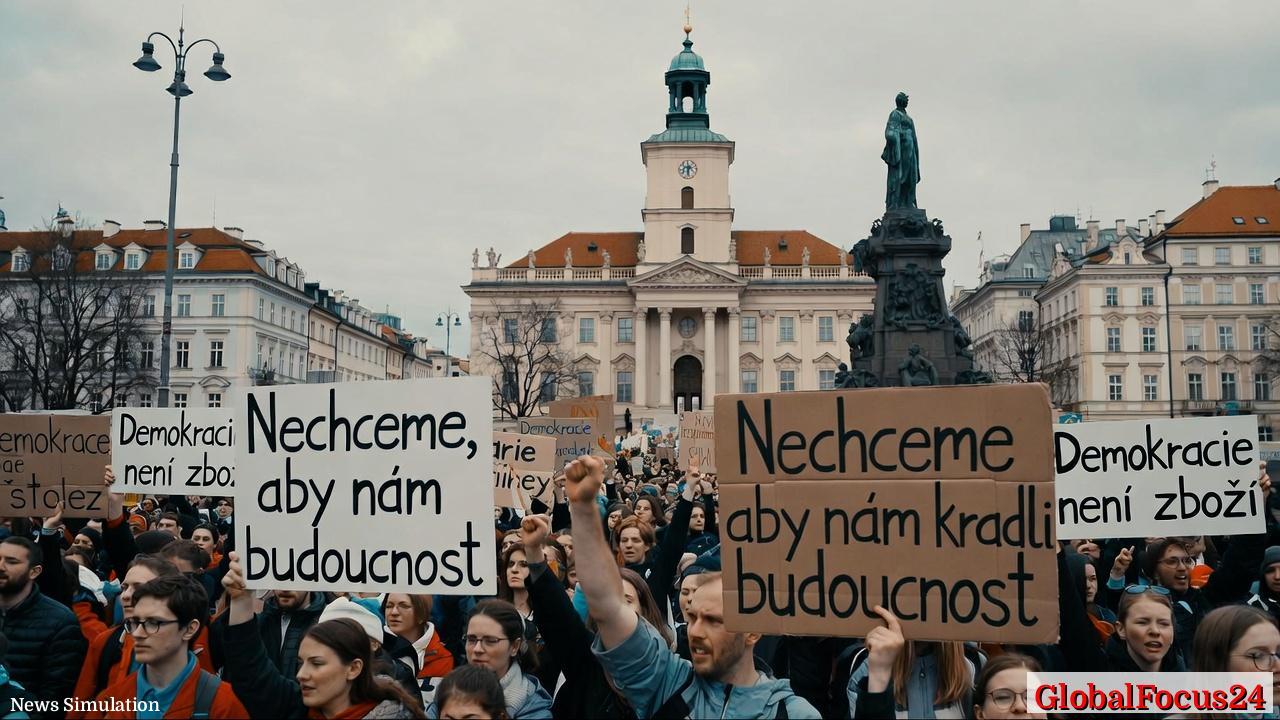
Hundreds of Thousands Rally in Prague Against Babiš Government Amid Rising Concerns Over Democratic Backsliding
Massive Turnout in the Czech Capital
PRAGUE — One of the largest demonstrations in recent Czech history filled Prague’s Letná Plain on Saturday, as hundreds of thousands of people gathered to protest what they see as growing threats to democracy under the government of Prime Minister Andrej Babiš. Organizers estimated that around 400,000 protesters took part, waving national flags and carrying signs that read, “We will not let our future be stolen.”
The demonstration marks a decisive moment in the Czech Republic’s political landscape, reminiscent of the mass rallies that toppled communist rule in 1989. This time, citizens rallied not against a single-party regime, but against what critics describe as an erosion of democratic institutions and the increasing political influence of business interests tied to the state.
The atmosphere in Prague was charged yet peaceful. Protesters from across the country arrived by bus and train, packing the wide boulevards leading to the park. Demonstrations of this scale have not been seen since Babiš first took office in 2017, signaling renewed public frustration over his consolidation of political and economic power.
Core of the Discontent: Accusations of Oligarchic Influence
At the heart of public anger lies mounting concern that the billionaire-turned-politician is leveraging his media empire and economic clout to entrench himself in power. Critics argue that the government’s recent moves—particularly proposed changes to public broadcasting funding and new restrictions on foreign-funded organizations—represent an attempt to tighten state control over independent institutions.
The spark that ignited Saturday’s protests was the introduction of a controversial “foreign agents” bill. The law, modeled closely on Russian legislation, would require non-profit groups and media outlets receiving funding from abroad to register as “foreign agents.” Opponents say it could stigmatize civil society organizations and investigative journalists, effectively muzzling critics of the government.
Jan Svoboda, a university lecturer and one of the event’s organizers, said the protest aimed to “defend the right to an independent civil society.” He described the legislation as “a dangerous step that echoes policies in countries where democracy has already been hollowed out.”
Warnings of Democratic Backsliding
The scale of the demonstrations underscores a wider regional trend toward democratic decline that has worried both Czech citizens and European observers. Protesters and opposition leaders warned that the Czech Republic could follow the path of Hungary and Slovakia, where populist governments in recent years have curbed judicial independence and weakened press freedom.
“Democracy does not disappear overnight—it erodes slowly,” said opposition lawmaker Petra Nováková during her speech to the crowd. “What we are witnessing are the early signs of that erosion: attacks on media, politicization of public institutions, and rhetoric designed to divide society.”
Political analysts note that the situation in Prague mirrors broader fissures within Central Europe, where countries once hailed as post-communist success stories now struggle with political polarization. Hungary, under Viktor Orbán, has openly challenged liberal democratic norms; Slovakia, too, has faced growing concerns about corruption and state capture.
Economic Undercurrents and Public Frustration
Beneath the surface of political outrage lies a deep sense of economic unease. While the Czech Republic remains one of the most stable economies in Central Europe, inflation, housing costs, and stagnant wages have eroded public confidence in the government. Rising energy prices and slowing industrial growth have further strained households.
The Babiš government has faced criticism for cutting defense spending and for what opponents describe as a “soft” approach toward Russia, even as regional tensions remain high following Moscow’s continued pressure on Eastern Europe. Many Czechs worry that a failure to align more firmly with NATO and EU partners could undermine the nation’s security and international standing.
Economists have also warned that limiting transparency and weakening institutional checks could deter investment. “Political stability and the rule of law are essential to long-term economic competitiveness,” said Markéta Horáková, an economist at Charles University. “If the perception of corruption or authoritarian drift deepens, it will have real costs for the Czech economy.”
The Historical Echo of 1989
The protest’s visual and symbolic language drew heavily from the Velvet Revolution. Some demonstrators carried candles and jingled their keys, a reference to the historic moment when Czechs symbolically “unlocked” their path to freedom. The echoes of history were deliberate: an assertion that democratic vigilance remains as vital now as it was over three decades ago.
In the late 1980s, Prague’s Letná Plain hosted peaceful protests that ultimately brought down the communist regime. Many who attended Saturday’s event invoked that memory, noting the generational shift in what citizens are now fighting for. This time, they said, the battle is not to win democracy, but to preserve it.
Among the crowd was 72-year-old Milan Dvořák, who participated in the 1989 protests. “Then we wanted to end one-party rule,” he said. “Now we want to stop one man from controlling everything.”
Government Response and Calls for Dialogue
Prime Minister Babiš, responding to the protests, accused the opposition of “spreading panic” and dismissed accusations of democratic backsliding. His spokesperson stated that the government remains “committed to upholding European values” and to fostering “transparency and open debate.”
However, the administration’s messaging has done little to calm public mistrust. The proposed media reforms, which would shift funding oversight from parliament to a newly appointed council, have been seen by journalists and cultural figures as an attempt to silence dissent. Several newsrooms have already issued public statements calling for the bill’s withdrawal, arguing that it would undermine editorial independence.
Analysts suggest that the government’s next steps could determine whether Saturday’s protests mark a fleeting outburst or the beginning of sustained civil resistance. “If authorities proceed with these reforms without public consultation, they risk galvanizing an opposition movement with significant political weight,” said Tomáš Richter, a political scientist at Masaryk University.
Comparing Czech Developments with Regional Trends
In the broader Central European context, the Czech Republic’s political trajectory reflects a regional tension between populist governance and liberal democratic traditions. In Hungary, restrictive legislation against NGOs and media outlets has reshaped the political landscape. Slovakia, after years of corruption scandals, has seen waves of protests demanding accountability and judicial reform.
Unlike its neighbors, however, the Czech Republic has thus far maintained a robust opposition and a vibrant civil society. Many protesters in Prague cited this difference as a reason for hope. “We still have space to change the direction of our country,” said activist Lucie Kovářová. “But that window is closing.”
The European Union has also taken a keen interest in developments in Prague. While Brussels has avoided direct confrontation with Babiš’s government, EU officials have repeatedly emphasized that democracy, rule of law, and media independence remain core conditions for member states receiving structural funds.
A Moment of Choice for Czech Democracy
As night fell over Prague, chants echoed across the Vltava River, and demonstrators held up mobile phones like lanterns in a sea of light. Organizers promised to sustain pressure through further demonstrations and civic initiatives if the government does not withdraw the contested legislation.
The scale and symbolism of Saturday’s protest have made clear that many Czechs view this moment as a crossroads. Whether the government responds through dialogue or dismissal could shape the country’s democratic fabric for years to come.
For now, the message from the streets of Prague remains unequivocal—a collective demand that the Czech Republic preserve its hard-won democratic freedoms and resist the temptation of oligarchic power.