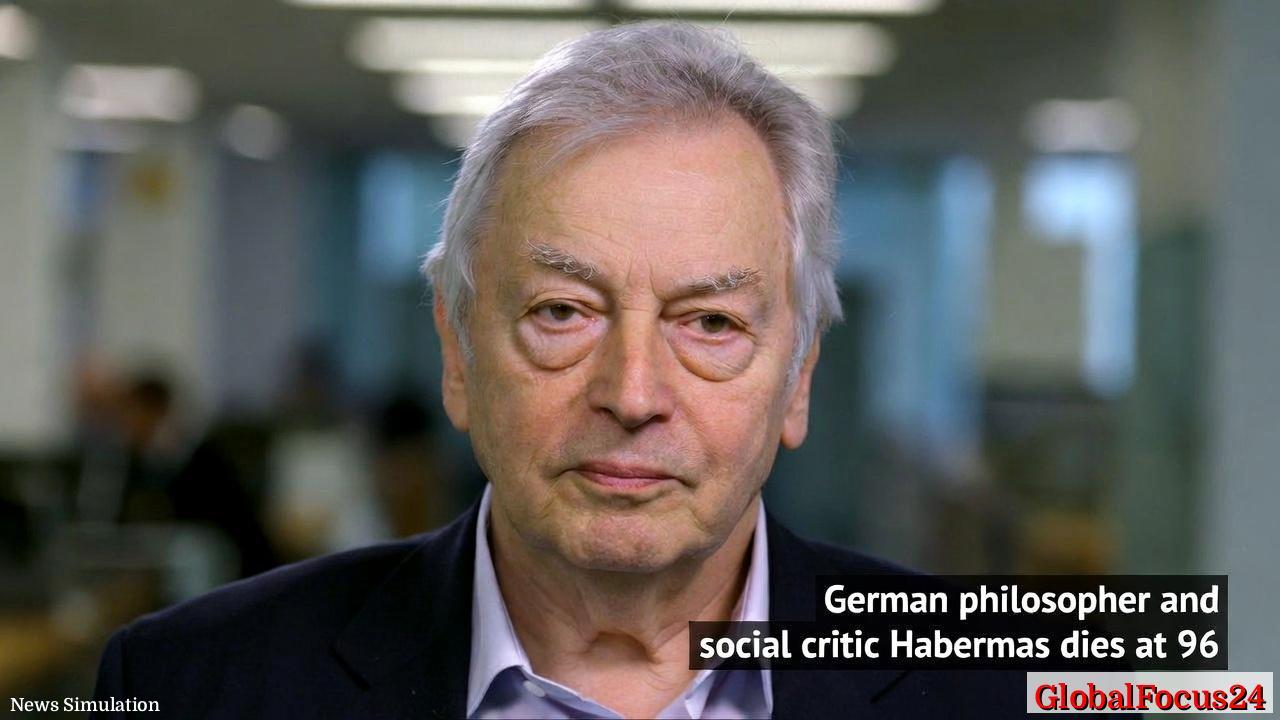
Jürgen Habermas, Architect of Modern Critical Theory, Dies at 96
Jürgen Habermas, a defining voice of post-war European thought whose ideas on democracy, communication, and the public sphere reshaped modern social philosophy, has died at the age of 96. His passing marks the end of an era for critical theory, a tradition that sought to understand and challenge the ways power and ideology shape modern life.
Habermas’s intellectual influence spanned more than six decades, bridging philosophy, sociology, and political science. His work helped frame the democratic values of postwar Europe and inspired generations of scholars and activists seeking to reconcile freedom, rational debate, and social progress in an increasingly complex world.
Early Life in a Fractured Germany
Born in Düsseldorf, Germany, in June 1929, Habermas grew up during the turmoil of the Nazi era. As a child, he was briefly part of the Hitler Youth—a compulsory rite of passage for most German adolescents—but was too young to serve in World War II. The moral and intellectual devastation that followed the war left a lasting imprint on him.
Habermas often described his adolescence as a confrontation with the “silences and evasions” of postwar Germany. The discovery of the Holocaust and his father’s affiliation with the Nazi Party compelled him, as he later recounted, to question authority and cultivate an unwavering faith in open dialogue and democratic accountability.
He began studying philosophy after the war at Marburg University, then joined the University of Frankfurt’s Institute for Social Research, where the Frankfurt School had its intellectual home. This postwar generation of thinkers—including Max Horkheimer and Theodor Adorno—sought to probe how modern societies, driven by capitalism and technology, could foster conformity even in the absence of overt totalitarian control.
The Frankfurt School and Critical Theory
Habermas emerged as the most enduring heir to the Frankfurt School of Critical Theory, a movement that blended Marxist social analysis with philosophy, sociology, and psychoanalysis. Yet while earlier members like Adorno had grown deeply pessimistic about modernity, Habermas resisted pure despair.
He believed reason and communication, properly structured and liberated from domination, could still serve as foundations for a just and democratic society. His theory of communicative rationality proposed that mutual understanding and dialogue, not coercion or strategic manipulation, should guide human interaction—an ideal that would come to define his life’s work.
His 1981 two-volume magnum opus, The Theory of Communicative Action, synthesized this vision. Building on both the German philosophical tradition and American pragmatism, Habermas argued that modern societies sustain themselves not merely through political institutions or economic power, but through the shared pursuit of understanding—through the capacity of citizens to reason together about their common world.
A Voice for the Postwar Generation
Throughout the 1960s and 1970s, Habermas became a major public intellectual in West Germany. Teaching at the University of Frankfurt, he saw universities as laboratories for democratic participation. He supported the student protest movements of the 1960s, defending their call for reform and transparency while cautioning against radical impulses that risked sliding into violence.
During this period, his public defense of rational debate distinguished him from many contemporaries on both the Left and the Right. While sympathetic to critiques of capitalism, Habermas was wary of revolutionary shortcuts. His trust in language, discourse, and procedural democracy became guiding principles not only for German society but also for Western democratic theory more broadly.
The Public Sphere and Modern Democracy
Among Habermas’s most cited contributions is his concept of the public sphere—a space where citizens engage in rational debate, free from coercion, to hold power accountable. This idea, articulated in his early work The Structural Transformation of the Public Sphere (1962), traced how the growth of mass media and commercial culture had eroded genuine public dialogue, replacing it with consumption-driven passivity.
For Habermas, the vitality of democracy depended on citizens’ ability to deliberate openly. He warned that politicized media and market manipulation could transform informed publics into “spectators” rather than participants, threatening the very foundations of democratic legitimacy.
This framework proved prescient in later decades, as the internet, social media, and global information networks reshaped the contours of public discourse. Many contemporary thinkers have returned to Habermas’s early writings to understand the challenges of digital misinformation and the polarization that accompany them.
Historical Debates and German Identity
In the 1980s, Habermas played a central role in the so-called Historikerstreit—a historiographical debate among German intellectuals and historians over how the nation should remember the Holocaust. When some conservative historians attempted to relativize Nazi crimes by comparing them to other atrocities, Habermas responded with incisive criticism, defending the singular moral responsibility of Germany’s past.
His interventions in these debates helped solidify his status as Germany’s “moral conscience.” He insisted that democratic legitimacy in postwar Europe depended on facing history honestly, rather than seeking national redemption through denial or revision.
When the Berlin Wall fell and German reunification began in 1989–1990, Habermas again urged caution. While welcoming freedom for East Germans, he worried that rapid absorption into the West could unleash revived nationalism. He advocated for gradual integration and broader European unity as a bulwark against the return of parochial politics.
The European Project and Global Democracy
In later decades, Habermas became one of Europe’s most prominent defenders of integration and supranational governance. He viewed the European Union not merely as an economic bloc, but as a moral and political project—a chance to realize cosmopolitan democracy on a continental scale.
He argued that overcoming the limitations of nation-states was crucial for addressing global challenges such as migration, inequality, and climate change. His writings in the 1990s and 2000s, including The Postnational Constellation, called for deeper cooperation between democratic societies and for institutions that allowed citizens to participate meaningfully beyond their national borders.
While critics faulted his optimism about bureaucratic institutions, Habermas remained steadfast in his belief that democracy must evolve alongside globalization. His philosophy continued to inspire debates about the future of governance in an interconnected world.
Influence Beyond Philosophy
Habermas’s reach extended far beyond academia. His commitment to rational dialogue influenced fields as wide as law, education, and communication studies. The model of participatory debate he envisioned echoes in everything from media ethics to modern deliberative democratic theory.
In the United States, Britain, and across Asia, his ideas have shaped policy discussions and philosophical discourse. His analysis of modernity as an “unfinished project” resonated with both liberals and social democrats seeking to balance progress with human values.
He received numerous honors throughout his life, including the Kyoto Prize, the Erasmus Prize, and the Holberg International Memorial Prize. These awards recognized not only his philosophical contributions but also his enduring impact on public reasoning and democratic ideals.
Personal Life and Enduring Legacy
Habermas was known for his reserved demeanor, marked by humility and exacting precision. Born with a cleft palate that required several surgeries in childhood, he later reflected that his early struggles with speech shaped his fascination with communication and understanding.
He continued to write and lecture well into his nineties, publishing essays on ethics, religion, and democracy. Even as digital technology and populist politics reshaped public communication, Habermas remained a steadfast believer in reason’s power to guide collective life.
His influence persists in a generation of scholars who continue to expand his theories in areas such as deliberative democracy, feminist critique, and global justice. Universities on several continents still regard his frameworks as foundational to understanding how societies can sustain rational, inclusive dialogue amid deep cultural and political divisions.
A Philosopher for the Democratic Age
Jürgen Habermas leaves behind a legacy both intellectual and civic. He sought to reconcile faith in human reason with the lessons of history’s darkest episodes. His lifelong project—to preserve the conditions for public reasoning and mutual understanding—remains one of the most ambitious moral undertakings of the modern era.
In a world increasingly fractured by disinformation, polarization, and distrust, Habermas’s insistence on dialogue as the essence of democracy offers a renewed call for reflection. His life’s work stands as a reminder that the health of a society depends not only on its economic might or political structure, but on its citizens’ ability to speak, listen, and reason together in pursuit of truth.