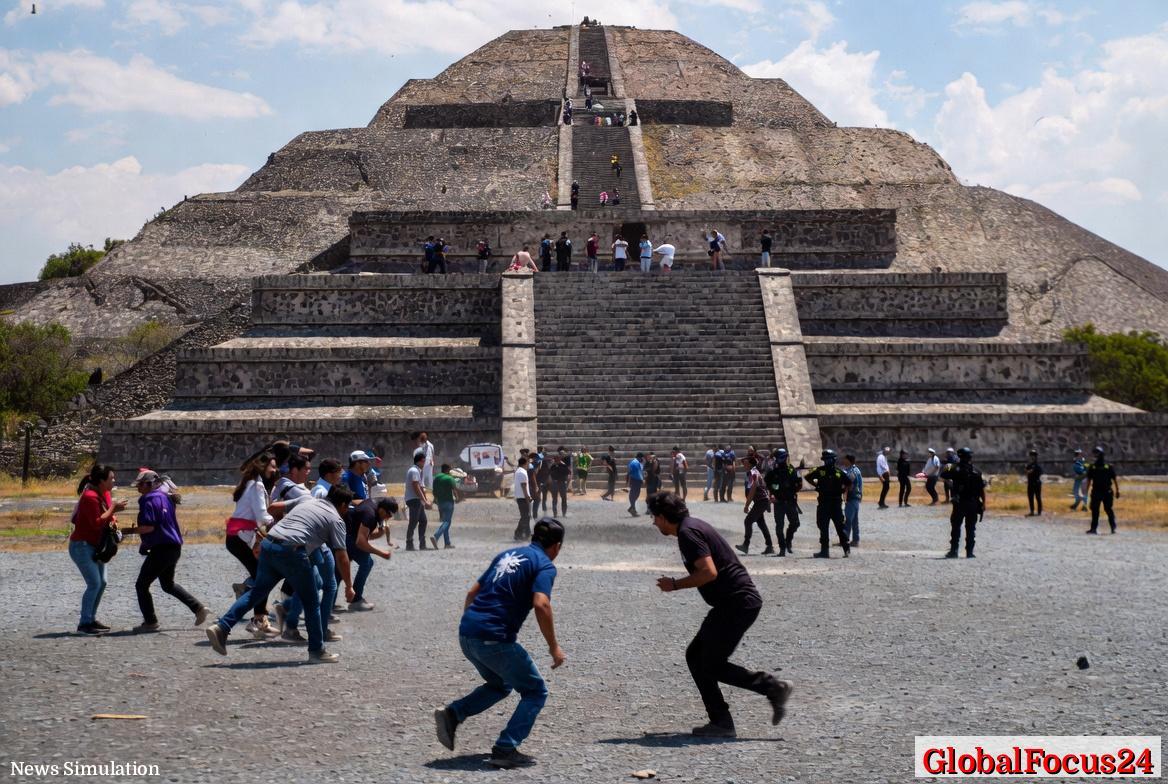
Deadly Shooting at Teotihuacán Shocks Tourists, Raises Security Concerns at Mexico’s Iconic Archaeological Site
Gunfire Erupts at Historic Landmark
A shooting at the Teotihuacán archaeological site outside Mexico City left one Canadian tourist dead and 13 others injured on Monday, marking an unprecedented act of violence at one of the country’s most visited cultural landmarks. Authorities confirmed that the gunman, whose identity has not yet been publicly disclosed, opened fire near the Pyramid of the Moon before taking his own life.
The incident unfolded during peak visiting hours, when hundreds of tourists typically gather to explore the ancient city’s towering pyramids and ceremonial avenues. Witness videos captured the chaos as gunfire echoed across the site, sending visitors scrambling for cover. In one recording, tourists can be seen crouching behind stone structures as screams pierced the air.
Emergency responders from both state and federal security forces arrived swiftly after distress calls were made. By the time they secured the area, two individuals were confirmed dead: the suspected shooter and a Canadian national visiting the site.
Injuries Span Multiple Nationalities
Authorities reported that 13 people sustained injuries, including seven with gunshot wounds. The victims reflect the international draw of Teotihuacán, with injured tourists identified from several countries. Among them were six U.S. citizens, two of whom were shot. Two minors, aged 6 and 13 from Colombia and Brazil respectively, were also among the wounded.
All injured individuals were transported to nearby hospitals in Mexico City and surrounding municipalities. Medical officials indicated that several victims remained in serious condition, though no additional fatalities had been reported as of late Monday evening.
The presence of children among the injured has intensified public concern, particularly given the site’s reputation as a family-friendly destination.
A Site Steeped in History
Teotihuacán, located roughly 30 miles northeast of Mexico City, is one of the most significant archaeological sites in the Americas. Established around 100 BCE and flourishing until approximately 550 CE, it was once among the largest cities in the ancient world, with an estimated population exceeding 100,000 at its peak.
The site is best known for its monumental structures, including the Pyramid of the Sun and the Pyramid of the Moon, as well as the Avenue of the Dead, which runs through the heart of the ancient city. Recognized as a UNESCO World Heritage Site, Teotihuacán attracts millions of visitors annually, making it a cornerstone of Mexico’s tourism industry.
Historically, the site has been regarded as a safe and controlled environment, with security measures focused primarily on preservation and crowd management rather than protection against violent crime. Monday’s attack challenges that longstanding perception.
Security Measures Under Scrutiny
The shooting has prompted renewed scrutiny of security protocols at major tourist destinations in Mexico. While the country has grappled with issues related to organized crime and violence in certain regions, archaeological zones like Teotihuacán have generally remained insulated from such incidents.
Security at these sites typically includes:
- Controlled entry points with ticketing systems.
- On-site guards and limited police presence.
- Surveillance cameras focused on artifact protection.
- Emergency response coordination with local authorities.
However, the scale and nature of the attack have raised questions about whether these measures are sufficient in the face of unpredictable threats.
Officials have indicated that a comprehensive review of security procedures is underway. Additional federal forces may be deployed to major tourist sites in the short term, and discussions are expected regarding enhanced screening protocols for visitors.
Economic Impact on Tourism
Tourism is a vital component of Mexico’s economy, contributing significantly to employment and foreign exchange earnings. Archaeological sites like Teotihuacán play a central role in attracting international visitors, particularly from North America and Europe.
In 2024, Mexico welcomed more than 40 million international tourists, with cultural tourism accounting for a substantial portion of that figure. Teotihuacán alone receives an estimated 4 to 5 million visitors each year.
Incidents of violence at high-profile destinations can have immediate and lasting economic repercussions. Travel advisories may be updated, tour operators could see cancellations, and visitor confidence may decline in the short term.
Comparisons can be drawn to similar घटनाओं in other global पर्यटन hotspots. For example:
- In Egypt, isolated security incidents near archaeological sites led to temporary declines in visitor numbers, followed by gradual recovery after increased security measures.
- In France, attacks in public spaces affected tourism flows but were mitigated over time through visible policing and international cooperation.
- In Turkey, incidents near historic landmarks prompted rapid government action to reassure travelers and stabilize the पर्यटन sector.
Mexico’s response in the coming days will likely play a crucial role in determining whether this घटना leads to a sustained impact on visitor numbers or remains an isolated disruption.
Public Reaction and International Response
The shooting has triggered an outpouring of concern both domestically and internationally. Social media platforms were flooded with firsthand accounts and footage from the scene, amplifying the sense of भय and urgency.
Foreign governments, including those of Canada and the United States, have acknowledged the incident and are working with Mexican authorities to provide assistance to affected citizens. Consular services have been activated to support victims and their families.
Tourism industry stakeholders, including hotel operators and tour agencies, have expressed condolences while emphasizing the importance of maintaining traveler confidence. Some operators have reported an uptick in inquiries regarding safety conditions at popular destinations.
Investigating the Motive
As of Monday evening, the motive behind the shooting remained unclear. Authorities have not indicated whether the attack was premeditated or if the gunman had any known affiliations or grievances.
Investigators are examining several lines of inquiry, including:
- The shooter’s personal background and mental health history.
- Possible connections to criminal organizations or ideological motives.
- The method by which the firearm was brought into the site.
Forensic teams continue to process the scene, while surveillance footage and witness statements are being analyzed to reconstruct the sequence of events.
Balancing Accessibility and Safety
The घटना underscores the broader challenge faced by cultural heritage sites worldwide: balancing accessibility with security. Open, expansive environments like Teotihuacán are designed to accommodate large numbers of visitors while preserving historical authenticity. Introducing stricter security measures must be carefully managed to avoid disrupting the visitor experience.
Experts suggest that a layered approach to security may be necessary, combining visible deterrence with discreet monitoring. Potential measures could include:
- Enhanced प्रवेश screening using non-invasive technology.
- Increased uniformed presence to reassure visitors.
- Real-time communication systems for rapid emergency response.
Such strategies have been implemented in other high-traffic पर्यटन sites with varying degrees of success.
A Turning Point for Cultural Tourism Security
Monday’s shooting represents a rare but significant breach of safety at one of Mexico’s most treasured landmarks. While the full implications will unfold over time, the incident has already sparked critical conversations about how best to protect visitors without compromising the accessibility and cultural value of historic sites.
For now, Teotihuacán stands as both a symbol of ancient civilization and a reminder of modern vulnerabilities. As investigators work to uncover the причины behind the attack, authorities face the urgent task of restoring confidence in a destination that has long been considered a cornerstone of global cultural tourism.