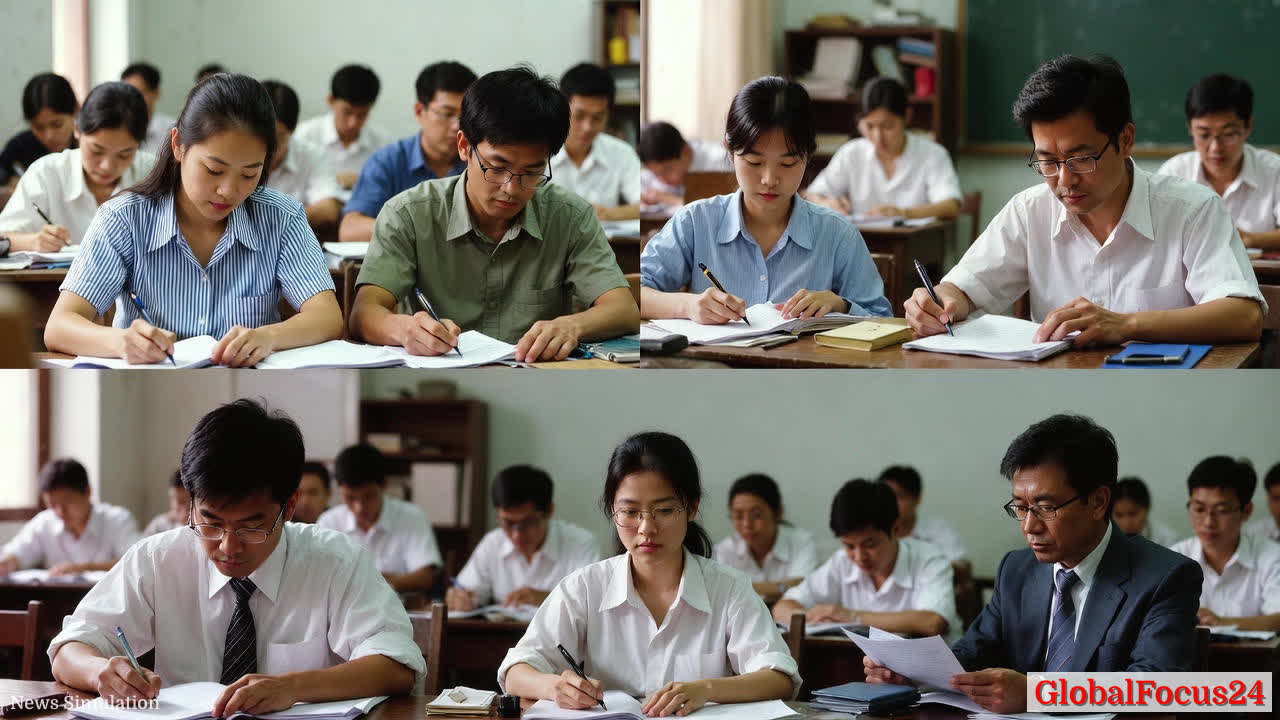
Civil-Service Exams in China and India: Grueling Tests Shaping Societies
Civil-service examinations in China and India stand as formidable gateways to government positions, offering candidates security, status, and financial stability. These tests, known for their extreme difficulty, attract millions annually but select only a tiny fraction, influencing not just individual careers but broader societal structures. The enduring relevance of these exams reflects deep historical roots, persistent economic imperatives, and regional parallels that illuminate how meritocratic systems shape governance, labor markets, and public life.
Historical context and evolution
China’s civil service tradition traces back to imperial curricula designed to recruit literate, capable officials who could administer a vast empire. The legacy arc stretches from the ancient keju system to the modern National Civil Service Examination, known as guokao. The keju mechanism, formalized during dynastic eras, rewarded scholarly achievement and standardized the path to bureaucratic roles. This lineage framed merit as a counterweight to aristocratic privilege, enabling social mobility through disciplined study. The guokao, established in its contemporary form in 1947 and refined over time, echoes that historical ambition: to identify competent administrators from a broad applicant pool, with examinations that test aptitude, policy knowledge, and administrative thinking. The system’s endurance speaks to China’s preference for centralized technocratic governance, a model that has evolved but remained influential in modern policymaking.
India’s civil services heritage has its own colonial and postcolonial trajectory. Introduced during British rule as a mechanism to administer a large and diverse subcontinent, the Civil Services Examination was retained after independence as a cornerstone of governance. The examination structure—preliminary screening, a rigorous main exam with multiple essay-style papers, and a personality assessment during interviews—embodies a deliberate balance between knowledge, critical thinking, and temperament. Over decades, reforms expanded the curriculum and added components such as ethics and general knowledge to reflect evolving administrative needs. The Indian system’s continuity underscores a national consensus on the importance of a capable, nonpartisan bureaucracy for managing a complex, diverse society.
Economic impact and workforce dynamics
The sheer scale of applicants demonstrates the economic and opportunity costs tied to civil-service exams. In both countries, tens of millions view these exams as a pathway to job security and social status, prompting intense investment in coaching, prep materials, and time. The downstream effects include delayed entry into the private labor market for many young graduates, which can suppress early-stage consumer spending and alter career trajectories. In China, the competitive pipeline into state governance intersects with a broader push toward technocracy, where specialized knowledge in policy, law, and administration translates into influence over regulatory environments, urban planning, and public finance. In India, the exam serves as a gatekeeper to a wide array of administrative roles across central and state governments, shaping regional development, public service design, and implementation of federal policies.
Low success rates are a defining reality. Roughly, only a small percentage of test-takers secure appointments each year—well under 2% in many cycles. This elevated selectivity reinforces a merit-based narrative but also concentrates opportunity among those with substantial resources and support networks for preparation. The economic implications extend beyond individual outcomes: the high value placed on examination success incentivizes sustained investment in coaching industries, mock tests, and study materials, contributing to a substantial supplementary economy around public service recruitment.
Societal effects, mental health, and public perception
The social reverberations of such exams are profound. For many, the pursuit becomes a defining life project—an all-consuming quest that shapes daily routines, social status, and family expectations. The pressure upholds a narrative of meritocratic fairness, yet the intense competition can exacerbate mental health challenges, including anxiety, depression, and burnout. There are real concerns about the toll of prolonged preparation, especially when individuals sacrifice income and personal time for many years in hopes of a breakthrough. In both countries, public discussion increasingly recognizes the need for balance: ensuring rigorous standards while broadening pathways to public service that reward practical leadership, teamwork, and on-the-job judgment.
Administrative efficiency and global comparisons
From a global perspective, the rigorous selection process aims to improve governance by aligning public servants with complex, high-stakes responsibilities. Yet both nations face ongoing questions about overall administrative effectiveness and public sector performance. Global metrics sometimes reveal that even with elite entry mechanisms, bureaucratic efficiency hinges on pathways for ongoing training, incentives for innovation, and capacity-building across local and national levels. The exams’ aspirational goals—competence, integrity, and public trust—depend not only on entry criteria but also on the quality of training, career progression, and policy outcomes that follow appointment.
Regional comparisons offer a nuanced view. In East Asia, centralized meritocratic exams have historically supported large-scale administrative coherence, facilitating rapid implementation of government programs and coordinated economic development. South Asia’s federated structure, with substantial state-level autonomy, requires a broader approach to recruitment that harmonizes national standards with regional needs. Both models emphasize the importance of standardized assessment but differ in how they translate merit into day-to-day governance, accountability, and leadership development. The evolving role of technology and data analytics in examination design, candidate tracking, and performance evaluation is a common thread driving modernization efforts in both contexts.
Illustrative questions and testing philosophy
To understand the exam experience, it helps to glimpse the variety of assessment components. In China, the guokao combines multiple-choice sections that measure aptitude with policy-focused essays that test comprehension of governance issues, legal frameworks, and social policy implications. The interview phase probes analytical thinking, ethical reasoning, and the ability to translate policy concepts into practical administrative strategies. In preparation, candidates often study broad historical, legal, and social topics, developing a capacity to synthesize information and present coherent policy arguments under time pressure. In India, the civil services exam includes a preliminary round to filter candidates, followed by a demanding main examination featuring nine essay-style papers on topics ranging from governance to ethics and public administration. The personality test or interview stage assesses communication, temperament, and leadership potential—elements that are crucial for frontline administration and crisis management. These formats reflect a shared belief in the value of well-rounded civil servants who can navigate complex policy landscapes.
Public reaction and future outlook
Public attitudes toward civil-service examinations are diverse and context-specific. For some, the exams symbolize opportunity, social mobility, and national service. For others, the process is a rigorous, sometimes opaque, system that may privilege certain preparation resources or socio-economic backgrounds. In both countries, policymakers face the challenge of preserving rigorous standards while expanding access and modernizing selection methods. Ongoing discussions explore incorporating experiential assessments, situational judgment tests, and ongoing professional development to complement traditional exams. The goal is to cultivate a bureaucracy capable of adaptive leadership, cross-functional collaboration, and evidence-based policy implementation.
Conclusion
Civil-service examinations in China and India endure as central institutions that shape careers, governance, and societal expectations. They embody a long-standing belief in meritocratic selection while highlighting the human costs and social consequences that accompany high-stakes testing. The interplay between historical legacies, economic implications, and regional governance needs ensures that these exams will continue to evolve. As both nations navigate the demands of 21st-century governance, the balance between rigorous academic assessment and practical administrative capability will remain a defining feature of their public sectors, influencing not only who serves but how effectively they serve their communities.