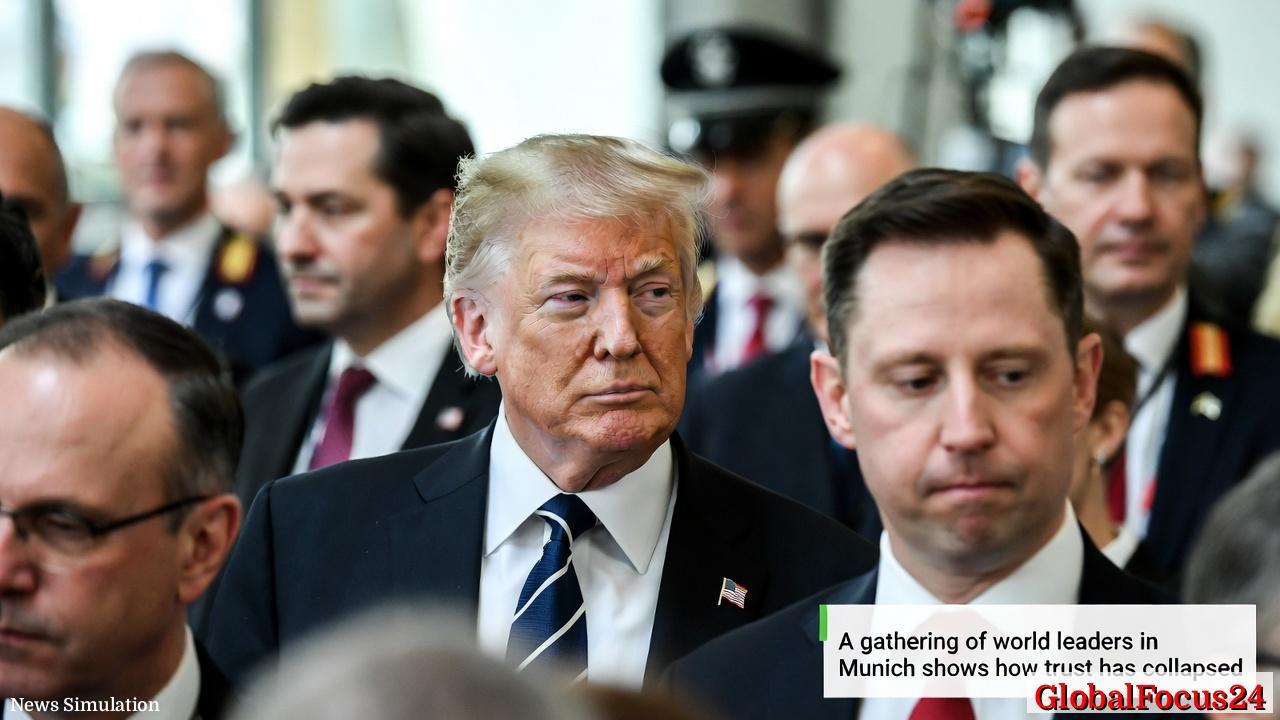
Global Trust Crisis Deepens as World Leaders Clash in Munich
MUNICH — What began as a routine gathering of world leaders in Bavaria has instead become a sobering reflection of the shifting international order. The annual Munich Security Conference, traditionally a forum for reaffirming Western unity, revealed this week the fragility of trust that now defines relations among major powers. Diplomats, defense chiefs, and heads of government filled the ornate halls of the Bayerischer Hof hotel, but the convivial tone of past years was replaced by tension, uncertainty, and barely concealed frustration.
A Fractured Transatlantic Alliance
Envoys sent by former U.S. President Donald Trump, returning to the global stage amid speculation about his renewed political influence, sought to reassure longtime allies of America’s continued leadership. Yet their messages appeared to fall flat. European ministers voiced doubts behind closed doors about Washington’s reliability, referencing years of fluctuating commitments to NATO, shifting trade priorities, and abrupt foreign policy reversals.
German Chancellor Annalena Baerbock underscored that “alliances cannot function on memory alone,” a pointed reminder of Europe’s growing determination to build greater self-reliance in defense and energy security. French and Polish officials echoed similar concerns, emphasizing the need for what one delegate called a “post-illusion strategy” — strengthening Europe’s capabilities in anticipation of potential U.S. disengagement.
The tension underscored a broader transformation: the transatlantic partnership that defined the 20th century is struggling to adapt to an era of multipolar rivalry, technological competition, and domestic political volatility.
Europe’s Anxiety and America’s Ambiguity
Across closed briefings, European diplomats privately voiced apprehension about the direction of U.S. foreign policy. While the current administration has reaffirmed its support for NATO and Ukraine, the possibility of shifting priorities under another Trump term has unnerved policymakers. Participation at Munich by Trump’s foreign policy surrogates — business figures and ex-officials loyal to his worldview — added to the uncertainty. Their message, couched in pragmatic terms, emphasized burden-sharing and national sovereignty, but offered little clarity on long-term commitments.
The ambiguity has real-world implications. Defense budgets across Europe are rising at the fastest pace in decades, with Germany’s newly established €100 billion modernization fund marking a generational turning point. Yet, despite widespread recognition of the need for stronger capabilities, European militaries remain heavily reliant on U.S. logistical networks and intelligence infrastructure. The fear of strategic abandonment — once a theoretical debate among think tanks — now shapes real policy.
Historical Parallels and Lessons Ignored
Several analysts at the Munich gathering drew parallels to earlier moments of uncertainty, from the post-Vietnam realignment of the 1970s to the crises of the early 2000s when the Iraq War fractured transatlantic unity. Each period forced allies to recalibrate expectations about American leadership. Yet what differentiates this moment, diplomats suggested, is the cumulative fatigue of repeated shocks — from the withdrawal from Afghanistan to trade frictions and pandemic-era isolationism.
The erosion of trust has unfolded not through a single rupture but through a steady accumulation of doubts. As one senior European adviser remarked, “We are not witnessing a collapse; we are witnessing corrosion.” That corrosion is visible in dwindling policy coordination, erratic communication channels, and growing reliance on regional ad hoc coalitions rather than global institutions.
The Global South’s Expanding Voice
Beyond the Atlantic theater, representatives from Africa, Latin America, and South Asia used the Munich stage to challenge what they described as Western double standards. Leaders from Kenya, Brazil, and Indonesia underscored the growing expectation that global governance structures must reflect demographic and economic realities of the 21st century. Their statements highlighted an accelerating shift: influence is diffusing, and the old guardians of order struggle to adapt.
In energy and trade discussions, emerging economies pushed for fairer terms in technology transfer, climate finance, and resource management. This assertiveness reflects their rising leverage; with global supply chains decoupling and new corridors from the Indo-Pacific to the Gulf expanding, Western policymakers can no longer assume alignment based on historical ties alone.
Economic Consequences of Diplomacy in Disarray
The diplomatic unease in Munich also carries tangible economic implications. Investor sentiment across global markets remains cautious amid geopolitical fragmentation. Defense and energy sectors saw mild upticks in anticipation of sustained rearmament and diversification. However, broader indicators — including the euro’s volatility and declining transatlantic investment flows — suggest growing nervousness over the long-term stability of Western trade frameworks.
Europe’s leadership vacuum compounds existing vulnerabilities. Debates over fiscal flexibility, the energy transition, and migration remain unresolved within the European Union. Meanwhile, U.S.-China competition continues to disrupt global research and manufacturing partnerships, further straining confidence in shared standards and intellectual property protections.
For multinational firms, fragmented regulation and tariffs triggered by competing geopolitical agendas are reshaping long-established production lines. Executives attending Munich described contingency planning as “the new normal” — rotating supply routes through Southeast Asia, reinforcing cybersecurity layers, and preparing for potential sanctions fluctuations reminiscent of the Cold War playbook.
Regional Comparisons Highlight Widening Gaps
Comparisons with Asia and the Middle East underscore just how dramatically Western cohesion has faltered. In Asia, the expansion of regional security dialogues like the Quad and AUKUS demonstrates how alliances rooted in shared strategic goals continue to evolve dynamically. Although not free from friction, these frameworks exhibit clearer alignment around emerging threats and technological cooperation.
In contrast, Europe’s internal divergences — between north and south, east and west — persist unresolved. Countries like Poland and the Baltic states advocate robust deterrence against Russia, while others such as Hungary and Slovakia pursue pragmatic engagement, reflecting divergent threat assessments. Southern European nations remain preoccupied with climate migration and Mediterranean security, further complicating collective action.
In the Middle East, long-time partners of the West are diversifying relationships with China and Russia, seeking economic and defense partnerships that dilute U.S. influence. The Munich conference reflected this realignment, as Gulf representatives spoke more openly about “multi-vector diplomacy” — balancing global ties rather than pledging exclusive loyalty.
Trust as the New Currency of Power
More than any new treaty or initiative, trust emerged as the defining theme of the Munich deliberations. Without it, even the most sophisticated alliances falter. Foreign ministers spoke of needing “strategic predictability” — a concept that transcends ideology and instead rests on dependable communication, consistent policy execution, and mutual respect for institutions.
Yet the task of rebuilding trust will be formidable. The very information ecosystems through which nations communicate — from encrypted military networks to public social media platforms — are now arenas of competition, disinformation, and surveillance. Transparency, once the foundation of diplomatic diplomacy, risks becoming a casualty in the race for digital advantage.
Public Reaction and the Waning Faith in Institutions
Public opinion across the Western world mirrors the disillusionment on display in Munich. Polls show declining confidence in international organizations such as the United Nations, NATO, and the World Trade Organization. Citizens increasingly perceive global engagement as costly or unresponsive to domestic needs. This domestic skepticism further constrains leaders’ willingness to compromise or invest in long-term alliances.
In Germany, protests against rising defense spending and energy inflation continued outside the conference perimeter. In the United States, political debates over foreign aid and the cost of overseas commitments dominate election-year rhetoric. Across France, Italy, and the Netherlands, populist movements capitalize on fatigue with internationalist policies once embraced as moral imperatives.
The cumulative effect is feedback between public distrust and diplomatic dysfunction — a cycle that weakens both governance and cooperation.
The Munich Takeaway: A Turning Point Unacknowledged
As the conference concluded, the mood was neither defiant nor celebratory, but unsettled. The absence of a unifying declaration — long a hallmark of the event — spoke volumes. Even as leaders reiterated familiar phrases about solidarity and shared values, the atmosphere was unmistakably defensive. Few believed that mere rhetoric could reverse the erosion of confidence underpinning today’s global instability.
The events in Munich underscored that the crisis of trust is not confined to any single nation or administration; it is structural. The international order built across seven decades relied on enduring habits of coordination — habits now fraying as new powers rise, societies polarize, and global challenges intensify.
The path forward may depend less on grand summits and more on slow, patient reconstruction of credibility — through consistent policy, accountability, and realistic expectations. Until then, the echoes of disquiet from Munich will linger as a warning: in an age of uncertainty, trust remains the world’s most fragile currency.