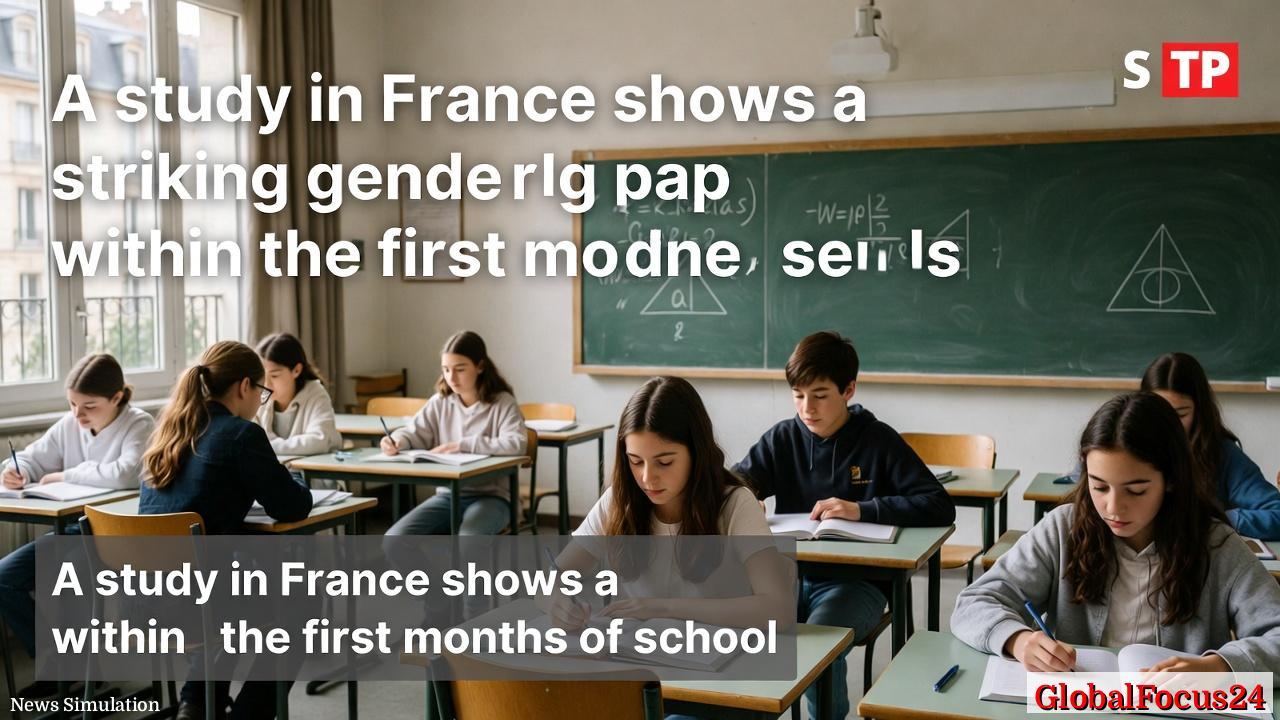
Study Reveals Early Gender Gap in French Schools as Girls Fall Behind in Mathematics
Early Learning Divide Raises Alarms in France’s Education System
A new longitudinal study conducted in France has revealed a surprising and concerning trend within the nation’s earliest levels of education: girls are already falling behind boys in mathematics within the first few months of primary school. The findings point to an emerging gender gap that takes root long before traditional testing benchmarks, prompting a reexamination of educational practices, social conditioning, and classroom dynamics across Europe’s historically egalitarian school systems.
The report, encompassing data from thousands of students across multiple French regions, challenges longstanding assumptions that gender differences in mathematical performance develop later in schooling or adolescence. Instead, researchers found distinctive patterns emerging as early as age six, suggesting that social perceptions, implicit biases, and pedagogical structures may contribute to diverging academic trajectories almost from the outset of formal education.
Measuring the Gap: What the Study Found
The French research team analyzed standardized math assessments and teacher evaluations conducted during the first year of elementary school. While overall academic performance between boys and girls appeared relatively balanced in reading and language comprehension, the gender gap in mathematics stood out as both statistically significant and widening over time.
By the end of the first academic term, boys on average scored several percentage points higher on basic arithmetic and spatial reasoning tests. Teachers also tended to report more confidence in boys’ problem-solving abilities, even when actual performance differences were minor. Girls, meanwhile, displayed higher levels of self-doubt regarding mathematical tasks, often coupling their perceived shortcomings with anxiety over “not being good at math,” a self-assessment increasingly correlated with early classroom experiences.
The researchers stressed that these findings do not reflect innate abilities. Rather, they highlight the interplay of subtle cues, differing expectations, and early feedback mechanisms that shape how children engage with quantitative reasoning.
Early Socialization and Stereotypes
Experts in developmental psychology have long warned that early socialization plays an outsized role in shaping learning attitudes. In the French study, classroom observations revealed that boys were often encouraged to take risks or explore different problem-solving strategies, while girls were praised for neatness or compliance.
Such differences, though seemingly minor, may accumulate into measurable disparities over time. When teachers correct errors differently — for instance, explaining missteps in detail to boys but simply marking girls wrong — it can reinforce varying levels of persistence in the face of academic difficulty.
In broader society, gendered messaging about math and science abilities often begins well before schooling, reflected in toys, media, and even family interactions. The French Education Ministry has previously acknowledged that stereotypes remain deeply ingrained despite repeated policy efforts to promote gender equality in classrooms.
Historical Context: France’s Longstanding Commitment to Equality
France has historically viewed education as a cornerstone of its republican values, emphasizing universal access and equality of opportunity since the 19th century. Reforms following the 1960s expanded educational opportunities for girls, leading to a generation that has outperformed boys in many academic fields, particularly in language and humanities.
However, mathematics has remained a persistent exception. Since the 1980s, national assessments have continuously shown a small but consistent difference in math proficiency between genders, especially at the secondary and university-preparatory levels. The new study indicates that the root causes of this divide may lie earlier than previously imagined, during foundational cognitive development.
In comparison, neighboring European countries such as Sweden and Finland have implemented early-childhood programs designed to neutralize these biases. These include curriculum standards that build confidence in numerical reasoning among all students and targeted teacher training focused on unconscious bias. While such measures have narrowed gaps elsewhere, France’s recent findings suggest that its strategies may need renewal.
Regional Disparities Within France
The study also noted variations across French regions, with more pronounced gender gaps observed in rural and lower-income areas compared to major metropolitan centers like Paris or Lyon. These differences likely reflect both socioeconomic and educational resource disparities.
In rural regions, schools often operate with larger class sizes, fewer specialized instructors, and limited access to advanced teacher training. Teachers in these areas frequently face additional challenges due to lack of staff support, making it harder to identify and address early confidence gaps. Urban schools, by contrast, tend to benefit from experimental pedagogies and dedicated gender-equality initiatives piloted by the Ministry of Education.
Socioeconomic background further compounds the issue. Families with higher educational attainment were found to intervene earlier, offering supplementary learning materials and positive reinforcement at home, while lower-income families were less likely to engage in mathematics-related activities outside school.
Economic Implications of the Gender Divide
An underrepresentation of women in science, technology, engineering, and mathematics (STEM) fields has long fueled concerns about Europe’s future competitiveness. Economists point out that early educational disparities can translate into long-term workforce imbalances, affecting productivity and innovation.
In France, women currently make up less than one-third of all STEM graduates and occupy an even smaller share of technical leadership roles in private industry. Studies by the Organization for Economic Cooperation and Development (OECD) suggest that reducing gender gaps in STEM could boost the country’s GDP by several percentage points over time, given the high demand for scientific and technical expertise in a digitizing economy.
If girls internalize lower mathematical confidence from an early age, it may discourage them from pursuing advanced coursework or careers requiring quantitative skills, perpetuating a cycle of underrepresentation. The French report thus links classroom inequalities not only to educational fairness but also to future economic resilience.
Reactions and Calls for Reform
The revelations sparked swift responses from educators, child development experts, and policymakers. Teachers’ unions have called for more structured professional development to help educators identify and counteract implicit bias in instruction. Some have also requested resources to promote cooperative learning models that encourage both boys and girls to participate equally in solving math problems.
The Ministry of National Education announced plans to expand gender-awareness training across all early-grade teacher education programs by 2027. Pilot initiatives in select academies will introduce revised lesson plans emphasizing inclusive language, balanced participation in classroom activities, and positive feedback loops aimed at boosting confidence among all students.
Public reaction has been mixed. Parents’ associations broadly welcomed the findings as an overdue wake-up call but warned against measures that might unintentionally stigmatize boys or foster resentment. “The goal should be true equality of opportunity — not correction through favoritism,” one national parents’ federation representative commented, underscoring the need for balanced responses.
International Comparisons
Globally, several nations have faced similar revelations. In the United Kingdom, research found that girls begin to show math anxiety as early as eight years old, largely influenced by parental expectations and teacher feedback. In the United States, large-scale assessments such as the National Assessment of Educational Progress (NAEP) indicate a narrowing but persistent gender gap in mathematics proficiency during elementary years.
Notably, countries with the smallest gaps — including Finland, Singapore, and Estonia — have integrated early numeracy programs emphasizing curiosity, teamwork, and non-competitive classroom environments. These curricula treat math as an exploratory language rather than a test of aptitude, reducing anxiety and encouraging broader participation.
France’s new findings provide an opportunity to reassess its pedagogical frameworks in light of these models. By enhancing teacher training, promoting family engagement, and diversifying classroom role models, education leaders hope to replicate the progress seen abroad.
Looking Ahead: Toward Equal Foundations
While the study’s revelations are cause for concern, they also highlight France’s data-driven approach to improving equality within education. Acknowledging early disparities allows policymakers to intervene at a point when mindsets are still forming, making corrective actions far more effective than later-stage reforms.
Experts advise ongoing monitoring to track whether new teaching strategies reduce the gender gap over successive school years. Additionally, expanding the focus beyond mathematics — into science exposure, spatial reasoning games, and logic-based play — could help nurture balanced cognitive development for all children.
The French education system, widely regarded as one of Europe’s models of public instruction, now faces a crucial moment of introspection. How it addresses this early-forming divide may shape not just the academic landscape of the next generation but also the country’s economic and social fabric in the decades to come.
For educators, parents, and policymakers alike, the challenge lies in translating awareness into sustained action — ensuring that the question of who succeeds in math depends not on gender, but on equal opportunity from the very first day of school.