Republicans Rally Behind Trump Over Iran War Despite Media Critics, Poll Finds
Strong Party Alignment Behind Trump’s Iran Strategy
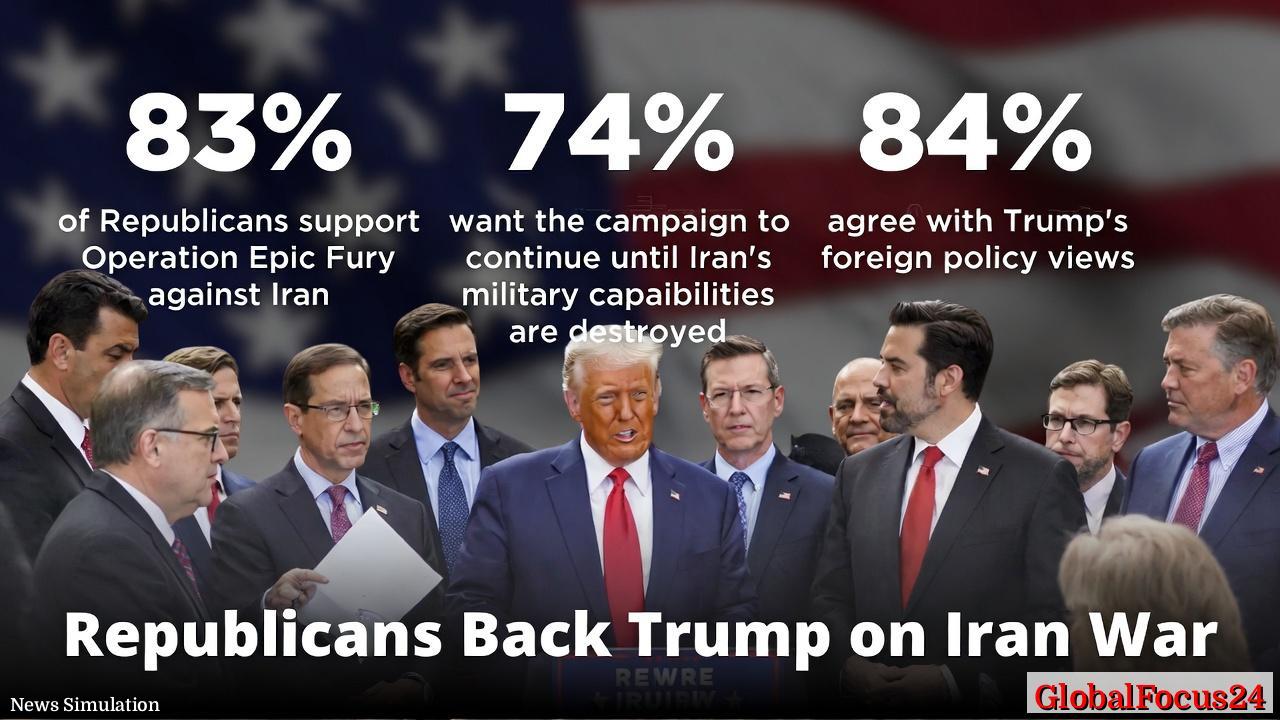
A new nationwide survey reveals overwhelming Republican support for President Donald Trump’s military campaign against Iran, contradicting suggestions of internal GOP disagreement. The J.L. Partners poll, conducted March 17–18 among 1,018 likely Republican voters, found that 83% back Operation Epic Fury, the administration’s controversial air and naval strikes targeting Iran’s military infrastructure. Only 9% reported opposing the campaign, while 8% remained undecided.
The findings suggest that despite recent criticism from prominent conservative media figures like Tucker Carlson and Megyn Kelly, the Republican electorate has largely closed ranks behind the president. Nearly three-quarters of respondents—74%—want the U.S. to continue the operation until Iran’s military capabilities are “effectively destroyed.” Just 16% favor halting the mission immediately.
These figures provide crucial insight into the current mood of the Republican base as the U.S. enters an uncertain phase of Middle Eastern conflict. The level of support echoes the strong approval Trump enjoyed among his party during earlier interventions, most notably his 2020 strike that killed Iranian commander Qassem Soleimani. That event briefly rallied conservatives around a message of deterrence and strength—sentiments that remain powerful motivators among GOP voters today.
Media Split: Podcasters vs. the Party Base
Carlson and Kelly have been among the most vocal critics of Trump’s intervention. Both have questioned the strategic rationale for broad military escalation, warning of “endless war” and “mission creep.” Yet the poll indicates their influence may have waned sharply among Republican voters.
When asked whom they trust more on foreign policy decisions, 83% of Republican voters chose Trump, compared to only 6% for Carlson and Kelly combined. The gap widened slightly when respondents were asked who they take more seriously on world affairs—85% cited Trump versus another 6% for the media commentators.
This stark disparity underscores a growing divide between the populist conservative media ecosystem and the Republican voter base, which increasingly views Trump himself—not traditional media or pundits—as the primary voice of the movement.
Historically, right-leaning media outlets have played an outsized role in shaping Republican foreign policy attitudes. During the 2003 invasion of Iraq, talk radio and cable news hosts acted as enthusiastic cheerleaders. But today’s conservative media landscape is more fragmented, with figures like Carlson promoting a more isolationist message, while others, including talk radio personality Mark Levin, firmly back Trump’s interventionist approach.
Trump Responds—And Elevates His Supporters
President Trump has so far refrained from directly engaging his critics by name, but in recent days he has praised Mark Levin for his staunch defense of the administration’s Iran strategy. Levin, whose syndicated program commands millions of weekly listeners, has exchanged barbed words online with Kelly, accusing her of undermining national unity during wartime.
In a post published March 15 on his social platform Truth Social, Trump described Levin as “a truly Great American Patriot,” contrasting him with “people with far less intellect, capability, and love for our country.” The president’s message cast the conflict with Iran as a moral and existential fight: “They are not MAGA, I am,” Trump wrote, asserting that his core movement is about preventing a “sick, demented, and violent terrorist regime” from obtaining nuclear weapons.
Such rhetoric reflects Trump’s long-standing tendency to fuse domestic political identity with foreign policy strength. Throughout his presidency and subsequent campaigns, he has characterized national security decisions as direct extensions of his “Make America Great Again” platform—an image that continues to resonate with his supporters, even amid intensifying global tensions.
Impact on Congressional Races and GOP Strategy
The J.L. Partners poll also indicates the potential domestic political ramifications of the Iran war within the 2026 midterms. Roughly 78% of Republican respondents said they are more likely to support a congressional candidate who backs Trump’s military action, compared with only 10% who would prefer a candidate opposed to the war.
Conversely, 55% said they would be less likely to vote for a candidate associated with the Carlson-Kelly camp, suggesting a clear political incentive for GOP incumbents and challengers alike to align themselves with the president’s approach.
If these trends persist, they could significantly shape the messaging and candidate selection process in Republican primaries across key battleground states such as Arizona, Ohio, and Georgia—regions where loyalty to Trump remains a decisive factor. Historically, wartime conditions have strengthened executive authority within the party in power, and Trump’s command over GOP voters appears no exception.
Historical Context: Republican Views on Military Engagement
The party’s robust support for the Iran campaign fits a broader historical pattern of Republican hawkishness on foreign affairs. Since the Cold War, GOP voters have consistently associated military strength with patriotism and deterrence. From President Reagan’s expansion of defense spending in the 1980s to President George W. Bush’s “war on terror,” Republicans have long favored assertive strategies aimed at projecting U.S. power abroad.
However, that trend showed signs of shifting in recent years. After two decades of engagement in Iraq and Afghanistan, many Republicans—especially younger voters—expressed war weariness. Figures like Carlson capitalized on this sentiment, championing a “national interest first” philosophy that emphasized border security and domestic renewal over foreign intervention.
The Iran conflict appears to have tested that recalibration. Faced with what many perceive as a direct threat to U.S. and allied security, Republican voters have reverted to traditional instincts of military strength and retaliation, especially when articulated by Trump.
Analysts note that this alignment may not necessarily reflect a full return to neoconservative interventionism, but rather a hybrid model of Trump-era nationalism combined with Reagan-era projection of force—a mix that portrays military action as both a defensive necessity and a show of national resolve.
Economic and Geopolitical Consequences
While domestic political support for the war appears solid among Republicans, economists and defense analysts caution that the long-term economic impact could be substantial. Military operations of this scale demand billions in additional defense spending, much of it allocated to naval logistics, drone strikes, and regional troop deployments.
Energy markets have already reacted sharply. Brent crude prices spiked above $110 per barrel following the first wave of U.S. airstrikes, the highest level since early 2022. Analysts at the Energy Policy Institute predict further volatility if conflict disrupts shipping routes through the Strait of Hormuz, a critical artery through which one-fifth of global oil passes.
For the U.S. economy, sustained high fuel prices could translate to ripple effects across transportation, manufacturing, and consumer goods sectors. Historically, similar episodes—such as the 2019 Saudi oil attacks—triggered short-term inflationary pressures. Yet unlike previous administrations, Trump has framed these economic risks as acceptable collateral in the pursuit of “strategic dominance” and energy independence.
Internationally, the White House’s aggressive posture has unsettled European allies. Germany and France have urged caution, while Britain has offered limited logistical support. Regional powers, including Israel and Saudi Arabia, publicly back the campaign but privately express concern about escalation.
China and Russia, meanwhile, have positioned themselves as diplomatic counterweights, calling for a ceasefire while increasing their engagement with Tehran. The resulting geopolitical split sharpens the stakes for Washington, raising questions about the sustainability of a prolonged campaign without broader international backing.
Regional Comparisons and Strategic Lessons
When compared to previous U.S. interventions in the Middle East, Operation Epic Fury exhibits both similarities and departures. Like the 2014 offensive against ISIS, it relies heavily on precision-guided munitions, remote drone operations, and cooperation with allied intelligence services. However, the political atmosphere differs markedly.
During the Obama and Bush eras, bipartisan coalitions often underpinned major military actions; now, support is far more partisan. Democrats remain largely opposed, framing the assault as reckless escalation, while independent voters are sharply divided.
Regionally, Iran’s response has thus far been restrained compared to earlier confrontations, suggesting that targeted strikes may be achieving temporary deterrence. Yet experts caution that the regime’s asymmetric capabilities—cyber operations, proxy militias, and long-range missile networks—could still destabilize neighboring states from Iraq to Yemen.
For now, U.S. commanders report that Iranian air defenses have been “significantly degraded,” a claim impossible to verify independently but consistent with satellite data showing extensive damage at key Revolutionary Guard installations.
Public Reaction and the Road Ahead
Within the Republican electorate, public enthusiasm for the campaign remains intertwined with personal loyalty to Trump. Rallies across the Midwest and South in recent days have featured chants of “Stop Tehran, Save America,” echoing a patriotic tone reminiscent of the early post-9/11 years.
For swing-state voters, however, the path forward is less certain. Pollsters caution that while support for military action tends to spike at the onset of hostilities, it can wane if the conflict drags on or if casualties mount.
At present, the administration has not outlined a definitive timetable for withdrawal, emphasizing instead “mission completion” defined as the incapacitation of Iran’s strategic weapons systems.
As the operation enters its next phase, the political and strategic calculus will continue to evolve. But this week’s poll makes one point unmistakably clear: the Republican Party remains firmly united behind Donald Trump’s handling of the Iran war, signaling that in the current GOP, loyalty to the former president continues to outweigh dissent from even the movement’s most high-profile conservative media voices.