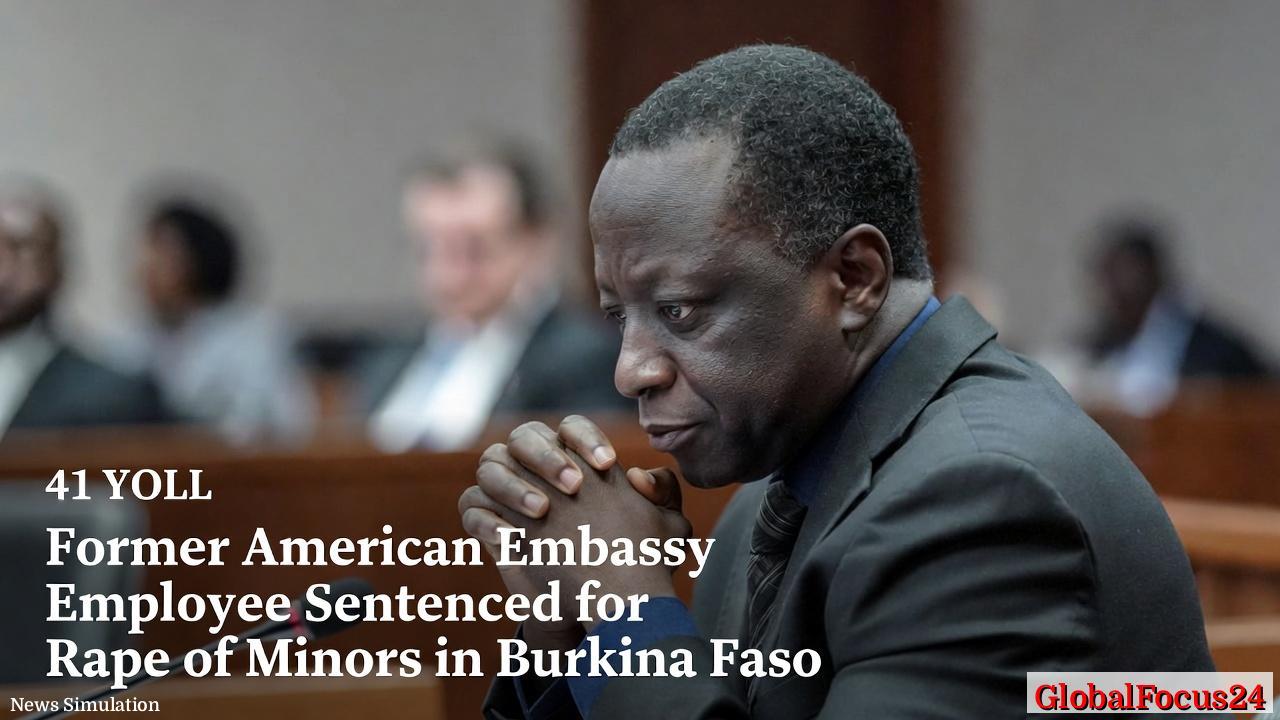
U.S. Embassy Employee Sentenced to Life in Prison for Raping Minors in Burkina Faso
A Maryland man who once worked at the U.S. Embassy in Ouagadougou has been sentenced to life in prison after a federal jury found him guilty of multiple aggravated sexual abuse charges involving two underage girls in Burkina Faso in 2022 and 2023. The decisive verdict and sentence illustrate how the U.S. justice system continues to pursue accountability for crimes committed abroad by individuals linked to federal missions, and it underscores the ongoing international dimensions of child protection and law enforcement collaboration.
Historical context: a broader pattern of safeguarding minors in international deployments International postings have long carried complex responsibilities for diplomatic staff, including safeguarding the welfare of local communities and ensuring the safety of staff members. Over the past decade, federal authorities have increasingly emphasized the protection of children in and around diplomatic facilities, with a framework that pairs rigorous investigations with cross-border cooperation. The case at hand sits within this broader historical arc, reflecting persistent efforts to address offenses that occur in foreign postings and to hold individuals accountable regardless of their location.
Details of the case and charges According to court records, the defendant, a 41-year-old U.S. citizen, engaged in criminal acts against two minor girls in Burkina Faso during 2022 and 2023. He was convicted after a two-week trial in October 2025 on four counts of aggravated sexual abuse of a minor, one count of attempted coercion and enticement of a minor, and one count of attempted obstruction of justice. The life sentence conveys the gravity of the offenses and the severity with which the federal system treats crimes involving the exploitation of children, especially by someone connected to a government mission abroad.
Legal and prosecutorial perspective Assistant Attorney General A. Tysen Duva highlighted that the defendant’s status as a former embassy employee did not shield him from accountability. The department’s Criminal Division underscored that the sentence reflects the seriousness of preying on vulnerable children and reaffirms the principle that crimes against minors will be met with substantial penalties, regardless of the perpetrator’s position or affiliation. U.S. Attorney Kelly O. Hayes for the District of Maryland reiterated a commitment to pursuing justice for victims and enforcing laws designed to protect children from exploitation.
Protective measures and agency response Officials from the Diplomatic Security Service (DSS) emphasized their ongoing obligation to protect the integrity of diplomatic missions and the safety of local communities. Deputy Assistant Director George Semertsidis noted that protecting children remains a paramount responsibility and that allegations involving personnel associated with U.S. facilities are investigated thoroughly in cooperation with law enforcement partners. The case demonstrates a heightened awareness within federal agencies of safeguarding standards and the serious consequences for those who violate them.
Economic and societal impact While the direct financial costs of criminal prosecutions are a fraction of the broader implications, the case reverberates through several layers of impact:
- Public trust and mission credibility: Incidents involving misconduct by personnel assigned to diplomatic missions can affect public perception of international engagement and the safety of local communities hosting diplomatic staff.
- Resource allocation for safeguarding: Government agencies may increase investments in training, background screenings, and oversight mechanisms for personnel serving abroad, potentially affecting international operating budgets and staffing practices.
- Local community safety: When crimes occur in foreign postings, host-country communities can experience a mix of concern and reassurance as investigations proceed and accountability is enforced, reinforcing the perception that international entities are held to high ethical and legal standards.
Regional comparisons: safeguarding standards across postings Across different regions, the approach to safeguarding and accountability has evolved to emphasize proactive risk management and rapid response. In general, the precautionary framework involves:
- Pre-deployment compliance: rigorous background checks, ethics training, and clear codes of conduct for personnel stationed abroad.
- Onsite oversight: periodic reviews and audits of facilities, with channels for reporting and addressing misconduct.
- Post-incident accountability: prompt investigations, cooperation with local and international law enforcement, and consistent application of U.S. law to post-associated personnel when crimes are committed abroad.
In comparable cases, jurisdictions outside Burkina Faso have pursued similar prosecutorial paths, ensuring that offenses involving minors, particularly by individuals associated with state missions, are subjected to comprehensive investigations and substantial penalties. These parallel efforts illustrate a shared international emphasis on protecting children and maintaining integrity within diplomatic operations.
Victims and societal reaction The sentencing of a former embassy employee on charges involving minor victims often resonates deeply within affected communities and among advocacy groups focused on child protection. Victims’ families and local partners may experience a mix of relief, validation, and ongoing healing, while communities at large may reflect on safety measures and the accountability framework that governs international professionals working abroad. Public messages from officials frequently highlight the commitment to victims’ rights, ongoing support services, and the importance of reporting suspicious or abusive behavior.
Process and timeline: from investigation to sentencing The case progressed through several stages typical of federal criminal proceedings:
- Allegations surfaced and investigations were conducted by federal authorities in coordination with domestic and international partners.
- A grand jury returned indictments based on collected evidence, outlining counts of aggravated sexual abuse, coercion, enticement, and obstruction of justice.
- A two-week trial in October 2025 produced a guilty verdict on all counts.
- A sentencing hearing resulted in a life imprisonment sentence, reflecting the court’s assessment of the offenses and the need for deterrence and protection of the public.
Implications for future policy and practice The outcome may inform ongoing policy discussions about anti-abuse measures within international postings, including:
- Strengthening screening and ethics training for personnel before and during deployment to foreign facilities.
- Enhancing mechanisms for reporting, investigating, and addressing allegations quickly and transparently.
- Bolstering interagency and international collaboration to ensure that offenses are pursued vigorously regardless of geography.
- Ensuring survivors and witnesses have access to support services and are treated with dignity throughout the legal process.
Public interest and transparency Cases involving crimes by individuals connected to state missions generate sustained public interest, underscoring the need for transparency in investigative and prosecutorial processes while balancing privacy and security concerns. Officials emphasize that accountability is central to maintaining trust in diplomatic institutions and in the rule of law, both at home and abroad.
Conclusion: a decisive statement on accountability and protection The life sentence handed down in this case marks a significant moment in the ongoing effort to safeguard minors and uphold the integrity of international missions. It demonstrates that U.S. authorities will pursue those who abuse vulnerable children, regardless of where the crimes occur or the perpetrator’s former role within a government facility. As the legal proceedings conclude, attention increasingly turns to victim support, preventative measures, and continued vigilance by agencies responsible for protecting communities associated with diplomatic operations.
Note: This article presents a factual overview of the case, its context, and its implications based on publicly available information. It avoids political commentary and focuses on the legal, protective, and societal dimensions of accountability in international postings.