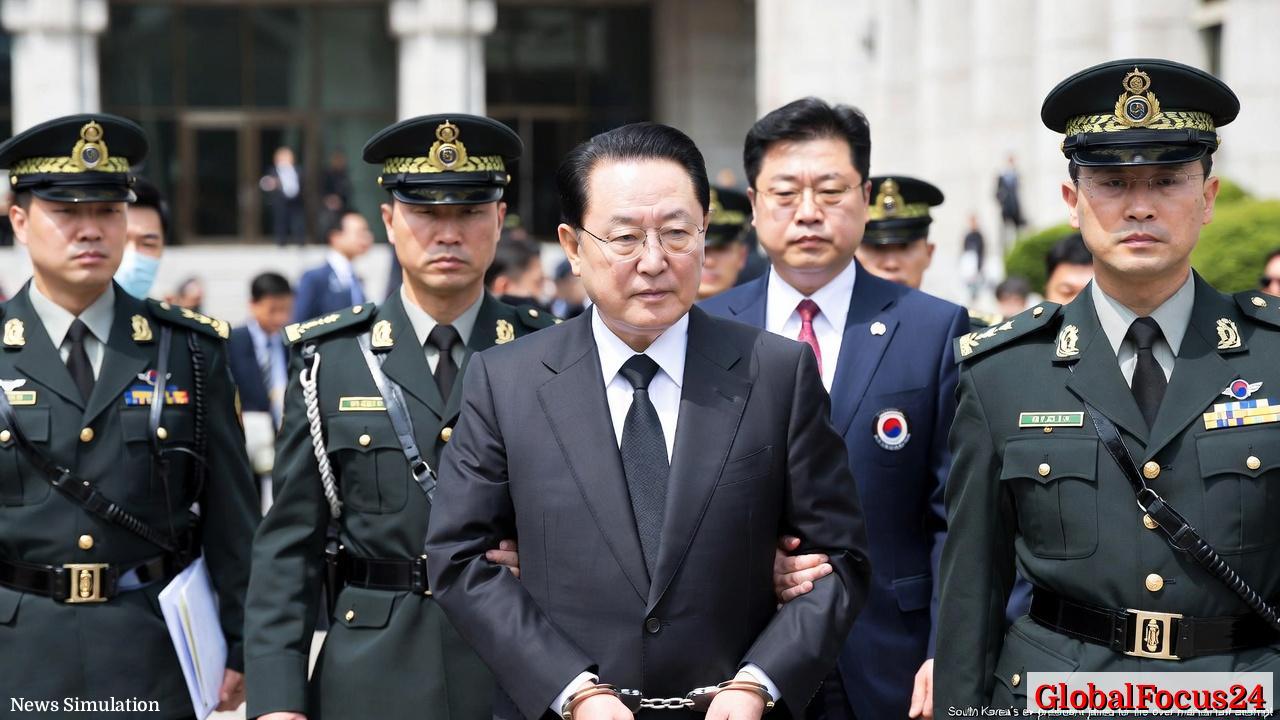
South Korea’s Former President Yoon Suk Yeol Sentenced to Life in Prison Over 2024 Martial Law Attempt
Court Hands Down Life Term in Landmark Insurrection Case
A Seoul court has sentenced former South Korean President Yoon Suk Yeol to life in prison for leading an attempted insurrection through the imposition of martial law in December 2024. The ruling marks one of the most consequential criminal judgments against a former head of state in South Korea’s modern history and sends a powerful signal about the limits of presidential power in the country’s constitutional democracy.
The three-judge panel of the Seoul Central District Court concluded that Yoon abused his authority and attempted to subvert the constitutional order by mobilizing military forces to intimidate and constrain the National Assembly. Prosecutors had sought the death penalty, arguing that the former president’s actions constituted a direct assault on the foundations of South Korea’s democratic system, but the court opted for a life sentence, citing both the gravity of the crime and the need to avoid further deepening political division.
The 2024 Martial Law Declaration and Its Swift Collapse
On 3 December 2024, Yoon declared martial law, invoking emergency powers that South Korea’s constitution reserves for situations such as war, armed uprising, or comparable national emergencies that threaten public safety on a mass scale. According to the court and subsequent legal analyses, those conditions did not exist; instead, Yoon cited escalating confrontation with an opposition-controlled legislature and political gridlock as justification for the move.
The martial law order was accompanied by the deployment of troops and security forces around key government sites, including the National Assembly compound in Seoul. Lawmakers reported being blocked by military personnel and police, with some forced to climb over perimeter walls to access the legislature and convene an emergency session. Within hours, the National Assembly passed a motion to lift martial law, reflecting broad political consensus that the president had overstepped his constitutional authority.
Facing intense public protests and a rapidly consolidating parliamentary response, Yoon rescinded the martial law decree roughly six hours after issuing it. That swift reversal did little to stem public outrage, however, and set in motion an impeachment process and criminal investigations that would ultimately culminate in Thursday’s life sentence.
Legal Reasoning: Insurrection and the Limits of Executive Power
The court convicted Yoon under Article 87 of South Korea’s Criminal Act, which defines insurrection as the use of force with the intent to disrupt or overthrow the constitutional order. Judges emphasized that the statute does not require loss of life; what matters is the deployment of armed force against core state institutions, such as the legislature or constitutional bodies.
In its reasoning, the panel found that Yoon’s approval of a military mobilization to surround the National Assembly during the martial law declaration was the decisive act that transformed a controversial political maneuver into an insurrection. The court determined that the operation was designed to constrain lawmakers and intimidate the opposition, not to respond to any genuine national security emergency.
The ruling builds on a 2025 decision by the Constitutional Court, which unanimously upheld Yoon’s impeachment and removal from office. In that earlier judgment, the country’s highest constitutional body held that neither the substantive nor procedural requirements for declaring a state of emergency had been met, and that the martial law order amounted to a “grave violation” of democratic governance and fundamental rights. Together, the impeachment decision and the criminal verdict define a clear legal boundary: emergency powers, including martial law, cannot be used as tools against the legislature, the judiciary, or independent commissions.
Historical Context: South Korea’s Democratic Trajectory and Past Crises
South Korea’s modern democracy emerged from decades of authoritarian rule, including periods of military government and previous abuses of emergency powers. In the 1970s and 1980s, martial law and similar measures were used to suppress dissent, control universities, and manage opposition movements, shaping a collective memory that remains vivid for many South Koreans.
The 2024 crisis therefore resonated deeply with the public, tapping into longstanding fears that emergency powers can be weaponized to undermine democratic institutions. Mass protests quickly formed outside government buildings, with citizens framing the confrontation as a defense of the constitution rather than a partisan dispute. It was within this historical context that the National Assembly moved rapidly to impeach Yoon, and the Constitutional Court later underscored the need to guard against any backsliding toward authoritarian practices.
The life sentence handed down this week invites comparison with past accountability efforts in South Korea, where former presidents have previously faced charges for corruption, abuse of power, and in some cases complicity in violent crackdowns. What distinguishes the Yoon case is the central role of martial law and insurrection charges, placing it at the heart of the country’s struggle to define and protect constitutional limits on executive authority.
From Impeachment to Verdict: A Prolonged Constitutional Crisis
The impeachment of Yoon followed swiftly after his failed martial law gambit. On 14 December 2024, the National Assembly voted 204–85 to impeach the president, accusing him of staging “rebellion” and orchestrating a series of actions that threatened public order and the constitutional system. The impeachment automatically suspended his powers and transferred executive authority to the prime minister pending judicial review.
On 4 April 2025, the Constitutional Court delivered an 8–0 decision upholding the impeachment. Its 114-page ruling rejected Yoon’s arguments that he was acting within his constitutional discretion and that opposition obstruction justified extraordinary measures. The court concluded that his declaration of martial law, deployment of troops, and related actions against the National Assembly and independent institutions were so serious that they outweighed any potential costs of removing a sitting president.
Once stripped of presidential immunity, Yoon faced multiple criminal investigations, including insurrection, abuse of authority, and obstruction-related charges. In a separate case, he had already received a shorter prison term over aspects of the same episode, but the insurrection trial became the focal point of domestic and international attention. Thursday’s verdict, delivered in a courtroom ringed by security and watched by supporters and critics alike, marked the culmination of a two-year constitutional crisis that tested the resilience of South Korea’s institutions.
Co-defendants and the “Insurrection from the Top”
Yoon was not the only senior official held responsible for the attempted imposition of martial law. Courts have handed down significant sentences to a range of former top officials, including members of his cabinet and security team, reflecting a broader view that the episode amounted to a coordinated effort at the highest levels of government.
Former Prime Minister Han Duck-soo was sentenced to 23 years in prison last month for his role in supporting and facilitating the insurrection plan. Former Defense Minister Kim Yong-hyun, who advised Yoon to declare martial law and played a central role in troop mobilization orders, received a 30-year sentence on the same day as Yoon’s life term. Other senior figures, including the former interior minister, the former intelligence chief, and a former national police leader, also received lengthy prison sentences, with judges describing the episode as an “insurrection from the top.”
Collectively, these verdicts underscore the judiciary’s position that responsibility for the crisis extended beyond a single individual and encompassed an entire circle of decision-makers who failed to uphold their constitutional duties. The breadth of the convictions is likely to influence how future administrations structure the chain of command during emergencies and how civil servants and military leaders evaluate orders that appear to stretch legal boundaries.
Public Reaction and Political Repercussions
Public reaction to the life sentence has been intense but largely peaceful, reflecting both the emotional weight of the verdict and the country’s broader democratic maturity. Outside the courthouse, groups of demonstrators gathered on both sides of the divide—some denouncing Yoon as a would-be strongman, others arguing that he had been unfairly targeted for political reasons.
For many South Koreans, the case reopens debates about how to balance strong leadership with institutional checks and balances in a country that sits on a volatile security frontier with North Korea. Supporters of the verdict point to the swift rescinding of martial law in 2024, driven by street protests and parliamentary action, as evidence that South Korea’s democratic safeguards are functioning effectively. Critics, including Yoon’s legal team, argue that the trial followed a “pre-written script” and that the life sentence risks deepening partisan polarization.
Regardless of perspective, the legal process is not yet finished: Yoon retains the right to appeal, and any appeal would send the case to higher courts, potentially extending the timeline before the sentence becomes final. That prospect ensures that the political and social reverberations from the 2024 martial law attempt will continue to shape public discourse in the months ahead.
Economic Impact and Market Confidence
While the immediate martial law episode in 2024 was short-lived, lasting only hours, it triggered several months of political turmoil that weighed on business sentiment and financial markets. Political uncertainty contributed to volatility in equities and dampened investor confidence as companies assessed the risk of institutional instability in one of Asia’s key export-driven economies.
South Korea’s economy is heavily dependent on global supply chains, technology exports, and investor perceptions of regulatory and political stability. The impeachment, the subsequent constitutional proceedings, and the criminal trials raised concerns that prolonged internal strife could distract policymakers from economic challenges such as slowing global demand, demographic pressures, and industrial competition from regional rivals.
Yet the eventual institutional response has been interpreted by many analysts as a stabilizing factor, demonstrating that constitutional mechanisms can resolve crises without systemic breakdown. By clarifying the legal limits of emergency powers and reaffirming the independence of both the legislature and the judiciary, the outcome may ultimately bolster long-term investor confidence, even if the short-term political climate remains tense.
Regional Comparisons: Emergency Powers and Democratic Resilience
The Yoon case also invites broader comparisons with how other democracies in Asia and beyond manage emergency powers and attempted power grabs. In several countries, constitutional frameworks grant executives significant latitude during crises, but abuses of those powers have often sparked backlash, constitutional reform, or international criticism.
South Korea’s experience stands out for the speed and coherence of institutional responses: within hours of the martial law declaration, the National Assembly convened to overturn it, the public mobilized in large numbers, and within weeks lawmakers had initiated impeachment proceedings. Subsequent decisions by the Constitutional Court and the criminal courts have reinforced this pattern, illustrating how a combination of public pressure, legislative assertiveness, and judicial independence can constrain executive overreach.
For neighboring countries watching closely, the life sentence may serve both as a cautionary tale and as a case study in democratic resilience. It highlights the risks political leaders face when attempting to use security justifications for domestic power consolidation, and it underscores the potential economic and diplomatic costs of such moves in an interconnected regional order.
What Comes Next for South Korea’s Democracy
With the verdict delivered, South Korea now faces the challenge of moving beyond a turbulent period marked by impeachment, mass protests, and a high-stakes insurrection trial. The country has already transitioned to new leadership following Yoon’s removal, and the current administration must navigate a landscape where public expectations for transparency and constitutional fidelity are higher than ever.
Lawmakers and legal experts are likely to continue debating reforms to emergency law, civil–military relations, and safeguards for the independence of key institutions. Proposals may include clearer criteria for declaring martial law, stronger parliamentary oversight of security decisions, and enhanced protections for agencies such as election commissions and courts.
For many citizens, the life sentence represents both accountability for past actions and a warning for future leaders who might contemplate similar measures. Whether the case ultimately deepens political polarization or catalyzes a more broadly shared commitment to constitutional norms will depend on how political actors, civil society, and institutions conduct themselves in the post-verdict era.
A Defining Moment in South Korea’s Constitutional History
The imprisonment of former President Yoon Suk Yeol for life over his attempts to impose martial law and mobilize the military against the legislature is now etched as a defining chapter in South Korea’s constitutional history. It reflects a society determined to guard its democratic gains and a legal system willing to hold even the most powerful figures to account when they overreach.
As appeals proceed and political debates continue, the core message from the courts is unambiguous: emergency powers cannot be used to undermine the very institutions they are meant to protect. In a region where questions of executive authority and democratic resilience are increasingly central, South Korea’s response to its 2024 martial law crisis will likely remain a reference point for years to come.