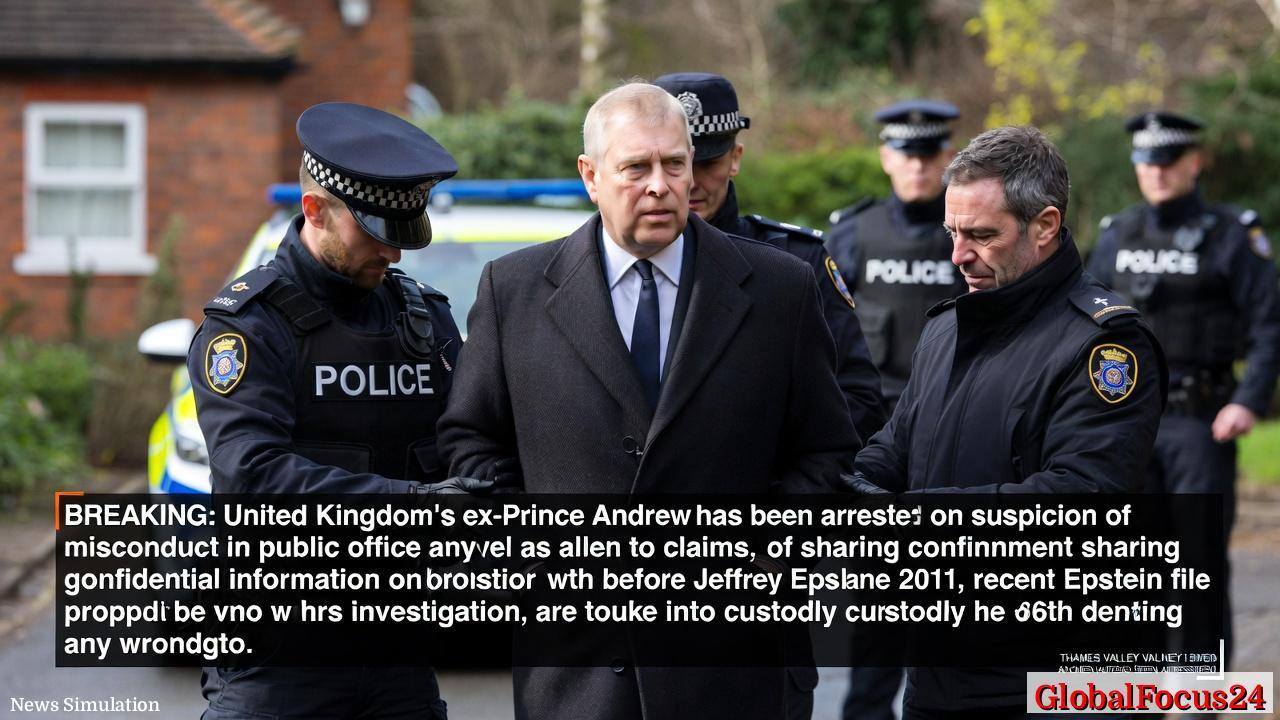
Former Prince Andrew Arrested on Suspicion of Misconduct in Public Office
Andrew Mountbatten-Windsor Taken Into Custody on 66th Birthday
LONDON — Andrew Mountbatten-Windsor, formerly known as Prince Andrew, was arrested early Thursday morning on suspicion of misconduct in public office. The arrest, carried out by Thames Valley Police, took place at his private residence on the Sandringham estate in Norfolk, England. The former Duke of York, who turned 66 on the same day, is now being questioned in custody as part of a widening investigation into the alleged sharing of confidential government information more than a decade ago.
Police confirmed that properties in both Berkshire and Norfolk are currently being searched in connection with the inquiry. Authorities stated that the investigation relates to claims that Andrew, during his tenure as the United Kingdom’s Special Representative for Trade and Investment, shared sensitive government information with the late financier Jeffrey Epstein. While the precise nature of the alleged disclosures remains unclear, the arrest represents one of the most serious criminal developments involving a senior member of the British royal family in recent history.
The Role and Origins of the Office Under Scrutiny
Andrew Mountbatten-Windsor held the position of Special Representative for Trade and Investment between 2001 and 2011, a role that placed him at the heart of British efforts to strengthen international trade ties and attract investment to the U.K. The appointment was officially sanctioned by the government of the time and involved both diplomatic and commercial responsibilities.
The position required regular interactions with foreign dignitaries, business leaders, and heads of state. In this capacity, Andrew functioned partly as a trade envoy and partly as a semi-official ambassador for British economic interests abroad. While the role was unpaid, it carried significant influence and access to confidential briefings.
The allegations now under investigation claim that during this period, Andrew shared sensitive trade or policy information with Epstein, who maintained ties with powerful figures across finance, politics, and international business. Although previous public scrutiny of the pair’s association had focused on social and personal connections, the questioning now takes on a distinctly national security and governance dimension.
The Epstein Connection Reignited
Epstein, an American financier and convicted sex offender, died in a New York prison cell in 2019 while awaiting trial on federal charges of sex trafficking. His complex network of acquaintances has continued to draw investigative interest from authorities in several countries.
Newly released documents from the so-called “Epstein files,” made public earlier this year under U.S. court orders, reportedly include communications referencing Andrew’s time as a trade envoy. While investigators have not disclosed specific evidence, British police sources suggested that these documents triggered a formal review that led to today’s arrest.
In previous statements, Andrew has repeatedly denied any misconduct. Following public backlash and a high-profile BBC interview in 2019, he withdrew from royal duties and later relinquished the use of his “His Royal Highness” title. In 2022, he reached an undisclosed settlement in a U.S. civil case related to Epstein’s trafficking network, though he admitted no guilt.
The new arrest marks a distinct turn, representing the first criminal investigation involving him rather than a civil dispute.
Legal Proceedings and Immediate Reaction
A spokesperson for Thames Valley Police confirmed that “a 66-year-old man was taken into custody in Norfolk this morning on suspicion of misconduct in public office. Searches are ongoing at two addresses as part of the investigation.”
Representatives for Andrew have not provided an official statement, though sources close to the family indicated he will cooperate with the inquiry. Buckingham Palace declined comment, saying only that “this is a matter for the appropriate authorities.”
Public reaction across the U.K. has been swift. Outside Sandringham, crowds gathered as news broke, with journalists and camera crews stationed near the estate gates. Local residents described seeing a convoy of unmarked vehicles arrive at dawn. Social media channels filled with a mixture of shock, criticism, and weary resignation — reflecting years of controversy surrounding Andrew’s personal associations.
Constitutional experts noted that while Andrew is no longer a working royal, his continued place within the royal family means the arrest still poses reputational risks for the monarchy. The Palace is expected to issue a more formal statement once police procedures conclude.
Misconduct in Public Office: A Serious Charge
The offense of misconduct in public office is a rare but serious criminal charge under English law, reserved for public officials who abuse positions of trust for improper purposes. Convictions can carry significant prison sentences, depending on the severity and consequences of the alleged misconduct.
Legal scholars pointed out that prosecutions under this charge often hinge on whether the accused held a clear “public duty” and whether the misuse of that position caused measurable harm. In past cases, such as those involving police officers or local officials, the courts have required clear proof of intent and personal advantage.
If formally charged, Andrew could face a lengthy and complex legal battle in which prosecutors must establish not only that he held confidential government information but that he deliberately used or shared it inappropriately. Until now, no senior royal has ever faced such allegations in the context of state secrets or diplomatic trade data.
Broader Historical Context and Royal Accountability
Historically, the British monarchy has endured crises of reputation, from Edward VIII’s abdication in 1936 to Princess Diana’s death and the subsequent public reckoning over royal transparency. Yet none involved a potential criminal prosecution of this nature.
Observers at the Institute for Government noted that today’s events could compel a broader conversation about the boundaries between royal privilege and civic accountability. The modern monarchy, while largely ceremonial, still occupies a unique constitutional and cultural position — one that has traditionally shielded its members from direct political or legal exposure.
With the Crown now functioning under strict public scrutiny, any perception of preferential treatment in the investigation could provoke public backlash. Conversely, a transparent and lawful process could bolster trust in the independence of British institutions.
Economic and Diplomatic Repercussions
While the case primarily concerns alleged conduct from nearly 15 years ago, it arrives at a delicate economic moment for the United Kingdom. Post-Brexit trade negotiations remain central to national growth strategies, and the country’s credibility in foreign economic partnerships partly depends on the integrity of those who represent it.
Analysts suggested that even the perception of wrongdoing by a former trade envoy could raise questions among trading partners about government oversight and ethical standards within official appointments.
Financial markets, as of early Thursday afternoon, showed minimal immediate reaction. However, some economic commentators warned that if the case reveals systemic weaknesses in the handling of confidential trade information, it could lead to procedural reforms and closer scrutiny of how semi-official diplomatic roles are vetted.
Internationally, several foreign ministries have reportedly requested updates through standard diplomatic channels. A State Department official in Washington said the U.S. is “monitoring the situation closely,” given that part of the investigation may involve material originating from Epstein’s American operations.
Regional and Comparative Perspectives
In the context of royal houses elsewhere in Europe, instances of members facing legal action have been uncommon but not unprecedented. Spain’s former King Juan Carlos I, for example, went into voluntary exile in 2020 amid corruption allegations, though he retained immunity from prosecution during his reign. In Scandinavia and the Netherlands, royalty typically steps aside from state-linked duties when embroiled in scandal, maintaining the distinction between symbolic and administrative roles.
By comparison, Britain’s constitutional monarchy has taken gradual steps to modernize its image while preserving continuity. The handling of Andrew Mountbatten-Windsor’s case will likely set a benchmark for how far that modernization extends into the realm of legal accountability.
Next Steps in the Investigation
Police officials are expected to continue questioning Andrew throughout the day, with legal advisers from the Crown Prosecution Service involved in assessing whether the evidence justifies formal charges. If charges are filed, proceedings could begin later this year at Westminster Magistrates’ Court before being transferred to the Crown Court for trial.
Sources close to the investigation suggested that inquiries will also focus on communications, emails, and diplomatic documentation recovered from storage sites and digital archives. Cooperation between U.K. and U.S. authorities is expected to be critical, as at least some materials may fall under American jurisdiction, given Epstein’s business operations and contacts.
A Turning Point for Transparency and Trust
Regardless of the investigation’s outcome, today’s arrest signifies a profound moment for British public life — one that touches the intersection of legacy, law, and accountability. For many observers, it represents a test not only of Andrew Mountbatten-Windsor’s conduct but also of the nation’s willingness to hold even the most prominent figures to the same standards that govern ordinary citizens.
As the inquiry unfolds, the world will be watching how Britain balances justice, tradition, and transparency in the face of one of its most sensitive and symbolic challenges in decades.