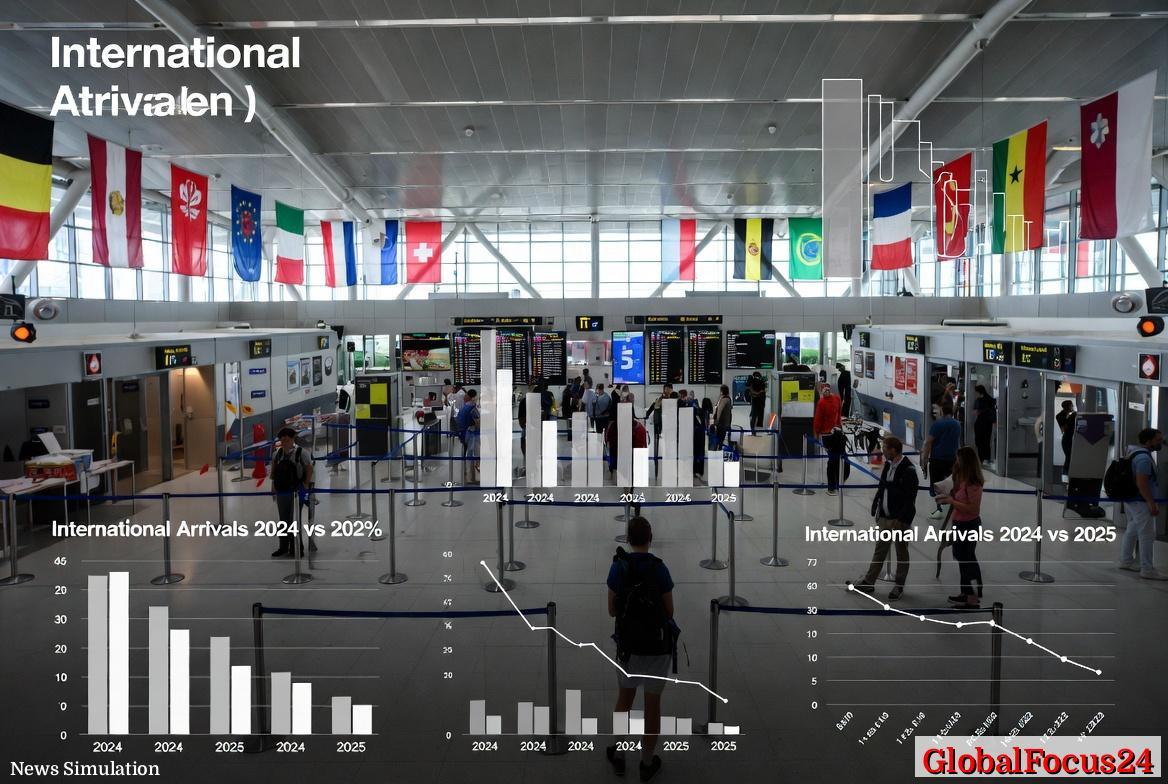
International arrivals at 20 key US airports have plummeted this year compared to 2024, marking a stark reversal in the post-pandemic recovery of foreign tourism to America. Detailed analysis of airport passenger data reveals a consistent downward trend across major gateways, raising concerns about the health of the US travel sector. This drop underscores shifting global travel patterns and economic pressures affecting inbound tourism flows.
Understanding the Drop in US International Tourism
The decline in foreign tourists visiting the United States in 2025 has been pronounced, with non-US citizen air passenger arrivals falling significantly from the previous year. For instance, in May 2025 alone, arrivals totaled 4.735 million, down 5.3 percent from May 2024, reaching just 86.3 percent of pre-pandemic levels from May 2019. Cities like Las Vegas and Miami have led the losses, with Las Vegas posting a 9.8 percent drop in international air traffic in June 2025, followed by Miami at 4.5 percent.
This trend contrasts sharply with earlier projections that anticipated growth. While some forecasts suggested international visits could rise to 85.2 million in 2025 from 77.7 million in 2024, updated data from airport records paints a more sobering picture, aligning with revised outlooks predicting a 6.3 percent decrease to 67.9 million visits. The 20 major facilities analyzed, including hubs like New York JFK, Los Angeles International, and Chicago O'Hare, collectively show reduced passenger volumes, with charts from I-92 data highlighting month-over-month declines in tourism flows.
Historically, US international tourism rebounded strongly after the COVID-19 disruptions. In 2024, arrivals approached record highs as pent-up demand from Europe, Asia, and Latin America fueled a surge, with total international seats exceeding previous benchmarks. However, 2025 has introduced new headwinds, turning what was expected to be a banner year into one of contraction. This shift echoes patterns seen in earlier downturns, such as the 2008 financial crisis, when global economic uncertainty curbed long-haul leisure travel to the US.
Key US Airports Hit Hardest by Tourism Decline
Major gateways bearing the brunt of this decline include Las Vegas, where the vibrant Strip—once a magnet for international gamblers and showgoers—saw its sharpest drop among tracked cities. Harry Reid International Airport's international terminal, expanded in recent years to handle growing Asian and European traffic, now stands quieter as visitor numbers wane.
Miami International Airport, a vital link for Latin American and Caribbean travelers, experienced a 4.5 percent decline in June, compounding earlier quarterly losses. This hub, which processed nearly 30 million international seats in 2025 projections, has felt the pinch from reduced flights from South America amid currency fluctuations in key markets like Brazil and Argentina.
Other affected airports include Los Angeles and New York JFK, the latter slated for 42.7 million international seats but facing actual shortfalls as transatlantic and transpacific routes underperform. Across the 20 facilities, the data illustrates a broader contraction, with originating non-stop international flights showing persistent weakness compared to 2024's robust figures.
Not all airports tell the same story. San Diego bucked the national trend with a 14.1 percent year-over-year increase in June, thanks to new nonstop routes to Tokyo, Panama City, Amsterdam, and London. Seattle-Tacoma also posted gains, bolstered by expanded European and Asian connections and anticipation for the 2026 FIFA World Cup. These outliers highlight how infrastructure investments and event-driven demand can counteract broader declines.
Historical Context of US Tourism Fluctuations
To grasp the severity of 2025's international arrivals drop, it's essential to place it within the arc of US tourism history. The sector boomed in the late 2010s, with foreign visitors topping 80 million annually by 2019, contributing over $250 billion to the economy through spending on hotels, dining, and attractions. The pandemic slashed this to under 20 million in 2020, but a V-shaped recovery ensued, with 2023 and 2024 seeing double-digit growth as borders reopened and airlines ramped up capacity.
Yet precedents abound for such pullbacks. Post-9/11, international arrivals fell 20 percent in 2002 due to security fears and global recession. The 2008 crisis trimmed numbers by 5 percent, while exchange rate shifts in the 2010s periodically deterred European and Canadian visitors. Today's decline mirrors these episodes but arrives amid unique pressures: lingering supply chain issues in aviation, volatile fuel prices, and a stronger US dollar making trips less affordable for overseas travelers.
Data from the Bureau of Transportation Statistics' I-92 records, which track non-US citizens on commercial flights, provides a reliable lens into these cycles, showing 2025's downturn as the first sustained drop since 2020. Charts derived from this dataset vividly depict the 2024 peak flattening into 2025's slump, with monthly arrivals consistently 5-10 percent below prior-year comparables.
Economic Impact on US Tourism-Dependent Regions
The reduction in international arrivals reverberates through local economies, particularly in tourism hotspots. Las Vegas, where visitors account for 40 million annual stays, faces revenue shortfalls estimated in the billions, hitting casinos, shows, and conventions hardest. Hotel occupancy dips and reduced gaming spend could idle thousands of jobs, echoing the 2020 shutdown's pain.
Miami's cruise and beach economy, intertwined with air arrivals, stands to lose similarly. With international tourists spending 2-3 times more per capita than domestics—averaging $4,000 per trip versus $1,200—their absence strains retail, hospitality, and transport sectors. Nationally, inbound tourism generated $175 billion in 2024; a 6-10 percent volume drop could erase $10-17 billion in 2025, curbing GDP contributions from key states.
Smaller markets feel it acutely too. Orlando's theme parks, drawing heavily from Europe and Asia, report softer bookings, while New York's cultural institutions see fewer overseas patrons at Broadway and museums. Domestic travel, projected to exceed pre-pandemic levels with a focus on local adventures, offers partial offset but can't fully replace high-spending foreigners.
Job losses loom large: the sector employs 10 million, with international tourism supporting 1.5 million positions. Regions like Hawaii and Florida, where inbound visitors comprise 25 percent of total, brace for contraction, prompting calls for diversified marketing. Airlines, facing grounded wide-body jets, may cut routes, further entrenching the cycle.
Regional Comparisons Highlight Global Shifts
Compared to peer destinations, the US's 2025 tourism decline appears more acute. Canada, leveraging a weaker loonie and proximity, saw international arrivals rise 8 percent year-over-year, with Toronto and Vancouver gaining US spillover traffic. Mexico's Cancun and Riviera Maya hubs reported flat-to-positive growth, aided by short-haul appeal and all-inclusive packages attracting Europeans bypassing the US.
Europe's major cities like Paris and London, buoyed by the Olympics hangover and cultural draws, posted modest gains despite transatlantic headwinds. Asia-Pacific markets, including Tokyo and Sydney, rebounded faster post-COVID, with intra-regional travel filling gaps left by long-haul dips. These contrasts stem from currency advantages— the euro and yen weakening against the dollar—and aggressive promotions targeting budget-conscious travelers.
Within North America, the US lags Mexico's recovery while outpacing Canada's volume growth in absolute terms due to scale. Globally, emerging destinations like Turkey and Thailand siphon mid-tier leisure seekers with lower costs, underscoring the US's vulnerability to price sensitivity. Airport data from counterparts, such as London's Heathrow (up 4 percent) versus JFK's stagnation, illustrates how infrastructure and visa policies influence flows.
Factors Driving the 2025 International Arrivals Slump
Multiple elements converge to explain the drop. Aviation capacity constraints persist, with airlines prioritizing profitable domestic and short-haul routes over international long-haul amid high jet fuel costs. A robust US dollar, up 7 percent against a basket of currencies since early 2024, prices out many from Europe and Latin America.
Consumer trends favor domestic exploration, with Americans rediscovering national parks and road trips, reducing the need for inbound marketing push. Wellness and eco-tourism surges domestically further divert spending. Public reaction mixes concern among industry workers—hotel staff in Miami voicing fears on social media—with traveler caution amid global uncertainties.
Airports' expansion efforts, like Seattle's doubled gates and San Diego's new links, show resilience potential, but national figures remain down. As 2025 progresses, events like the 2026 World Cup offer hope for rebound, yet current airport data signals prolonged pressure on US international tourism.
Outlook for US Tourism Recovery
While 2025 charts a downturn, historical patterns suggest rebounds follow contractions. Total US travel spending may still grow modestly to $1.35 trillion, driven by domestic leisure. Targeted incentives, route expansions, and currency stabilization could lift arrivals in late 2026.
Stakeholders monitor monthly I-92 updates closely, with facilities like JFK and LAX adapting through tech upgrades for smoother processing. The decline, though sharp, positions the industry to innovate, emphasizing sustainable practices and unique experiences that lured record crowds pre-2025. For now, the quieter terminals at major US airports serve as a cautionary snapshot of tourism's fragility.
(Word count: 1,248)