Faith and Prosperity: How Indonesia and Malaysia Are Redefining Modernization in Southeast Asia
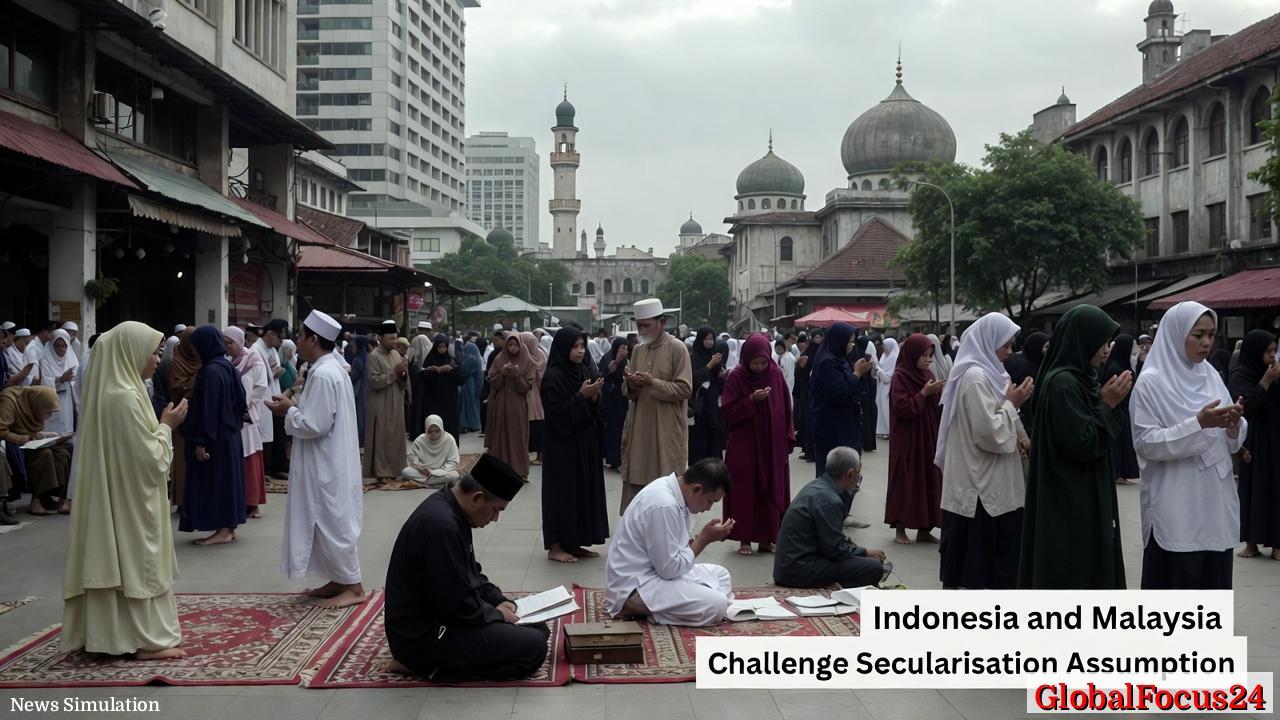
In Southeast Asia, two rapidly developing nations are challenging one of sociology’s longest-standing theories — that modernization inevitably leads to secularization. Indonesia and Malaysia, both of which have achieved robust economic growth and global integration, are demonstrating that prosperity and piety can coexist, even reinforce one another. Their experiences are reshaping global assumptions about the relationship between religion and development, as Islamic identity grows stronger amid urbanization, rising education levels, and expanding middle-class affluence.
Shifting the Modernization Paradigm
The traditional secularization theory, popularized in the mid-twentieth century by Western sociologists, held that as nations industrialized and citizens achieved higher standards of living, religious belief and practice would naturally decline. Wealth, education, and scientific rationalism were assumed to replace faith as organizing principles of modern life.
Yet in Indonesia and Malaysia, the opposite appears to be unfolding. Both countries have experienced decades of steady economic gains, falling poverty rates, and widening access to global culture. At the same time, they are witnessing what scholars now call “re-Islamization” — a revival of religious identity and observance that penetrates education, fashion, entertainment, and even corporate behavior.
For instance, Islamic banking and Sharia-compliant finance have become key pillars of both economies. Modest fashion industries are thriving from Jakarta to Kuala Lumpur, while religious programming dominates airwaves and digital platforms. Mosques are fuller than ever, and Islamic schools are attracting both traditional families and aspirational young professionals seeking moral grounding amid fast-paced change.
Indonesia: Faith in the World’s Largest Muslim Democracy
Home to more than 230 million Muslims, Indonesia is not only the world’s largest Muslim-majority nation but also one of its most pluralistic. Since transitioning to democracy in 1998, its economy has become one of Asia’s fastest growing. Middle-class expansion has brought new opportunities, especially in technology and consumer sectors. Yet as the economy grows, indicators of religiosity — mosque attendance, Quranic study groups, hijab adoption, and Islamic philanthropy — have intensified.
Researchers point to several reasons. First, religious practice offers a moral compass amid rapid social transformation. With urbanization and digital connectivity reshaping traditional family life, young Indonesians often turn to Islam as a source of stability and identity. Second, democracy itself has encouraged public expressions of faith. The political sphere is open, allowing religious organizations to participate freely in civic life, contrasting sharply with the stricter secularism of Turkey or the Middle East’s authoritarian religious controls.
Moreover, the economic ecosystem surrounding religion is expanding. The halal economy — spanning food, cosmetics, travel, and finance — is projected to exceed hundreds of billions of dollars in value. Jakarta’s skyscrapers now host Islamic start-ups, and social media influencers promote faith-based lifestyles that combine modern aesthetics with religious devotion. The result is a fusion of modern ambition and moral consistency rarely captured in earlier Western models of modernization.
Malaysia: Economic Growth Anchored in Religious Identity
Malaysia’s trajectory mirrors, but also diverges from, Indonesia’s. The nation’s Vision 2020 project helped it transform from an agrarian economy into an advanced manufacturing and service hub. Its wealth per capita outpaces most of its neighbors, and Kuala Lumpur ranks among Asia’s most cosmopolitan cities. Yet, from the 1980s onward, Malaysia has been the site of a deliberate Islamic resurgence — one that intertwined with state policy, social reform, and educational development.
Islamic banking was institutionalized earlier in Malaysia than anywhere else outside the Middle East. Today, Kuala Lumpur positions itself as a global capital for Islamic finance, hosting international conferences and pioneering Sharia-compliant bonds, or sukuk. Government-linked institutions promote not only economic integration but moral and ethical discipline derived from Islamic teachings.
At the social level, the growing Malay Muslim middle class has invested in religious schooling, halal entrepreneurship, and modest fashion. Many Malaysian professionals now pursue what sociologists describe as “pious modernity,” asserting that moral integrity enhances — rather than limits — professional success. For many families, religious observance signals stability, self-discipline, and community belonging in an era of intense globalization.
Economic Prosperity and the Search for Meaning
Both nations demonstrate that the more material advances a society achieves, the more its citizens may seek transcendence or purpose beyond wealth. In Jakarta’s upscale neighborhoods, prayer rooms fill during lunch breaks as office workers pause for spiritual reflection. In Kuala Lumpur, luxurious shopping malls host Ramadan bazaars and charity drives that blend consumer culture with piety.
This intensity of faith does not always indicate conservatism or isolationism. Rather, it reflects a complex negotiation between modern lifestyles and traditional values. Educated youth are not rejecting technology or progress; they are infusing it with religious meaning. Indonesian designers incorporate Quranic calligraphy into digital art. Malaysian entrepreneurs build halal e-commerce platforms catering to global Muslim consumers. Modernization, far from dissolving faith, is giving it new forms of expression.
Comparing Regional Trends
Elsewhere in Southeast Asia, similar patterns are emerging on smaller scales. In Brunei, Islam has long been woven into state identity, while southern Thailand and Mindanao in the Philippines exhibit strong religious resilience amid minority status. Yet Indonesia and Malaysia stand out in the magnitude and integration of their faith-driven modernity.
By contrast, in more secularized regional economies — such as Singapore, where economic growth has long been associated with rational technocracy — religious practice among Muslims remains significant but less publicly visible. This divergence underscores how local cultural histories and governance models shape the interaction between modernity and spirituality.
Globally, the phenomenon mirrors developments in parts of the Middle East, South Asia, and even Africa, where rapid urbanization often correlates with renewed spiritual engagement rather than decline in belief.
Historical Context: From Colonial Legacies to Cultural Confidence
The religious revivals in Indonesia and Malaysia cannot be separated from their colonial pasts. Under Dutch and British rule respectively, both societies experienced attempts to frame modernization through Western secular paradigms. Post-independence leaders initially embraced aspects of those frameworks — emphasizing industrialization, infrastructure, and education — but the return to faith in recent decades reflects a conscious reassertion of cultural sovereignty.
In both nations, the late twentieth century saw an upsurge of Islamic movements, education reforms, and cultural institutions that reoriented development priorities toward moral and social cohesion. As globalization deepened in the 2000s, societal anxiety about materialism, inequality, and cultural homogenization amplified the appeal of religion as a stabilizing force. Faith became not only a private refuge but also a public expression of national confidence — a declaration that modernity need not mean Westernization.
The Digital Age of Faith
Social media has magnified this dynamic. In Indonesia, religious influencers command millions of followers, blending Quranic teaching with lifestyle advice, entrepreneurship, and mental health content. Online communities promote charitable giving during Ramadan and encourage Quranic challenges that reach young audiences. In Malaysia, digital preachers and halal travel bloggers bridge traditional values with global connectivity, creating a vibrant ecosystem that normalizes visible piety in digital spaces.
These online networks have also democratized religious discourse. Younger Muslims no longer rely solely on local clerics or traditional institutions; they engage in theology through podcasts, YouTube, and online study groups. This decentralization makes religiosity more adaptable, enabling believers to shape a contemporary spiritual identity aligned with modern aspirations.
Economic Implications: The Halal Frontier
The global halal market is one of the fastest-growing sectors in international trade, and Indonesia and Malaysia are strategically positioned to lead it. By integrating religious compliance with quality standards, they have built export industries that are both competitive and culturally resonant.
In Indonesia, halal certification has become part of national industrial policy. Investments in food processing, cosmetics, and tourism are increasingly justified not just by profit but by values-based branding. Malaysia’s Islamic financial architecture attracts investors seeking ethical alternatives to conventional capitalism. Both governments support these initiatives as engines of economic diversification, innovation, and soft power.
At the same time, this blending of religion and commerce raises regulatory and ethical questions. How do authorities ensure authenticity without over-bureaucratizing religious norms? How can inclusivity be preserved in multicultural societies? These debates reflect the complexities of faith-based modernization, where economic efficiency intertwines with spiritual accountability.
Looking Ahead: Faith as a Modern Asset
The trajectories of Indonesia and Malaysia suggest that the secularization thesis may need fundamental revision. Rather than fading, religion is adapting — evolving into a sophisticated cultural and economic engine compatible with prosperity. Modernization, it seems, does not demand the abandonment of faith but its reinvention within new social realities.
Both countries are demonstrating that Islam can coexist with technological progress, democratic participation, and global engagement while remaining deeply rooted in moral tradition. In doing so, they are offering an alternative modernity — one where material success and spiritual depth are not in conflict, but in conversation.
As Southeast Asia continues to rise, the lessons from Indonesia and Malaysia could influence how other developing nations balance the impulses of growth and identity. Modernization, their stories show, need not secularize the world — it can also sanctify it, one innovation at a time.