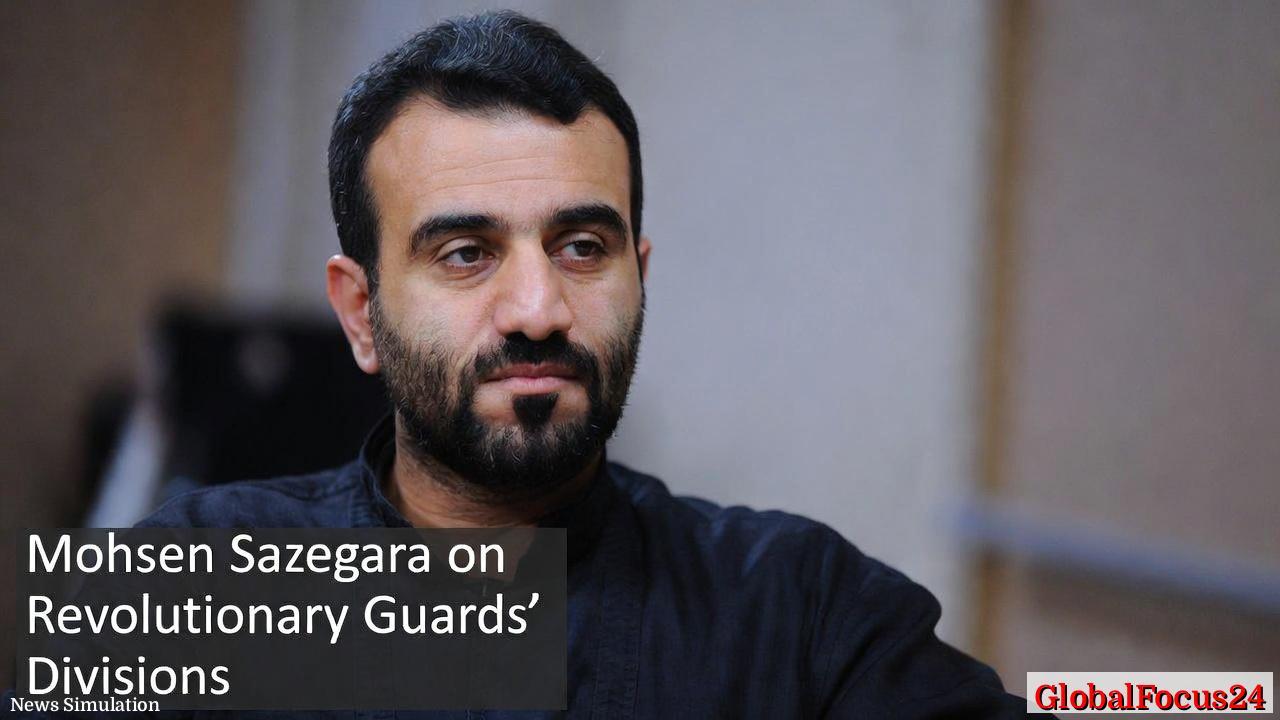
Iran’s Revolutionary Guards Face Internal Divisions, Founder Warns of Fractured Loyalties
A Former Insider’s Alarming Assessment
Mohsen Sazegara, one of the original founders of Iran’s Islamic Revolutionary Guard Corps (IRGC), has issued a striking assessment of the organization he once helped create. Decades after the 1979 revolution that brought the Islamic Republic to power, Sazegara now believes the IRGC is far more divided than it appears — a force that may no longer stand as a monolithic guardian of the regime. His comments come at a moment of growing domestic tension and international uncertainty over Iran’s political future.
According to Sazegara, internal fractures have deepened over time between different branches of the IRGC and the paramilitary Basij forces that operate under its umbrella. He argues that these divisions reflect not only generational and ideological differences, but also competing loyalties shaped by economics, power hierarchies, and regional allegiances.
From Revolutionary Vanguard to Power State
The IRGC was established in May 1979 by decree of Ayatollah Ruhollah Khomeini. Its founding purpose was to safeguard the revolution and prevent internal or external threats that could destabilize the new Islamic Republic. Unlike Iran’s traditional army, the Guards pledged direct allegiance to the Supreme Leader — a design meant to ensure political reliability rather than mere military competence.
Over the decades, the IRGC expanded far beyond its original defensive mission. Its reach extended into nearly every aspect of Iranian society — from business and construction to foreign policy and media. The organization grew into a parallel state within the state, with influence surpassing that of most formal institutions. By the late 1990s, it had also become a critical actor in regional conflicts, projecting Iranian power through proxy networks in Lebanon, Iraq, Syria, and Yemen.
Yet Sazegara suggests this vast expansion has come at a cost. “The IRGC today is not what it was intended to be,” he reportedly said in a recent interview. “Its units are fragmented by personal gain, internal mistrust, and fatigue from decades of entanglement in politics and war.”
Economic Entanglement and Uneven Loyalty
Much of the IRGC’s transformation stems from its growing economic power. Through its engineering and industrial arm, Khatam al-Anbiya, the organization controls large-scale infrastructure projects, oil and gas ventures, and import channels. This economic empire grants it autonomy from civilian oversight while also feeding corruption and internal rivalries.
Analysts note that control over such lucrative assets has created factions within the Guards. Senior commanders, many enriched through business interests, tend to prioritize regime stability as a guarantee of continued influence. By contrast, younger officers — many drawn from middle-class or provincial backgrounds — have become increasingly disillusioned, particularly as economic sanctions and inflation erode public support for the regime.
Sazegara claims these generational rifts run deeper than public appearances suggest. “There are those who would not risk their lives for a government that has lost legitimacy,” he said, describing how some mid-level commanders quietly sympathize with the economic grievances voiced in recent nationwide protests.
The Role of the Basij: Between Ideals and Disillusionment
The Basij militia, long portrayed as the grassroots moral arm of the revolution, is also showing signs of fatigue. Formed in 1979 as a volunteer force under the IRGC, the Basij played a central role in enforcing Islamic codes and suppressing dissent. During the Iran-Iraq War, its members were celebrated for their sacrifice. In recent years, however, their participation in domestic crackdowns has eroded their reputation.
Sazegara and other former officials suggest that many Basij members now enlist out of economic necessity rather than revolutionary zeal. With unemployment high and prospects limited, Basij service offers modest pay and social benefits. This shifting motivation may contribute to diminished ideological cohesion — a crucial factor in any future confrontation between state forces and public unrest.
Cracks Exposed by Recent Unrest
Iran’s internal security challenges have intensified since the nationwide protests of 2022–2023, sparked by the death of a young woman in police custody. Demonstrations spread across dozens of cities, drawing in a cross-section of society rarely seen in previous waves of unrest. The IRGC and Basij were central to the state’s response, but their actions revealed underlying stress within the ranks.
Reports at the time indicated inconsistent enforcement across provinces, suggesting variations in loyalty and willingness to act. Some regions experienced heavy crackdowns, while others saw security forces adopt a more restrained approach. Sazegara interprets this as evidence that discipline within the IRGC is increasingly localized — reliant on personal networks and local commanders rather than a top-down command structure.
Such fragmentation raises doubts about how cohesively the Guards would function in the event of a full-scale crisis, whether domestic or external. If confronted with mass civil disobedience or a power vacuum at the top, Sazegara believes not all units would obey orders to defend the regime “to the last man.”
Historical Parallels and Regional Comparisons
History offers several examples of elite security forces that eventually turned inward or fractured under pressure. In the Soviet Union’s final years, the KGB and Red Army became divided over political reforms and public protests. Similar patterns emerged during the fall of Eastern Bloc regimes, where once-loyal militaries hesitated to fire on civilians.
In the Middle East, parallels can be drawn with Syria and Iraq. In Syria, key military divisions remained loyal to the Assad family during the early years of the civil war, ensuring the regime’s survival. In contrast, Saddam Hussein’s Republican Guard in Iraq, though fiercely loyal in its prime, disintegrated rapidly after the 2003 invasion when its cohesion was tested.
Iran’s IRGC occupies an intermediate position. It retains substantial resources, advanced weaponry, and a pervasive intelligence apparatus. Yet the organization’s national legitimacy — once rooted in revolutionary idealism — has faded among younger Iranians, many of whom view it as a political and economic elite detached from social realities.
Economic Pressures Deepening the Divide
Economic strain continues to shape the internal dynamics of the IRGC. Years of international sanctions have squeezed the broader Iranian economy, forcing the regime to rely even more heavily on the Guards’ business networks for survival. While this grants the organization enormous influence, it also exposes its members to popular resentment. Many Iranians associate the IRGC with corruption, smuggling, and economic inequality.
Inflation remains persistent, and unemployment among youth is high. These conditions have eroded public patience with state institutions, creating an undercurrent of anger that could test the loyalty of security forces in a prolonged confrontation. Sazegara’s observations imply that some commanders are already questioning how far they are willing to go to maintain a system increasingly despised by those they patrol.
Shifting Regional Role and Military Fatigue
Externally, the IRGC’s elite Quds Force continues to command operations across the Middle East, supporting allied militias and political movements. However, the cost of maintaining these proxy networks — in Syria, Iraq, and Lebanon — has heightened debates within Iran’s leadership. Some officers reportedly argue that the country’s financial and human resources should be redirected to address domestic problems rather than foreign entanglements.
This strategic fatigue mirrors broader shifts in regional power. Gulf states have diversified their security partnerships and economies, while Iran’s isolation persists. Even among its traditional allies, Tehran faces new skepticism. Lebanon’s economic collapse and Iraq’s internal instability have reduced the strategic returns on Iranian engagement, limiting the IRGC’s regional leverage.
The Future of the IRGC’s Cohesion
Despite internal strains, the IRGC remains a formidable institution. Its integrated command, sophisticated surveillance infrastructure, and deep entrenchment in Iran’s economy make it unlikely to disintegrate suddenly. However, Sazegara’s account highlights a slow but significant evolution — from the ideological unity of the 1980s toward a fragmented structure sustained by privilege and survival instincts.
The ultimate question is how those fractures might affect Iran’s political stability in future turning points. If economic decay continues and generational divides widen, the IRGC’s top leadership may struggle to enforce nationwide discipline. In such a scenario, localized or factional loyalties could dictate responses to potential uprisings, possibly accelerating the regime’s loss of control.
An Uncertain Guardian of the Revolution
More than four decades after its birth, the Revolutionary Guard Corps stands at a crossroads — powerful yet vulnerable, cohesive on the surface yet eroded from within. Sazegara’s comments have reignited debate among Iranian observers about how deeply these divisions run and what they mean for the country’s future. His warning carries historical weight: the man who once helped forge the Islamic Republic’s most enduring institution now questions whether it would still defend that republic in its darkest hour.