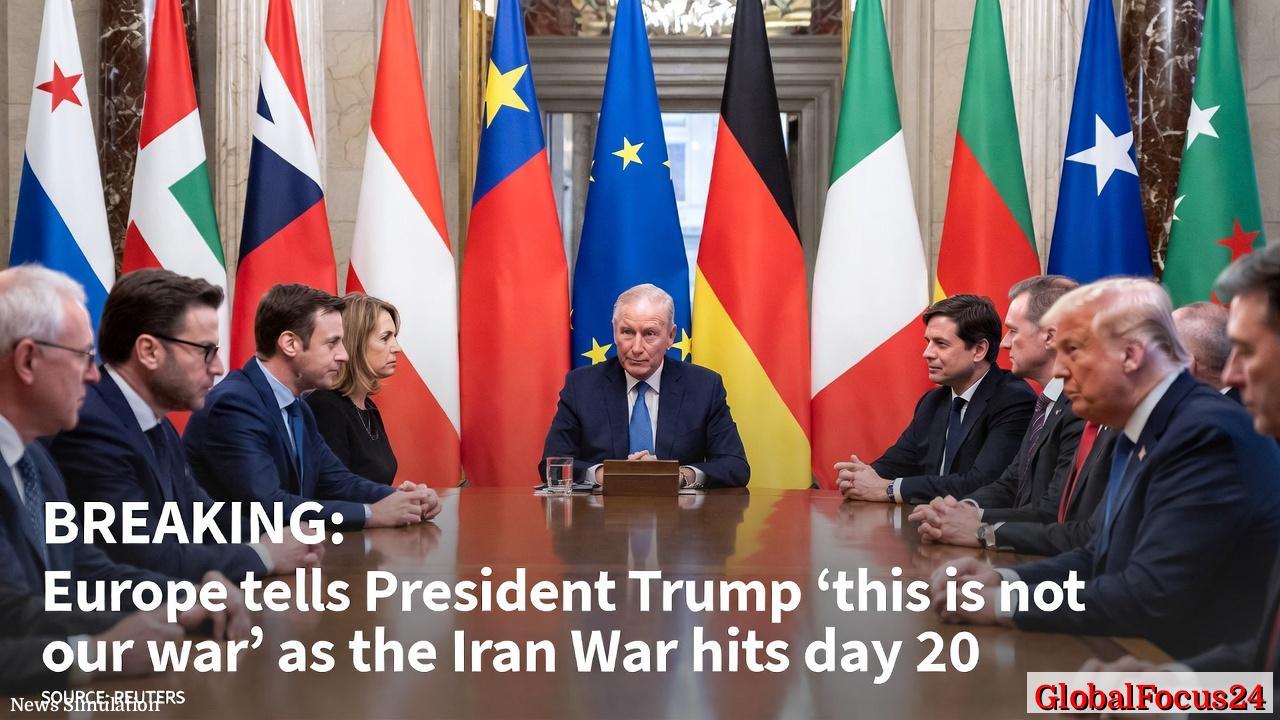
European Leaders Distance Themselves as Iran War Reaches 20th Day
Growing Transatlantic Rift Over Middle East Conflict
As the war between the United States and Iran enters its twentieth day, European leaders have moved to clarify their stance: this is not their war. In a series of coordinated statements and diplomatic communiqués, officials from major European capitals have emphasized their commitment to de-escalation, signaling a widening divide between Washington and its traditional allies.
The fighting, which began three weeks ago following a rapid escalation around key Gulf shipping lanes, has now drawn in multiple regional actors and severely disrupted global energy markets. European nations, while condemning Iranian provocations that led to the outbreak of hostilities, have urged restraint and warned of “unmanageable consequences” should the conflict continue unchecked.
Diplomatic Statements Underscore Europe’s Neutral Posture
From Paris to Berlin, the message has been remarkably consistent. French President Emmanuel Macron reiterated France’s “unwavering commitment to stability in the Middle East,” stressing that “Europe’s security interests lie in preventing further bloodshed, not exacerbating it.” German Chancellor Anna-Lena Baerbock echoed the sentiment, noting that “our focus must remain diplomatic—Europe has no appetite for expanding military operations beyond NATO’s defensive framework.”
Italy, Spain, and the Nordic countries have also endorsed a neutral stance, arguing that involvement would serve neither European interests nor international law. Several European Union officials privately expressed frustration with Washington’s unilateral military decisions, noting the absence of consultation before the first U.S. strikes on Iranian infrastructure.
A History of Divergent Approaches
This transatlantic rift is not without precedent. Since the early 2000s, Europe and the United States have often viewed Middle Eastern conflicts through different lenses. The 2003 invasion of Iraq marked an early turning point, dividing the Western alliance between those supporting U.S. intervention and those warning of long-term instability. The 2018 U.S. withdrawal from the Iran nuclear deal—formally the Joint Comprehensive Plan of Action (JCPOA)—deepened that divide.
Europe’s commitment to the JCPOA, even after Washington abandoned it, shaped much of the current policy mood. Leaders in Brussels and national capitals see diplomacy as the only viable means of curbing Iran’s nuclear ambitions. The present conflict, in their view, risks erasing years of patient negotiation.
Economic Stakes for Europe
Beyond political principles, the economic consequences of the war are already rippling across Europe. Oil prices surged above $120 per barrel in early trading this week, their highest level since 2022, driving up transport and manufacturing costs across the continent. Energy-dependent economies such as Germany and Italy now face renewed pressure just as they were emerging from two years of sluggish post-pandemic recovery.
Europe’s manufacturing sector, particularly in chemicals, automotive, and heavy industries, depends heavily on stable energy prices. Prolonged instability in the Gulf threatens to derail inflation-reduction efforts and complicate monetary policy decisions by the European Central Bank.
Analysts caution that if the conflict closes the Strait of Hormuz or disrupts major shipping routes, Europe could face fuel shortages by early summer. The prospect has prompted emergency energy coordination within the European Council, including discussions about strategic fuel reserves and potential energy-sharing mechanisms between member states.
Security and Strategic Autonomy
While Europe's immediate focus is on avoiding entanglement, some policymakers view the crisis as a test of the continent’s long-term strategic autonomy. NATO’s Article 5 commitments—centered on collective defense—do not automatically apply to American offensive operations initiated outside Alliance coordination. That distinction has allowed European governments to maintain diplomatic neutrality while expressing solidarity with U.S. troops stationed in the Middle East.
Defense experts argue that Europe’s lack of unified military command makes it difficult to formulate a coordinated response even if participation were politically feasible. The European External Action Service has instead concentrated on humanitarian planning, preparing for potential refugee flows or disruptions to international trade routes.
Regional Comparisons Highlight Contrasting Approaches
Regional comparisons underscore the uniqueness of Europe’s cautious stance. In contrast, several Gulf Cooperation Council states, particularly Saudi Arabia and the United Arab Emirates, have supported limited U.S. operations targeting Iranian missile sites. Israel has conducted its own defensive raids, citing heightened threats from Iran-backed militias along its borders.
In Asia, Japan and South Korea have condemned Iranian aggression but avoided direct involvement, focusing instead on securing maritime trade routes through the Indian Ocean. Russia and China have both called for an immediate ceasefire, though Western intelligence sources suggest that Moscow has quietly increased arms shipments to Tehran amid the turmoil.
Within this global context, Europe's restraint stands out as both strategic and pragmatic. The continent, geographically removed yet economically exposed, is balancing support for the United States with its long-term interest in regional stability and open trade.
Humanitarian and Refugee Concerns Mount
As the conflict expands, humanitarian consequences are drawing increasing international concern. Thousands of civilians have been displaced within Iran’s southern provinces, and reports of infrastructure damage have emerged from several Gulf states. European humanitarian agencies, coordinated through the EU Civil Protection Mechanism, are preparing aid packages and medical response teams in case of a broader regional spillover.
The war’s impact on global shipping is another pressing issue. More than 30 percent of Europe’s imported crude oil passes through the Persian Gulf. Disruptions to logistics, insurance, and maritime security could trigger secondary effects across supply chains already stretched by recent geopolitical crises.
Public Opinion and Political Pressure
Domestic opinion within Europe overwhelmingly favors non-involvement. Polls conducted across major EU member states show consistent public opposition to military engagement, with strong support for diplomatic mediation instead. Political parties across the spectrum, from centrist to conservative blocs, have largely converged on the message that Europe must act as a peace broker rather than a combatant.
However, this stance does not come without tension. In Eastern Europe, where reliance on American security guarantees remains strong, some leaders have quietly warned that distancing from Washington could weaken transatlantic defense cohesion. Yet even these governments have stopped short of offering military assistance, opting instead to supply humanitarian aid and logistical support for international relief efforts.
Calls for an International Ceasefire
Europe’s diplomatic machinery has mobilized behind one central demand: a ceasefire. The EU’s High Representative for Foreign Affairs has proposed an emergency summit involving regional powers, including Turkey, Qatar, and Oman, to mediate between Washington and Tehran. Early discussions have focused on securing temporary safe zones and reopening maritime corridors for essential goods.
The United Nations Security Council has held several emergency sessions, with European delegations emphasizing multilateral diplomacy over unilateral strikes. The message, as one senior diplomat described it, is “restraint through engagement.”
Long-Term Implications for Transatlantic Relations
The longer the conflict drags on, the greater its potential to strain U.S.–European relations. Analysts warn that persistent policy divergence could accelerate Europe’s drive toward independent security and energy frameworks, reducing its reliance on Washington-led initiatives. In particular, the war has strengthened momentum behind the EU’s ongoing development of a unified defense capability, including joint rapid response units and collective cybersecurity infrastructure.
Still, few predict a full rupture. Despite recent disagreements, the U.S.–European alliance remains rooted in shared democratic values and decades of cooperation. Most observers expect that once the conflict subsides, diplomatic repair efforts will follow swiftly. Yet, the current episode may leave lasting marks on how future crises are handled—especially when U.S. actions affect European interests without prior consultation.
A Continent Watching from the Sidelines
For now, Europe watches warily from the sidelines, urging calm amid rising global tensions. In capitals across the continent, leaders face a delicate balance: defending their moral stance on peace and diplomacy while managing the real economic and security consequences of a distant but consequential war.
As the Iran conflict deepens into its third week, one reality has become undeniable: even wars fought far from Europe’s borders can reverberate across its energy markets, its political alliances, and its sense of global purpose. Whether the continent’s strategy of cautious neutrality can hold depends largely on how quickly the fighting subsides—and whether Washington is willing to once again listen to the voices across the Atlantic calling, above all else, for restraint.