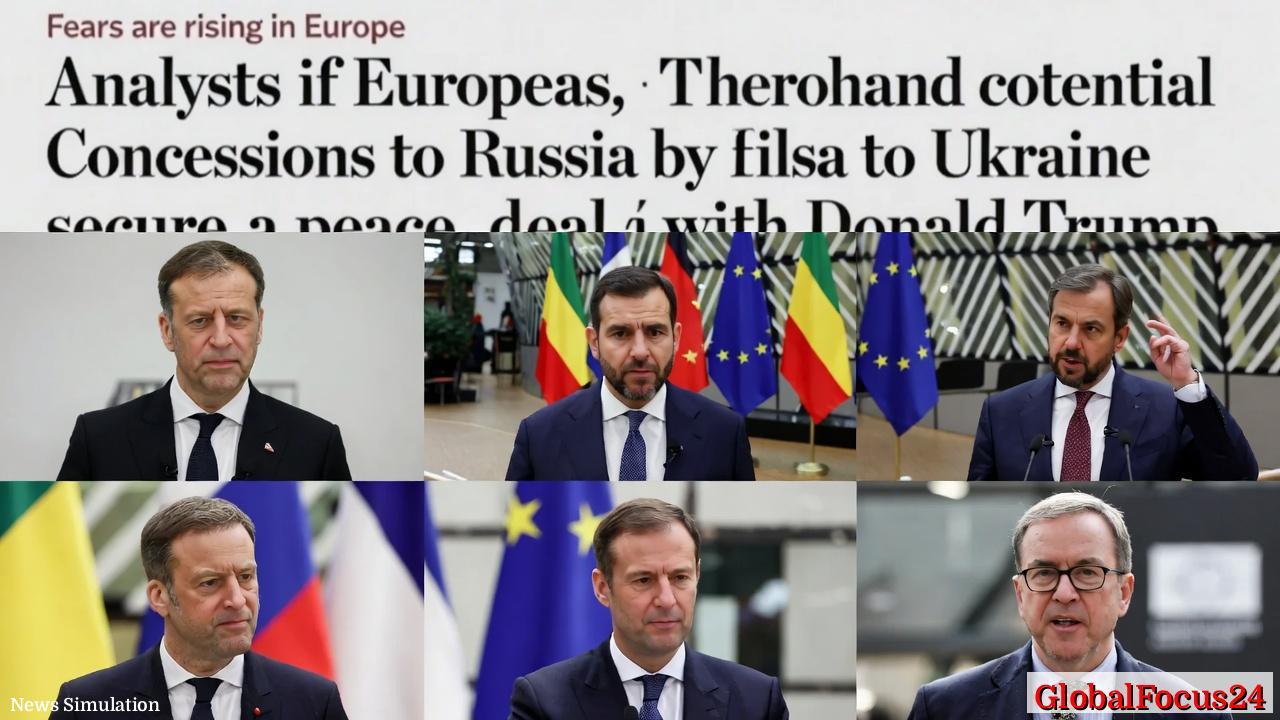
Trump’s Ukraine calculus and the Kremlin’s “Greatest Deal”: European concerns and global implications
In the dense tapestry of post-Soviet geopolitics, few threads are as closely watched as the intersection of U.S. policy, Russian resource politics, and Ukraine’s sovereignty. As European capitals monitor rapidly shifting U.S. political signals, fears have intensified that a potential U.S. administration could press Kyiv to concede strategic territory or political autonomy in exchange for access to Russia’s vast mineral wealth, including gold reserves. The Kremlin’s framing of a so-called “Greatest Deal”—a supposed path to normalized relations and lifted sanctions that would unlock trillions of dollars in opportunities for Western investors—adds a new layer of urgency to a debate already fraught with risk for Kyiv and its European partners. The conversation spans historical memory, current sanctions regimes, economic calculations, and regional comparisons that reveal both the precariousness and the potential of any such strategic bargain.
Historical context: a long arc of sanctions, leverage, and regional security
To grasp the present anxieties, it helps to revisit the arc of Western sanctions against Russia and the broader strategic consequences for Europe. Since the annexation of Crimea in 2014, Moscow’s economy has faced repeated shocks from targeted sector restrictions, financial sanctions, and export controls. The resulting frictions have redirected capital, trade patterns, and energy security calculations across the continent. Ukraine has emerged not only as a frontline state but as a focal point for Western solidarity and strategic investment aimed at sustaining Ukrainian resilience and deterring further destabilization.
Historically, sanctions are designed to incentivize changes in behavior rather than to extract immediate, all-encompassing gains. Yet the Kremlin’s rhetoric about enormous potential rewards—despite substantial legal and political barriers—has consistently aimed to exploited perceptions of near-term windfalls. European policymakers recognize that even with optimistic assumptions about resource access or investment flows, the underlying economics are deeply contingent on sanctions relief, geopolitical risk, and the durability of post-conflict stabilization. The tension between aspirational economic gains and the realities of a destabilized regional order forms a persistent backdrop to any discussion of a “great deal.”
Economic impact: weighting resource wealth against risk and infrastructure realities
Analysts who study Russia’s resource sector point to a paradox: Russia possesses vast mineral wealth, including precious metals, rare earths, and hydrocarbon reserves, that could attract substantial investment if political and legal safeguards were credible. However, several obstacles complicate the prospect of a rapid, broad-based rebound in Western investment. Sanctions regimes remain in place or evolve with political changes, creating a high-risk environment for long-horizon, capital-intensive ventures. Legal uncertainty, corporate governance concerns, and the challenge of transferring assets through opaque ownership structures further deter risk-averse investors.
From an economic perspective, the supposed trillions in opportunity must be weighed against the friction of sanctions, infrastructure damage from years of conflict, and the ongoing need for modernization in Russia’s own economy. Even if some sanctions were lifted, investors would demand robust protections against expropriation, reliable dispute resolution mechanisms, and guarantees of market access. The cost of doing business in a reform environment with persistent geopolitical volatility would likely dampen enthusiasm for a rapid, large-scale capital inflow.
For Ukraine, the stakes are even higher. Any proposed framework that pressures Kyiv to recognize occupation, or to relinquish control over critical border regions, risks destabilizing its security guarantees and eroding Western support. The European Union, as well as NATO allies, faces a delicate balancing act: sustaining Ukraine’s sovereignty and defense, while keeping channels open for constructive diplomacy with Moscow. The outcome will shape not only Ukraine’s future political alignment but also Europe’s broader security architecture and energy diversification strategies.
Regional comparisons: Europe’s divergent paths toward resilience and diversification
Within Europe, nations are responding to the prospect of a closer U.S.-Russia rapprochement in varied ways, reflecting different exposure to energy dependence, defense commitments, and domestic political climates. In Northern and Western Europe, where energy diversification has accelerated in recent years, policymakers argue that resilience is rooted in diversified supply, storage capacity, and mutualized European heating and power markets. Countries in these regions have invested heavily in liquefied natural gas (LNG terminals), interconnector pipelines, and strategic reserves to reduce exposure to any single supplier or geopolitical shock.
Central and Eastern Europe, with proximity to Russian markets and historical dependencies, approach the question with heightened strategic caution. Here, even discussions about potential sanctions relief or new investment regimes are filtered through concerns about the long-term security of borders, the integrity of international law, and the risk of renewed pressure on neighbor states. For these countries, any credible path toward a stabilized European security environment hinges more on verifiable reforms, transparent governance, and sustained political will than on speculative compensation tied to resource wealth.
Southern Europe’s perspective emphasizes economic diversification and resilience through technology, services, and manufacturing. While not as exposed to immediate energy price volatility as their northern peers, southern markets watch how any major geopolitical détente or economic redesign could alter demand for goods, affect supply chains, and shift investment flows that support regional growth.
Public reaction and the urgency of credible commitments
Public sentiment across Europe has grown wary of high-stakes deals that might sacrifice foundational principles—such as sovereignty, territorial integrity, and rule of law—for promises of future gains. Citizens tend to favor transparent, verifiable arrangements that offer durable guarantees rather than ad hoc concessions. The sense of urgency among policymakers is amplified by the humanitarian cost of the conflict, the long-term risk to regional stability, and the potential ripple effects on global markets, including commodity prices and energy security. In this environment, credible commitments—clear timelines, enforceable safeguards, and robust dispute resolution mechanisms—are essential to sustaining public trust and ensuring that any deal aligns with long-term European interests.
Investor confidence, sanctions, and the risk premium
From the standpoint of investors, the Kremlin’s “Greatest Deal” rhetoric raises questions about risk premiums and market access. Even if sanctions policies were altered, investors would need to see a credible regulatory framework, enforceable property rights, and steady progress toward macroeconomic stability. The presence of ongoing sanctions is a significant signal of political risk and a reminder that any expected upside comes with a parallel set of constraints and governance challenges. In practice, the most attractive investment opportunities would likely emerge not from broad sanctions relief alone, but from targeted, transparent frameworks that protect investors while preserving international norms and regional security commitments.
Is the “Greatest Deal” realistic? Analysts weigh competing horizons
Economic realism remains the central test for the Kremlin’s grand narrative. Several streams of analysis contribute to a sober assessment:
- Legal and regulatory certainty: The rule of law in Russia and the reliability of property rights are fundamental to attracting Western capital. Persistent concerns about expropriation, contract enforcement, and regulatory unpredictability dampen long-term investment appeal.
- Sanctions architecture: The breadth and depth of sanctions, along with possible incremental relief, create a layered barrier to rapid capital flows. Even partial relief would likely come with strings attached, including verification mechanisms and strategic concessions.
- Infrastructure resilience: The scale of infrastructure repair, modernization, and logistical integration required for resource extraction and export is formidable. Repair costs, financing terms, and environmental considerations add layers of complexity.
- Political stability: Russia’s internal political economy and regional dynamics influence investment risk. Domestic policy shifts, regional governance, and social stability all feed into investors’ risk assessments.
- Ukraine’s security guarantees: European and transatlantic assurances regarding Ukraine’s sovereignty and territorial integrity are central to any credible framework. Without durable security commitments, the risk-reward calculus for sustained European investment into a post-conflict environment remains uncertain.
What a responsible, credible path could look like
Rather than focusing on high-level promises, a credible pathway would emphasize concrete milestones and safeguarded principles. Potential elements include:
- Verification and accountability: Independent, multinational oversight of any sanctions-relief measures, with clear benchmarks and time-bound reviews.
- Rule of law and governance reforms: Demonstrable improvements in judicial independence, anti-corruption efforts, and transparent regulatory processes to reassure international investors.
- Territorial assurances via international mechanisms: Robust, multilateral assurances regarding Ukraine’s borders, demilitarization terms, and security guarantees aligned with international law, with defined exit ramps that do not compromise Kyiv’s sovereignty.
- Economic diversification for Europe: Continued momentum on energy diversification, grid modernization, and regional cooperation to reduce vulnerability to any abrupt shifts in the geopolitical landscape.
- Support for rebuilding and resilience: Large-scale, transparent reconstruction and development programs in Ukraine that are financed through credible international partnerships and subject to strict governance standards.
Public health and humanitarian considerations
Beyond macroeconomic calculations, the humanitarian dimension remains central. The conflict has exacted a heavy toll on civilian populations, infrastructure, and regional stability. Any strategic maneuver that threatens displacement, disrupts essential services, or delays recovery would intensify humanitarian needs and complicate European and global responses. International relief efforts, civilian protection, and mechanisms to accelerate reconstruction must accompany any broader political or economic settlements to prevent a relapse into violence and to support a sustainable, peaceful outcome for the region.
Conclusion: navigating uncertainty with prudence and foresight
In the volatile theater of European security, the prospect of a U.S.-Russia détente framed around vast resource wealth raises as many questions as it promises answers. The economic allure of access to Russia’s mineral wealth and potential market size must be weighed against the enduring costs of sanctions, legal risk, and the imperative to uphold Ukraine’s sovereignty and regional security architecture. European leaders remain vigilant, seeking a path that preserves strategic autonomy, strengthens resilience, and anchors any agreement in transparent governance and verifiable commitments.
As Washington, Moscow, and Kyiv weigh their options, the world watches not only for immediate market signals but for the durability of guarantees that would prevent a destabilizing bargain from undermining long-term peace and prosperity. In this context, the most persuasive narratives are those grounded in concrete milestones, accessible safeguards, and a clear alignment with international law and regional stability. The future of Europe’s security and its economic trajectory hinges on choices that favor resilience, legitimacy, and inclusive growth over quick but precarious gains tied to unverified promises.