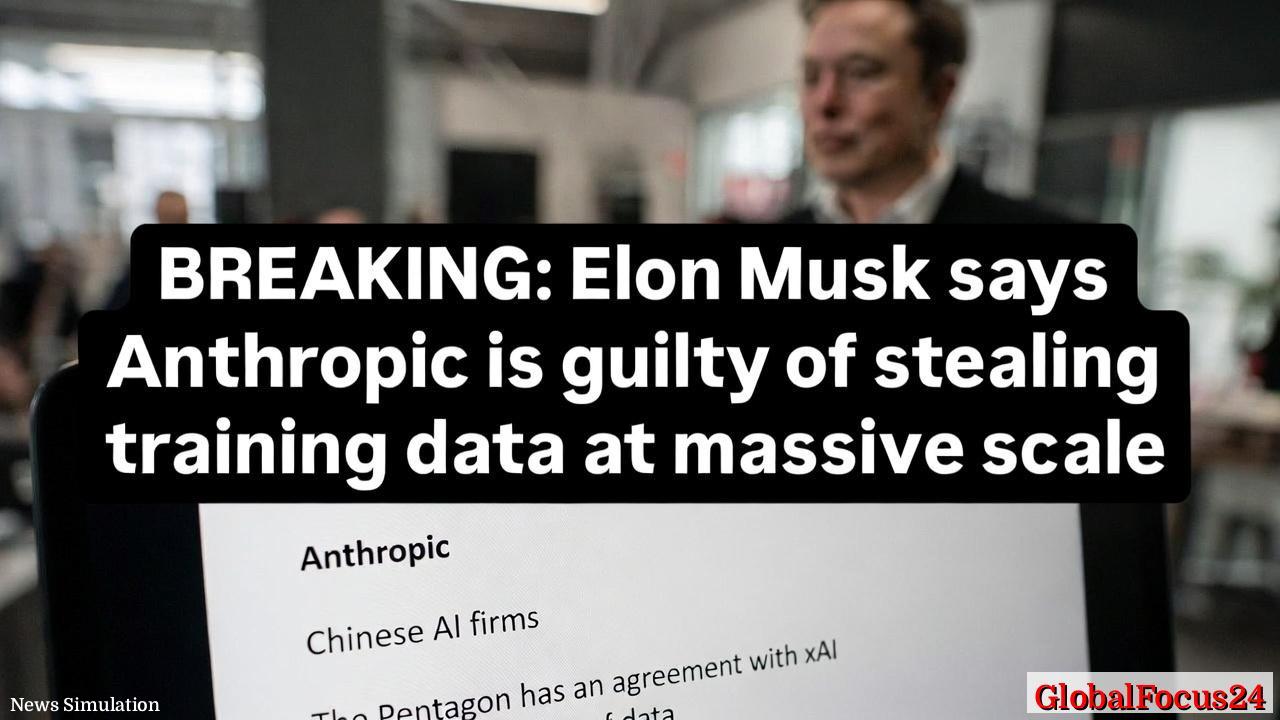
Elon Musk Accuses Anthropic of Massive-Scale Data Theft Amid Growing AI Disputes
Musk Levels Explosive Allegation Against Anthropic
A new rift has opened in the competitive world of artificial intelligence. Elon Musk, CEO of xAI and owner of the social platform X, has accused Anthropic, the developer behind the Claude AI models, of stealing training data on a massive scale. The claim comes as Anthropic faces its own wave of allegations that several Chinese AI companies—including DeepSeek, Moonshot AI, and MiniMax—engaged in “industrial-scale distillation attacks” targeting its systems.
The accusation marks an escalation in the growing feud among major AI developers, each grappling with issues of intellectual property, data sourcing, and model security. While Anthropic has denied wrongdoing in prior data-use cases, Musk’s assertion adds pressure to a company already balancing legal settlements, government negotiations, and international cybersecurity concerns.
Background: A Pattern of Data Disputes
Anthropic’s troubles trace back to long-running questions about the datasets used to train its language models. The company recently settled a $1.5 billion lawsuit concerning the data collection process behind Claude, agreeing to enhanced compliance reviews and restrictions on future data sourcing. The terms of the settlement were not publicly detailed, but legal analysts viewed it as a cautionary moment for the AI sector, where the boundaries between public data, proprietary content, and scraped material remain murky.
Musk’s accusation adds a new twist to that narrative. Although he has yet to release formal legal filings, his statement follows a pattern of public confrontation between leading AI firms. Industry observers note that Musk’s own ventures, including xAI’s Grok model, operate in a similarly contentious data environment, where model training depends heavily on both licensed and publicly available information.
China’s Alleged AI Offensive
The timing of Musk’s claim is notable. Just days earlier, Anthropic accused several Chinese AI developers of orchestrating systematic data-extraction efforts directed at its Claude series models. According to details released by the company, automated systems executed millions of simulated user exchanges, effectively attempting to reverse-engineer the conversational and reasoning capabilities of Claude’s architecture.
The technique—known in AI circles as model distillation—involves one system mimicking another by replicating answers and behaviors at scale. In a legitimate context, distillation can improve efficiency or compress large models. However, at industrial scale without authorization, it amounts to intellectual property theft. Anthropic stated that these attacks jeopardized its competitive advantage in the global AI arms race.
Chinese technology commentators dismissed the allegations as “hypersensitive,” suggesting that open interactions between AI systems fall within a gray area of technological competition. Nonetheless, Western cybersecurity specialists say the incidents underscore deep structural vulnerabilities in how advanced models are exposed online.
U.S. Defense Ties Deepen AI Rivalries
Adding complexity to the unfolding drama, the U.S. Department of Defense has entered the fray by striking a high-level agreement with Musk’s xAI. The partnership will deploy the company’s Grok language model within secure military systems for classified analytical functions. Meanwhile, the Pentagon is still negotiating with Anthropic over possible adoption of Claude AI under strict security and ethical use conditions.
Defense Secretary Pete Hegseth is scheduled to meet with Anthropic CEO Dario Amodei later this week to finalize terms. Sources close to the discussions say Washington’s primary concern centers on data confidentiality and the integrity of model training sources, particularly in light of the recent allegations from both Musk and Anthropic.
The Pentagon’s dual-track approach—engaging two rival AI firms simultaneously—illustrates the U.S. government’s desire to maintain diverse partnerships within the rapidly advancing AI ecosystem. National security analysts describe the situation as a “strategic hedge,” ensuring that no single commercial entity controls the government’s access to cutting-edge generative models.
Economic Stakes and Corporate Repercussions
The fallout from these allegations could reshape the competitive landscape of the AI economy, which exceeded $50 billion globally in 2025 and continues to expand at double-digit rates. For Anthropic, legal uncertainty threatens investor confidence, just as the company seeks additional capital to fund its next-generation Claude 4 model. The firm has positioned itself as a more safety-conscious alternative to rivals like OpenAI and xAI, emphasizing “constitutional AI” principles that align model behavior with human values.
If regulatory probes intensify, Anthropic could face renewed scrutiny from both American and European authorities. Its ongoing discussions with defense agencies make ethical transparency especially critical. Critics argue that Musk’s accusation, regardless of its merit, could slow Anthropic’s approval processes and complicate future government partnerships.
For xAI, the Pentagon deal marks a significant victory. Market analysts suggest that access to defense infrastructure boosts xAI’s credibility as a serious contender in the AI enterprise sector—an area long dominated by OpenAI, Google DeepMind, and Anthropic. The contract’s potential value has not been disclosed, but defense procurement experts estimate it could run into hundreds of millions over several years.
Historical Context: Echoes of Early Tech Wars
The current wave of data controversies recalls earlier milestones in Silicon Valley’s history. In the 1990s and early 2000s, disputes over web scraping, search indexing, and software reverse engineering fueled numerous court battles. Companies like Google, eBay, and Oracle clashed over data ownership, setting precedents that continue to shape internet law. The AI revolution has revived many of those unresolved questions—made far more complex by the scale and opacity of large language models.
Unlike early disputes that focused on discrete databases or code libraries, today’s AI systems rely on trillions of tokens and intricate interconnections. Determining the origin of specific portions of training data is virtually impossible at current technological levels. That ambiguity makes legal enforcement difficult, leaving much of the industry’s accountability reliant on corporate ethics and public transparency.
Legal scholars note that until regulatory frameworks evolve, most disputes—such as Musk’s accusation—are likely to play out in public discourse, influencing reputation more than courtroom outcomes. Still, as government contracts and global trade relations hinge increasingly on AI reliability, reputational damage can have tangible economic consequences.
Global Context: AI Rivalries Across Regions
The Musk–Anthropic dispute also reflects a deeper geographic divide in AI development. The United States, China, and the European Union are now the three poles of global AI power, each pushing distinct regulatory and strategic agendas. Washington emphasizes innovation balanced with security, Beijing prioritizes state-driven industrial scale, and Brussels anchors its approach on consumer rights and transparency.
In this geopolitical landscape, accusations of data theft carry both economic and diplomatic implications. Cross-border data flows, especially between U.S. and Chinese firms, remain flashpoints for national security agencies. The alleged “distillation attacks” on Anthropic’s Claude models strengthen the argument of U.S. policymakers who advocate stricter export controls on AI architectures and more aggressive cybersecurity monitoring.
Meanwhile, European regulators observing these events may push for international audits on AI data provenance. The European Parliament’s upcoming revisions to the AI Act, originally passed in 2025, are expected to tighten rules governing training datasets and cross-company transparency obligations.
Industry Reaction and Public Response
Within the tech sector, reactions to Musk’s allegation remain mixed. Some AI researchers contend that the claim may reflect broader frustration with the industry’s lack of standardized data ethics rather than evidence of a specific infraction. Others see it as a strategic move timed to coincide with xAI’s expanding commercial relationships and defense entrenchment.
Investors responded cautiously. Anthropic shares, traded privately on secondary markets, reportedly dipped following the accusation, while sentiment around xAI’s valuation briefly rose. Social media discussion mirrored the divide: Musk’s supporters praised his stance as “defending innovation,” while critics accused him of inflaming tensions in an already volatile industry.
Public trust in AI companies continues to fluctuate, influenced by opaque training methods and rising concerns about privacy, misinformation, and automation. Analysts believe that the resolution—or escalation—of this dispute could shape how consumers perceive corporate accountability in the next phase of artificial intelligence adoption.
The Road Ahead for AI Governance
As the world’s most powerful AI developers trade accusations, policymakers face the daunting task of governing a technology that evolves faster than legal systems can adapt. The Musk–Anthropic conflict may serve as a catalyst for clearer global frameworks on data rights, model transparency, and cross-border collaboration.
Defense partnerships, economic stakes, and international competition now intertwine AI innovation with national power in ways reminiscent of past technological revolutions—from nuclear research to the internet boom. What distinguishes this era is the speed at which AI’s influence spreads across civilian, commercial, and military domains.
For now, the tension between Musk and Anthropic reflects more than a corporate rivalry. It highlights a fundamental question looming over the AI age: who truly owns the intelligence built from humanity’s collective data? Until that question finds a durable legal answer, the world’s most advanced models will remain both marvels of innovation and magnets for controversy.