China’s Evolving Holiday Travel Rush: Shifts in Spring Festival Journeys Reflect Broader Social Changes
Record-Breaking Travel Despite Demographic Slowdown
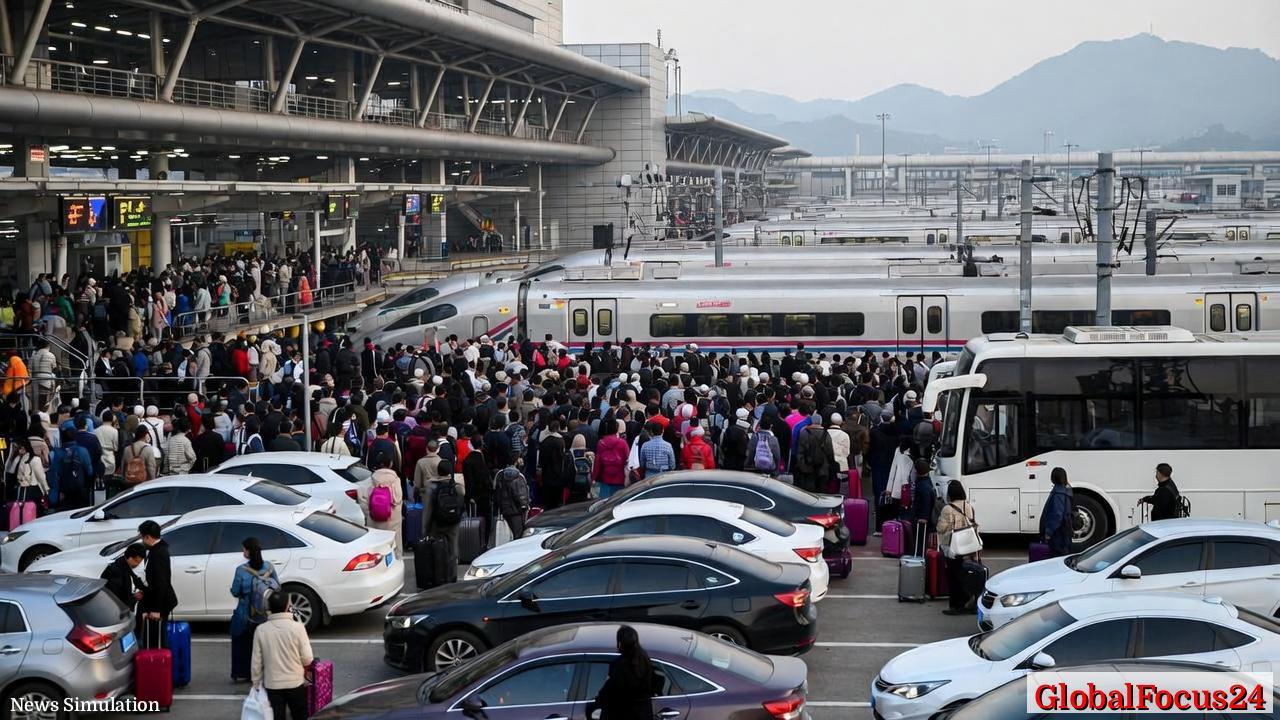
China’s annual Spring Festival travel rush, known as chunyun, has once again demonstrated the nation’s unmatched mobility and social dynamism. Authorities expect a staggering 9.5 billion passenger trips during the 40-day period surrounding the Lunar New Year holiday—up sharply from 8.4 billion in 2024. The sheer scale defies expectations amid China’s first sustained population decline in six decades, signaling that travel behavior, rather than absolute numbers, is driving the increase.
This year’s extended official holiday, running from February 15 to 23, provided workers with a rare opportunity to combine home reunions with domestic tourism. Analysts estimate that nearly half of travelers incorporated leisure activities into their itineraries, a significant shift from the traditional practice of returning solely to family homes. While the average spending per traveler has fallen below pre-pandemic levels amid consumer caution, total tourism revenue still rose by 5.7% compared to last year, adjusted for the longer break.
Growth of Domestic Tourism and Consumer Restraint
Economic headwinds have shaped traveler choices in subtle but telling ways. Many households, facing a slower job market and cautious wage growth, opted for budget-conscious itineraries. Duty-free centers in coastal and central provinces such as Fujian, Hubei, and Hainan saw record foot traffic as travelers prioritized modest leisure over luxury getaways. In Hainan’s resort towns, the influx of “winter sun” tourists pushed hotel occupancy rates above 90%, while smaller cities within driving distance of major urban cores reported brisk business in homestays and short-term rentals.
These trends confirm a pattern of pragmatic optimism—consumers remain eager to spend, but they are recalibrating toward value-for-money experiences. Economists note that this shift not only supports domestic consumption but also redistributes travel revenue more evenly across regions. Local governments have responded with cultural festivals, digital coupons, and discounted rail passes, feeding a growing ecosystem of regionally focused tourism.
The Rise of “Reverse Chunyun”
Perhaps the most striking social trend this year is the surge in “reverse chunyun,” where parents and grandparents journey to visit younger relatives who live and work in large cities. On social media, stories of older family members boarding trains or long-distance buses to celebrate the New Year in Shanghai, Beijing, and Shenzhen have gone viral, reflecting changing family structures and the growing comfort of the elderly with independent travel.
This reversal underscores deeper demographic and cultural shifts. China’s urban population now exceeds 65% of the total, up from less than 50% a decade ago. As younger generations settle permanently in cities, the sense of “hometown” is becoming more fluid. Sociologists view reverse migration during holidays as an emblem of this modernization—where affection, not geography, defines familial connection.
High-Speed Rail as the Lifeline of Mobility
No feature better illustrates the transformation of chunyun than China’s vast high-speed rail network. From just 2,000 kilometers of track in 2010, the system expanded to over 50,000 kilometers by the end of 2025, connecting almost every major city with lines that rival airline punctuality and efficiency. This dense infrastructure has reshaped not only how far people travel, but also when.
Before the pandemic, peak travel days occurred roughly four days before Lunar New Year’s Eve, as workers endured long, uncertain journeys home. Now, data from mobile location services show the busiest rush happening just two days before the holiday. The change suggests travelers can rely on faster trains to reach destinations in hours rather than days, allowing them to work or study longer before departure. The effect has been a smoother, more predictable flow of passengers across the network and fewer instances of the overcrowded chaos once synonymous with chunyun.
Private vehicles, too, have risen as the dominant transport mode, accounting for roughly 80% of all trips when local and short-distance journeys are included. Cross-province highways have grown more sophisticated, with improved service areas, electric-vehicle charging networks, and real-time traffic management. The combined evolution of road and rail has effectively created a multi-speed mobility ecosystem—one tailored to choice rather than necessity.
Shrinking Distances and the Rise of Regional Clusters
A closer look at travel patterns reveals that journey distances are shortening. Roughly 62% of trips this year occurred within the same province, compared to 54% in 2020. This shift reflects the rise of economic clusters that blend work, living, and leisure within mega-regions such as the Yangtze River Delta, Pearl River Delta, and Chengdu-Chongqing economic zone. Workers in Xi’an, for example, are increasingly traveling to Xianyang—a city less than an hour away—for family gatherings, bypassing longer cross-country routes.
Such regional connectivity has significant economic implications. Shorter trips mean lower carbon emissions and reduced strain on national transportation infrastructure. They also boost local economies, from restaurants in small towns to boutique hotels near industrial corridors. Urban planners see the intra-regional chunyun as a preview of China’s next demographic phase—one marked by mobility within integrated metropolitan spheres rather than mass migration across provinces.
Historical Evolution of China’s Travel Rush
The Spring Festival rush has long mirrored China’s social transformation. In the 1980s, as market reforms took hold, newly mobile workers from the countryside began returning home en masse each Lunar New Year, turning train stations into scenes of controlled chaos. By the 2000s, as coastal manufacturing boomed, the number of migrant laborers surpassed 200 million, and chunyun evolved into a logistical marvel—an annual pulse check on the nation’s growth.
With the advent of digital ticketing and high-speed rail in the 2010s, the once-chaotic scramble gave way to efficiency and scale. By 2019, before the pandemic interrupted travel worldwide, China had already achieved the world’s largest coordinated transportation operation, moving billions safely each year over a six-week window. Now, as the country emerges from years of intermittent restrictions, chunyun is once again expanding—this time powered by technology, tourism, and new social norms rather than sheer labor migration.
Economic Weight of the Travel Season
The numbers behind chunyun highlight its enormous economic footprint. Tourism agencies estimate that travel-related spending during the festival season accounts for nearly one-fifth of annual domestic consumption for some provinces. Hotels, airlines, restaurants, and retail chains rely heavily on the period’s surge in demand to meet quarterly targets. Railway authorities reported record sales of pre-ordered tickets in late January, while mobile payment platforms tracked year-over-year increases in digital red envelopes and transit transactions.
However, economists caution that the volume of trips should not be mistaken for unrestrained consumer confidence. Inflationary pressures remain subdued, and disposable income growth—particularly outside major urban centers—has cooled. Instead, the rising number of travelers reflects resilience in social and cultural habits: people continue to value reunion and mobility, even if they spend more carefully.
Regional Differences and Infrastructure Momentum
China’s eastern provinces remain the epicenter of chunyun activity. Cities like Shanghai, Hangzhou, and Nanjing see immense inflows and outflows within the Yangtze River Delta, where population density and wealth concentrate. Meanwhile, the western and northeastern regions show more modest growth, limited by distance and economic divergence. Yet, infrastructure investment is gradually narrowing this gap. New rail lines now connect Chengdu to Lhasa and Lanzhou to Urumqi, opening tourism corridors that once seemed remote.
Compared to other populous nations, China’s travel surge is unparalleled. India’s Diwali migration, for instance, involves hundreds of millions of people, but it lacks the logistical density of China’s coordinated rail and road systems. Within East Asia, Japan and South Korea experience modest spikes during Golden Week or Chuseok, but their smaller populations and shorter domestic distances make those journeys less intense. In sheer scale, chunyun remains unmatched—a unique socio-economic phenomenon that doubles as a real-world stress test for national planning.
The Future: From Rail to Air Mobility
Looking forward, the contours of China’s travel revolution are already shifting. Several startups and municipal authorities are investing in electric vertical take-off and landing (eVTOL) aircraft for intercity commutes under 200 kilometers—a pioneering step toward what policymakers describe as a “low-altitude economy.” In Shanghai, trials of aerial shuttle routes connecting the city to nearby Suzhou and Hangzhou have already begun. If scaled, such innovations could redefine future chunyun journeys, easing pressure on traditional networks and integrating air mobility into everyday transport.
At the same time, advances in AI-based scheduling, dynamic ticket pricing, and smart logistics are making the travel experience more adaptive. High-speed rail operators are testing predictive algorithms to manage passenger flow, while electric vehicle infrastructure continues to expand across rural highways, ensuring that even remote counties benefit from the mobility revolution.
A Reflection of a Changing Nation
The evolution of chunyun tells a larger story about contemporary China—of economic transition, technological prowess, and shifting social values. What was once a symbol of scarcity and endurance has become an expression of prosperity and choice. The record 9.5 billion trips anticipated this year are more than a logistical achievement; they signal a society in motion, finding new rhythms of life while holding fast to the traditions that bind it together.
As China continues to adapt to demographic transformation and economic recalibration, its Spring Festival travel season remains a mirror of national identity—restless, adaptive, and always on the move.