China’s Humanoid Robot Boom Faces Reality Check as Showcase Models Outpace Real-World Use
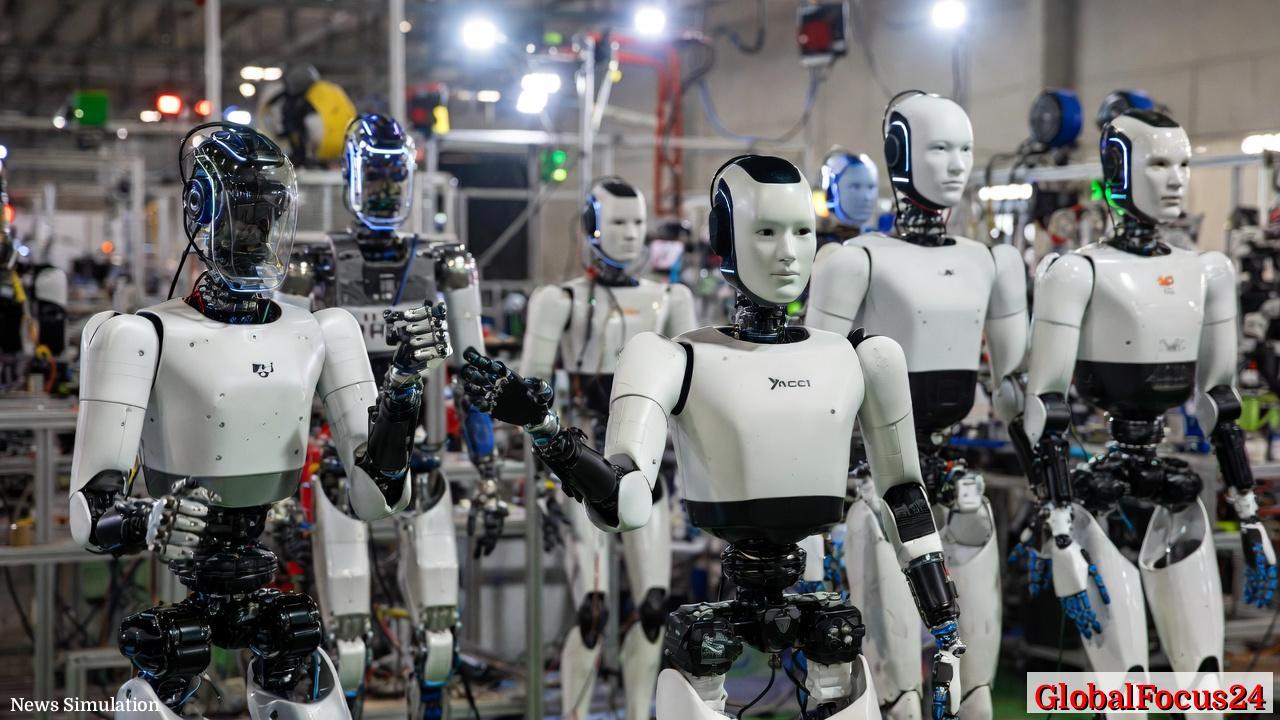
China’s humanoid robotics industry is surging with activity, filling expos and tech conferences with lifelike machines that wave, dance, and speak in natural tones. Yet behind the dazzling demonstrations lies a more sobering truth: the vast majority of these humanoids are not working in factories, offices, or hospitals. Instead, they remain confined to exhibition halls and branding events, serving as symbols of technological ambition rather than tools of economic transformation.
An Industry Built on Demos, Not Deployment
China’s recent emphasis on advanced automation has made humanoid robots a high-profile indicator of national progress in artificial intelligence and robotics. Companies from Shenzhen to Shanghai are racing to build machines capable of interacting with humans in increasingly sophisticated ways. They often tout mechanical flexibility, facial expressiveness, and integration with generative AI as signs of cutting-edge innovation.
Yet most prototypes belong to research and marketing teams, not production lines. Many are demonstrators intended to attract investors, impress policymakers, or generate publicity. The practical adoption of humanoid robots in Chinese industry remains rare. Even in sectors where China heavily invests in automation—such as logistics, manufacturing, and healthcare—functional robots tend to be task-specific machines rather than fully humanoid forms.
Economic Ambitions and Technological Limits
Beijing has labeled robotics a “strategic frontier industry,” placing it alongside semiconductors and renewable energy in its long-term economic plans. The humanoid sector, in particular, has drawn substantial venture capital and state support since 2023, with hundreds of startups receiving funding or incubation within tech zones across Guangdong, Zhejiang, and Jiangsu provinces.
However, developing a humanoid robot that can perform practical tasks safely and reliably remains enormously expensive. The engineering challenge lies not in making robots look human, but in enabling them to move, sense, and make decisions at a performance-to-cost ratio feasible for commercial use.
Motion dynamics, balance control, and hand dexterity are especially difficult. Even China’s most advanced humanoids struggle with unstructured environments, unexpected human interaction, or sustained physical labor. Their power systems also limit operational duration. These constraints have prevented mass deployment in warehouses or assembly lines, where specialized robotic arms and mobile platforms remain far more efficient and affordable.
Historical Context: From Industrial Robots to Humanoid Aspirations
China’s path toward robotics leadership began decades before its humanoid push. The country became the world’s largest consumer of industrial robots in the 2010s, driven by a pressing need to offset rising labor costs. Automation reshaped manufacturing in regions such as the Pearl River Delta, resulting in the widespread use of articulated robotic arms, welding machines, and automated guided vehicles.
In contrast, humanoid robotics is a much newer phenomenon. Early humanoid initiatives in China were largely academic, led by university laboratories in Beijing and Shanghai. By the late 2010s, global attention shifted as Japanese and South Korean firms demonstrated advanced humanoids capable of fluid motion and naturalistic gestures. These international examples—such as those developed by Honda and Hyundai—prompted Chinese enterprises to pursue similar R&D goals.
By the mid-2020s, government-backed innovation programs, including the “Made in China 2025” successor framework, highlighted humanoid robotics as an emblem of technological self-reliance and global competitiveness. Yet even as prototypes showed dramatic improvement in lifelike form and movement, widespread functional use lagged far behind industrial demand.
The Spectacle Economy of Robotics
At major robotics fairs in cities like Shanghai, Shenzhen, and Beijing, humanoid robots often serve as the centerpiece attractions. They greet visitors, deliver speeches, or perform synchronized movements against elaborate stage lighting. Social media platforms amplify these moments, generating millions of views within hours.
For companies, these events serve a dual purpose: signaling innovation while courting venture capital and government attention. Under China’s competitive tech ecosystem, startups strive to stand out by demonstrating visible progress—sometimes prioritizing rapid publicity over practical functionality.
This “spectacle economy” of robotics has fostered impressive aesthetic and media achievements but has done little to advance wide-scale commercial adoption. Analysts note that some companies effectively function as performers rather than manufacturers, focusing on generating buzz instead of solving industrial challenges.
Market Uncertainty and Cost Constraints
The fundamental question now confronting China’s humanoid robotics sector is economic viability. A functional humanoid robot currently costs far more to build and maintain than it can save in labor. While prototypes continue to improve, system reliability and unit economics limit their ability to replace or complement human workers in most workplaces.
Industry experts forecast that meaningful deployment may not occur until autonomous systems become significantly cheaper and more energy-efficient. Processing hardware must also advance; real-time decision-making requires powerful onboard computing that drives up component costs. Battery endurance—already a bottleneck for electric vehicles—poses an even greater challenge for mobile humanoids that need constant power to balance and move.
Regional Comparisons: China, Japan, South Korea, and the United States
Japan has long pioneered humanoid robotics through companies such as Honda and SoftBank, emphasizing safety, precision, and consistent technical refinement. South Korea’s approach has leaned toward integrating robots into educational and social environments. The United States, led by firms like Boston Dynamics and Tesla, frames humanoid development within the context of automation and AI research.
China’s model differs in scale and governance. Through government-backed industrial clusters and funding incentives, Chinese developers can prototype rapidly and iterate widely. This has produced an explosion of variety but not yet a corresponding depth of capability. Compared with Japan’s methodical progression and the U.S. emphasis on high-performance autonomy, China’s system prioritizes visible momentum and domestic industrial participation. The result is a high quantity of prototypes and presss but fewer real-world deployments.
AI Integration Promises a Second Wave
Recent advances in large-scale artificial intelligence models have opened new possibilities for humanoid cognition. Several Chinese firms now claim their humanoids use cloud-based AI systems for situational awareness and natural language interaction. Integration with generative AI allows these robots to interpret vocal commands, respond conversationally, and even simulate emotions.
If paired with improved mechanical design, this capability could push the industry beyond the demonstration phase. Analysts believe that AI-enabled control systems will eventually let humanoid robots perform flexible tasks that were once impossible, such as assisting in elderly care or adapting to dynamic environments. However, this transformation depends on continued progress in both software intelligence and energy efficiency—two areas where challenges remain significant.
Workforce Implications and Social Perception
Public fascination with humanoid robots has shaped China’s cultural and media landscape. Robots have appeared in fashion shows, tourist attractions, and television programs, symbolizing the country’s emergence as a global tech power. Yet public enthusiasm is tempered by skepticism about whether humanoids will genuinely contribute to productivity growth.
For workers, the notion of humanoid replacements remains largely theoretical. Most industries undergoing automation are doing so through conventional robotics and digital systems, not human-shaped machines. In contrast, humanoid robots appeal more to imagination than to payroll economics—at least for now.
The Path Forward: From Showcase to Service
For China’s humanoid robotics sector to mature, experts argue it must transition from the realm of display to that of deployment. This will require collaboration between research institutions, component suppliers, and manufacturing firms to make practical use a financial reality. Areas such as precision assembly, elderly care, and hazardous environment operations could benefit most if humanoid capabilities reach commercial readiness.
Future government initiatives are likely to emphasize integration standards, energy optimization, and human-robot safety protocols. Incremental applications—such as humanoid receptionists in hotels or public information assistants in transit hubs—may form the bridge between spectacle and service.
A Cautious Future for an Ambitious Industry
China’s humanoid robot boom reflects its broader technological ambition: to lead the world in next-generation automation. Yet the sector’s current imbalance between visual impact and functional value shows how difficult that ambition is to realize. The machines may impress on stage, but until they prove their usefulness in the factory, warehouse, or clinic, they remain expensive symbols of potential rather than pillars of productivity.
Sooner or later, the industry will face a reckoning—either evolve toward commercial practicality or remain a theater of prototypes. For now, China’s humanoid revolution continues to stride across exhibition floors, searching for its first true workplace.