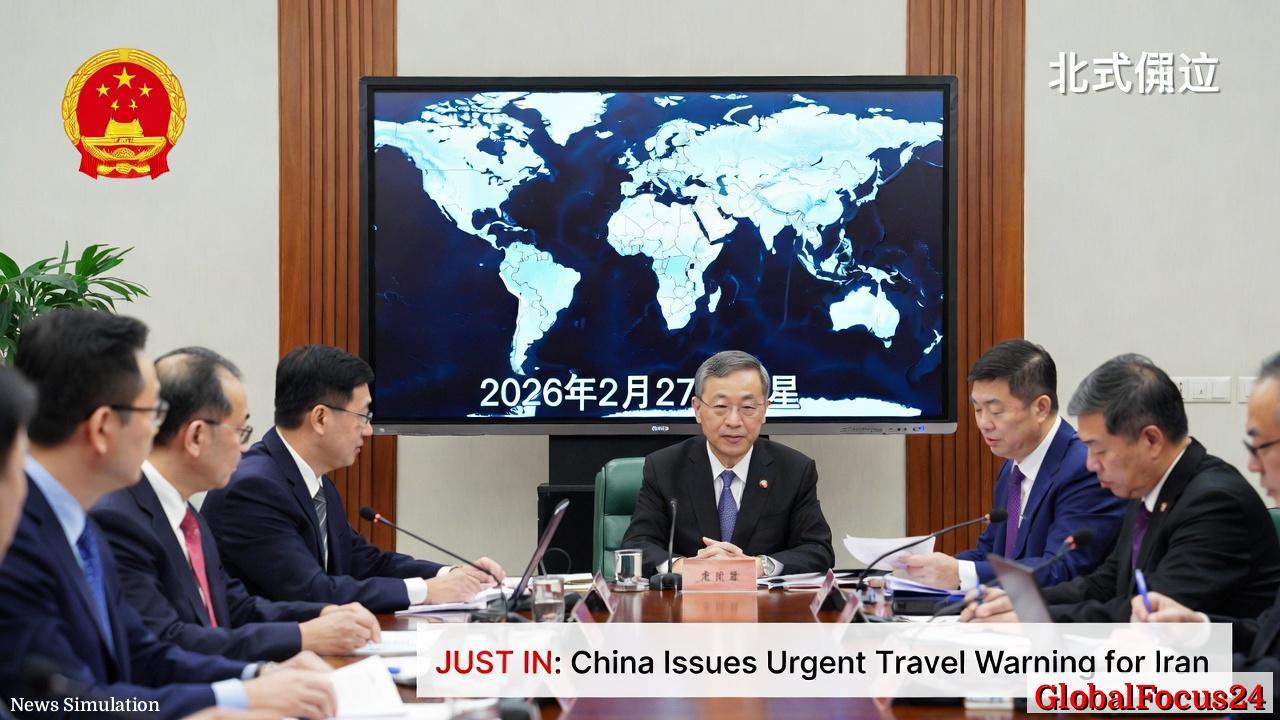
China Issues Urgent Travel Warning for Iran, Urges Citizens to Evacuate
Beijing, February 27, 2026 – China has issued an urgent travel advisory warning its citizens to immediately leave Iran, citing a surge in regional instability and deteriorating security conditions. The Foreign Ministry in Beijing said on Friday that rising external threats and disruptions across parts of the Middle East had created an environment “unsuitable for civilian travel or residence.”
The statement urged Chinese nationals currently in Iran to minimize unnecessary movements, strengthen personal safety precautions, and arrange departure “as soon as possible.” It further noted that Chinese embassies and consulates in Tehran and surrounding countries are coordinating assistance for citizens seeking repatriation, including through commercial flights and overland routes to neighboring states.
Rising Regional Tensions Spur Security Concerns
The alert arrives amid growing volatility across the Middle East, where escalating confrontations have affected trade, transportation, and diplomatic operations. While the Foreign Ministry did not specify a singular incident prompting the warning, analysts point to ongoing hostilities involving regional powers and non-state actors, which have increasingly targeted critical infrastructure and foreign interests in the region.
Over the past several months, incidents along the Persian Gulf, the Strait of Hormuz, and along Iran’s western borders have heightened fears of a broader conflict. Missile and drone strikes, sporadic clashes near oil facilities, and disruptions in communication networks have all contributed to what international observers describe as a rapidly worsening security environment.
Chinese nationals in Iran, numbering in the low thousands, include engineers, business professionals, and students. Many are based around Tehran, Isfahan, and southern industrial zones where Chinese companies maintain infrastructure and energy projects. The travel notice signaled that business operations in those areas could face temporary suspension or relocation.
Historical Context of Sino-Iran Relations
China and Iran have cultivated a complex economic and diplomatic partnership over the past two decades, centering largely on energy cooperation and infrastructure investment. Under the 25-year Comprehensive Strategic Partnership signed in 2021, Beijing committed to expanding trade and developmental collaboration with Tehran in exchange for stable access to energy resources.
Despite Western sanctions on Iran, Chinese firms have remained active in its oil, manufacturing, and construction sectors, often operating through local intermediaries and state-backed financing structures. However, these links have also made China cautious during times of political unrest.
This latest advisory echoes prior instances when Beijing issued similar alerts during regional crises, including the 2019 Gulf of Oman tanker incidents and the 2020 flare-up between the United States and Iran following the killing of Qasem Soleimani. Historically, such warnings tend to precede broader diplomatic recalibrations, designed both to safeguard citizens abroad and to preserve China’s non-interventionist reputation in volatile regions.
Economic Impact and Trade Implications
The evacuation call signals potential tremors through China’s energy supply network, as Iran remains a meaningful albeit indirect source of oil imports for Chinese refineries. While official import figures have been constrained by sanctions, analysts estimate that Iranian crude continues to reach Chinese markets through alternative channels routed via third-party intermediaries.
Any prolonged disruption in Iranian output or export logistics could raise costs for Chinese refiners and potentially nudge global oil prices upward if regional shipping lanes face additional security threats. The Strait of Hormuz—through which nearly one-fifth of the world’s petroleum passes—has been a focal point of concern for both commercial and defense stakeholders.
Beyond energy, the advisory may also affect ongoing Belt and Road Initiative (BRI) projects, including rail and terminal expansions connecting Iran to Central Asia. These infrastructure developments, positioned as part of Beijing’s broader ambition to enhance Eurasian trade corridors, depend on predictable security conditions and sustained international partnerships.
Industry observers note that even temporary pauses triggered by evacuations can delay key timetables, destabilize contractor networks, and disrupt financing arrangements with local partners. Meanwhile, logistics and insurance costs for companies operating in Iran are likely to rise sharply as global insurers reassess the country’s risk profile.
Precedents and Comparisons in the Region
Travel alerts of this nature are not uncommon in China’s foreign policy toolbox, but the degree of urgency in the latest statement stands out. Comparatively, Chinese advisories for other conflict-prone nations—such as Yemen, Syria, and parts of Sudan—have emphasized caution without urging immediate evacuation. The explicit call for departure from Iran underscores the seriousness of Beijing’s assessment of current conditions.
Regional comparisons reveal a broader pattern of increased evacuation readiness across multiple states. Japan and South Korea have also reportedly updated their warnings for citizens residing in or near Iran, mirroring steps taken by European nations earlier this month. In the Gulf states, heightened alert levels have prompted multinational corporations to reexamine their crisis response protocols and expatriate safety plans.
By aligning its warning with those of other major economies, China signals a shared international concern about Iran’s rapidly deteriorating security landscape. It also sends a message that civilian safety now supersedes economic considerations, at least in the short term.
Global Diplomatic Reactions
While Beijing has not directly commented on the geopolitical triggers behind the travel warning, its diplomatic posture remains one of cautious neutrality. The Chinese government reiterated that its citizens’ welfare is its “highest priority,” urging all parties in the region to “exercise restraint” and pursue peaceful dialogue.
Iran has not issued an official response to the advisory but has historically viewed such warnings as precautionary rather than political. In past situations, Tehran has expressed recognition of foreign governments’ duties to protect their nationals, while simultaneously reaffirming that major cities remain secure.
For now, coordination between China’s consular services and Iranian authorities appears ongoing. Local staff have been instructed to facilitate safe transit for Chinese citizens to airports and border crossings, with particular attention to areas around Tehran's Imam Khomeini International Airport and the central highways leading west toward Turkey and Iraq.
Broader Implications for Chinese Diplomacy
China’s decision to instruct its nationals to depart Iran comes at a time when Beijing is balancing its global diplomatic outreach with increasing domestic caution. In recent years, Chinese foreign policy has emphasized protecting citizens abroad amid expanding international engagements under the Belt and Road Initiative.
The Foreign Ministry’s growing emphasis on “security risk management” mirrors changes in consular policy worldwide, where governments now deploy digital platforms, hotlines, and early warning systems to monitor emerging crises. The evacuation advisory for Iran may serve as both a protective measure and a signal to other regions where Chinese investments intersect with unstable political environments.
Should the situation in Iran further deteriorate, observers expect China to temporarily scale back some cooperative ventures until safety guarantees are restored. Nonetheless, most experts anticipate Beijing will continue maintaining diplomatic channels with Tehran, mindful of Iran’s role in regional trade routes connecting Asia to the Middle East and Europe.
Looking Ahead
As reports of sporadic unrest and cross-border tension continue, the urgency of Beijing’s advisory suggests a strategic shift from passive observation to active citizen protection. Chinese officials have advised citizens traveling in adjacent countries—such as Iraq, Pakistan, and Afghanistan—to remain alert and register with local embassies for rapid communication in case of emergency.
Commercial airlines operating between China and the Middle East are reviewing flight itineraries for possible rerouting, while travel agencies have suspended package tours that include Iran as a destination. Insurance companies, too, are responding with updated coverage assessments reflecting higher risk classifications for the area.
For now, the Chinese government’s message is unambiguous: leave Iran as soon as possible. Whether the situation stabilizes or escalates will depend on how regional and global actors manage the mounting security threats that have put one of the world’s most strategically significant regions on edge.
As Beijing intensifies its evacuation efforts, the decision underscores a key truth of modern geopolitics: economic interdependence cannot always shield nations from the volatility of conflict-prone regions. The next few weeks are likely to reveal whether diplomacy, trade, and security can again find a balance—or if new uncertainties will redraw the contours of China’s engagement with the Middle East.