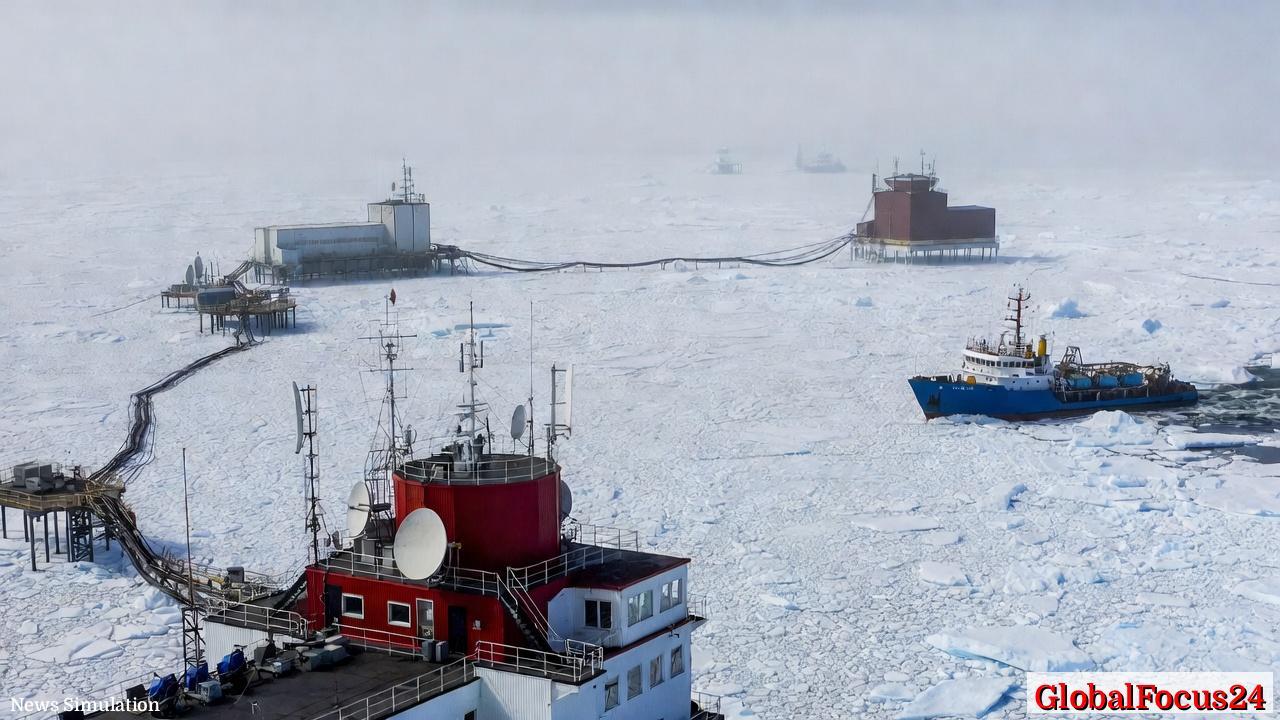
China’s Expanding Arctic Presence Raises Alarms in the West
Strategic Tensions Build in the Melting North
As the Arctic ice retreats at an unprecedented pace, a region once defined by isolation is fast becoming an active arena for global competition. Among the emerging powers vying for influence, China’s growing involvement stands out — and not merely for its scientific ambitions. Western officials from Washington to Brussels now regard Beijing’s expanding footprint in the far north, particularly in coordination with Moscow, as a potential challenge to both regional stability and the international governance of the Arctic.
China officially describes its activities as civilian in nature, focused on research, exploration, and economic cooperation. Yet many Western analysts argue that the scientific façade might conceal dual-use intentions, with applications extending into the military and strategic domains. The alignment between China and Russia — two nations often at odds with Western interests — has heightened concerns about a gradual shift in Arctic power dynamics.
The Arctic’s Rising Geopolitical Value
The Arctic’s importance has surged over the past two decades as climate change reshapes the region. Melting sea ice is opening previously impassable sea lanes, shortening global shipping routes, and unlocking vast reserves of oil, gas, and critical minerals. Estimates suggest the Arctic may hold up to 13 percent of the world’s undiscovered oil and 30 percent of its untapped natural gas. For nations seeking energy security and new trade corridors, the allure is immense.
China, despite being geographically distant from the Arctic Circle, has long positioned itself as a “near-Arctic state.” This self-designation, first formally articulated in its 2018 Arctic Policy white paper, signaled Beijing’s intent to play a significant role in the region’s development. The country’s emphasis on the “Polar Silk Road” — an extension of its Belt and Road Initiative — underscores its vision of integrating Arctic shipping lanes into global trade networks.
Collaboration with Russia Deepens
China’s partnership with Russia has become a cornerstone of its Arctic approach. The two powers have intensified cooperation on energy extraction projects, scientific research, and maritime operations. Joint ventures such as Russia’s Yamal LNG project — in which Chinese firms hold major stakes — illustrate how economic collaboration intersects with strategic alignment. In recent years, Chinese icebreakers have joined Russian counterparts in voyages across the Northern Sea Route, a corridor along Siberia’s coast that Moscow aims to transform into a major commercial artery.
For Russia, the collaboration provides much-needed investment and technological support amid Western sanctions. For China, it offers access to valuable resources and experience in operating under polar conditions. Yet Western defense experts caution that the overlap between commercial and military capabilities in Arctic infrastructure — such as ports, communication systems, and icebreakers — could blur the line between peaceful research and strategic positioning.
Western Security Concerns Mount
Officials in Washington, Ottawa, and several European capitals view this partnership with increasing unease. The Arctic’s remoteness once provided a natural buffer between great powers, but the region’s growing accessibility now exposes new vulnerabilities. U.S. defense planners warn that dual-use installations could enable surveillance, submarine tracking, or unmanned systems testing.
Canada, whose Arctic territory comprises nearly 40 percent of its landmass, has recently expanded its military presence and radar monitoring capabilities, citing concerns about both Russian maneuvers and external actors using civilian fronts for strategic advantage. Similarly, Nordic countries such as Norway and Finland have intensified coordination with NATO allies to safeguard regional airspace and infrastructure.
European Union officials also stress the geopolitical implications of China’s Arctic ambitions. While the EU promotes sustainable development and scientific cooperation, policymakers remain wary of potential erosion of the rules-based order that has governed the Arctic through the Arctic Council and related treaties since the late twentieth century.
Historical Context of Arctic Governance
The Arctic Council, established in 1996, has served as the principal forum for cooperation among Arctic states — Canada, Denmark (via Greenland), Finland, Iceland, Norway, Russia, Sweden, and the United States — along with observers that include China, India, and several European nations. Its mandate emphasizes environmental protection, research, and sustainable development, explicitly excluding military matters.
China gained observer status in 2013 after years of lobbying, arguing that global environmental changes in the Arctic affect the entire planet. Its participation has since grown, with research stations established in Norway’s Svalbard archipelago and in Iceland, and with regular scientific expeditions conducted by the Chinese icebreakers Xuelong and Xuelong 2. These activities, while publicly civilian, have drawn scrutiny for their potential intelligence-gathering capabilities and data-sharing arrangements with Russia.
Economic and Environmental Stakes
From an economic standpoint, the Arctic’s transformation presents both opportunity and peril. New maritime routes like the Northern Sea Route could reduce travel between Asia and Europe by up to 40 percent compared with the Suez Canal pathway. For shipping giants, this translates into lower costs and faster delivery times. For governments, however, it also raises questions of jurisdiction, search-and-rescue capacity, and environmental safeguards.
Critics argue that increased traffic in fragile ecosystems could accelerate pollution, disturb marine life, and compound the risks of oil spills in icy waters where disaster response remains logistically challenging. China and Russia’s emphasis on resource extraction compounds these concerns, especially given Beijing’s track record of aggressive resource pursuit in other regions.
By contrast, Canada, the United States, and European Arctic nations stress sustainable development and multilateral oversight. Yet even among allies, approaches differ. Norway and Iceland favor carefully regulated investment to boost local economies, while the U.S. and Canada emphasize national security and long-term environmental stewardship.
The Role of Technology and Research
Scientific research remains the most visible face of China’s Arctic engagement. The country operates advanced monitoring stations that collect data on climate patterns, ice thickness, and ocean currents. These contributions, in theory, benefit international efforts to understand global warming. But intelligence officials in several NATO countries worry that such installations could also serve to calibrate satellite systems or perform communications monitoring — functions that have military implications.
China’s development of polar-capable icebreakers further blurs the line between research and strategy. The Xuelong 2, launched in 2019, is the first domestically built Chinese icebreaker, featuring sophisticated navigation and endurance systems. Analysts note that similar capabilities could be adapted to support naval operations or logistics in harsh environments.
Regional Responses and Future Outlook
In response to the shifting landscape, the United States has revived its Arctic strategy, reopening the consulate in Nuuk, Greenland, and investing in new icebreaker construction after decades of neglect. Canada has launched domestic initiatives to modernize its northern infrastructure and strengthen partnerships with Indigenous communities who stand at the front line of environmental change. Nordic nations continue to expand joint military exercises, integrate satellite surveillance systems, and enhance coast guard operations in the region.
Despite rising tensions, most stakeholders stress the importance of dialogue through existing forums to prevent conflict escalation. Analysts assert that while the Arctic is not yet militarized, its rapid economic and strategic transformation demands vigilant governance. The underlying challenge lies in balancing legitimate scientific and commercial pursuits with the preservation of stability and transparency.
A New Great Game in the High North
The Arctic, once a frozen frontier, is emerging as a central theater for 21st-century geopolitics. For China, participation in the region symbolizes its arrival as a global power capable of shaping international norms beyond its immediate sphere. For Western nations and their allies, it represents a test of resilience in maintaining open seas, environmental safeguards, and a rules-based order.
The deepening alignment between Beijing and Moscow thus reverberates far beyond ice floes and research stations. It represents a potentially enduring shift in how power is projected in the world’s most extreme environment. As the ice melts and access widens, the question for the international community becomes not whether China and Russia will assert their presence — but how the rest of the world will respond to ensure the Arctic remains a zone of cooperation rather than confrontation.