China’s Energy Resilience: How Long-Term Strategies Are Stabilizing Power and Oil Amid Global Disruptions
China has navigated a volatile global energy landscape by leaning into long-term strategies aimed at energy self-sufficiency and resilient power systems. As nations around the world grapple with supply shocks, Beijing’s approach—centered on domestic production, strategic reserves, diversified sourcing, and adaptable refining—offers a case study in maintaining industrial continuity without triggering large-scale price volatility. The narrative unfolds against a backdrop of aging infrastructure, shifting international trade routes, and a government-led blueprint that prioritizes energy security as a foundational pillar of economic stability.
Historical context: lessons from the past, guidance for the present China’s energy strategy has long been shaped by the country’s rapid industrial ascent and its exposure to global supply chains. In the early decades of reform and opening, domestic oil output grew alongside robust downstream demand from a booming manufacturing sector. As output from mature fields plateaued, policymakers pivoted toward diversification—investing in strategic petroleum reserves, expanding pipeline networks, and cultivating multiple sources of crude in Africa, the Middle East, and the Americas. The goal was not merely to secure a steady flow of energy, but to insulate the economy from geopolitical flares, envoy-level disruptions, and the weather of supply-and-demand cycles.
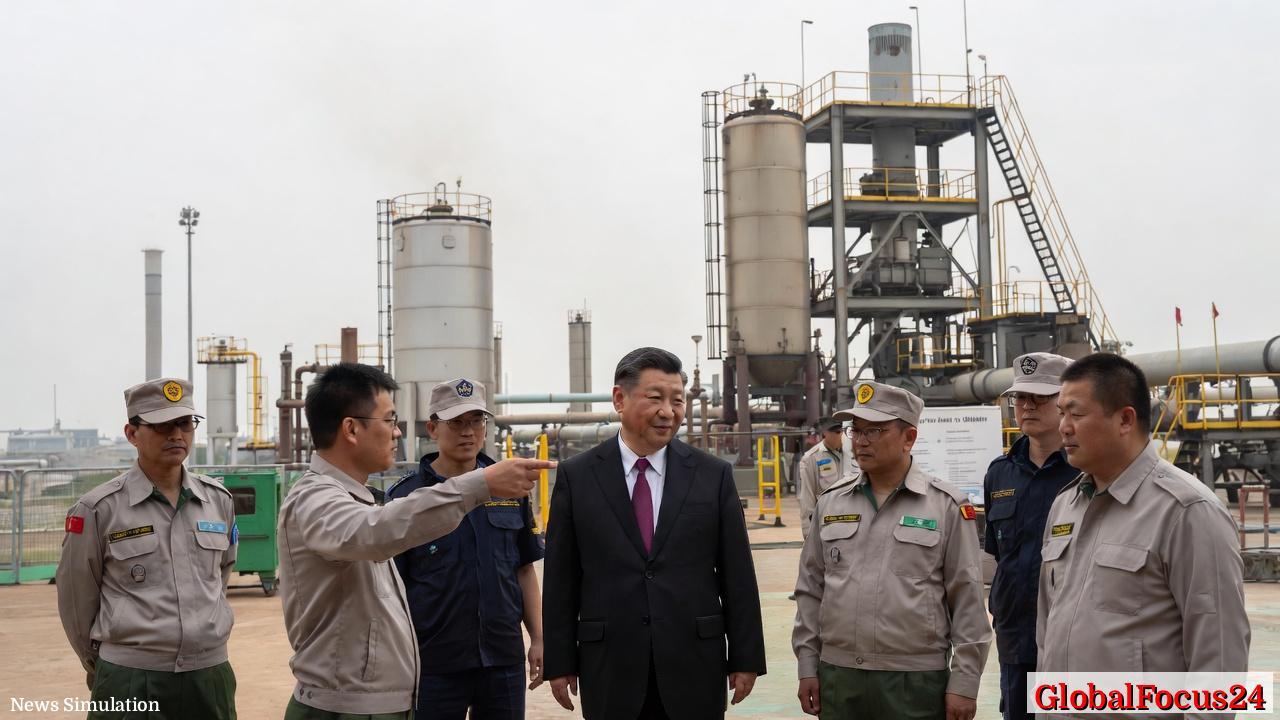
Five years ago, a symbolic moment underscored the shift: a national leader visiting an ageing oilfield along the eastern coast, framing the mission as securing China’s “energy rice bowl.” The rhetoric captured a broader engineering reality: aging fields can contribute meaningfully when paired with modernization efforts, enhanced recovery techniques, and disciplined stewardship of resources. Since then, the emphasis has evolved from simply accessing more crude to optimizing the entire energy ecosystem—production, processing, storage, and distribution—so that shocks in one segment do not quickly cascade into industrial slowdowns.
Operational realities: domestic production and strategic reserves as stabilizers Domestic oilfields in China today function as engines of reliability rather than sole engines of growth. Many of these fields operate below peak output, but state-supported efficiency drives—ranging from enhanced oil recovery (EOR) programs to digital monitoring of wells and pipelines—have stretched productive life and improved yield. The result is a more predictable supply line that complements imports rather than competing with them. In parallel, China maintains substantial strategic petroleum reserves designed to absorb several months of normal import needs. These reserves act as a buffer during short-term interruptions, helping to dampen price volatility and give policymakers time to adjust transportation, refinery operations, and industrial scheduling.
In addition to these stockpiles, refinery flexibility has grown markedly. Refineries can redirect crude streams across a broad slate of feedstocks, enabling quick responses to shifts in availability or price. This adaptability is particularly valuable when global trade patterns shift due to sanctions, maritime lane closures, or geopolitical tensions. By having the capacity to switch between heavy and light crudes, as well as alternate refining configurations, supply chains can stay intact even when specific routes or suppliers experience trouble.
Diversified sourcing and logistics: a hedge against chokepoints A central tenet of China’s energy strategy is diversification. No single corridor or supplier dominates domestic energy planning. While traditional sources remain important, new agreements and pipelines reduce overreliance on any one region. This diversification extends beyond crude oil to include natural gas, coal, and the broader fuels mix. Liquefied natural gas (LNG) imports, pipeline gas from neighboring regions, and a robust domestic coal sector all play roles in maintaining balance between reliability, affordability, and emissions goals.
Logistics and infrastructure investments reinforce this resilience. Storage capacity increases the buffer between extraction, refining, and consumption. Transportation networks—rail, road, and maritime—are choreographed to minimize bottlenecks for both industrial users and everyday consumers. In a global context, such resilience is especially valuable when navigating chokepoints that often expose economies to price spikes. For China, the policy architecture seeks to convert potential vulnerabilities into manageable, predictable outcomes for manufacturers, transport operators, and households.
Economic impact: maintaining industrial momentum and consumer confidence Maintaining a stable energy environment supports a wide array of economic activities. Heavy industry—steel, petrochemicals, automotive manufacturing, and machinery—depends on predictable feedstock costs and reliable power. When energy supplies tighten elsewhere, a resilient internal system can prevent pass-through effects that would otherwise erode competitiveness. For Chinese manufacturers competing in global markets, steady energy costs translate into more accurate pricing, improved planning horizons, and greater resilience against external shocks.
The broader economy benefits from the dampening of volatility as well. Consumers face fewer abrupt changes in fuel prices, which helps sustain household budgets and discretionary spending. In turn, consumer demand supports services and retail sectors, sustaining jobs and city-level economic activity. The net effect is a more stable macro environment that can sustain investment in innovation, infrastructure, and urban development.
Regional comparisons: how China’s approach stacks up against peers When compared to other large economies facing energy disruption, China’s blend of domestic production, strategic reserves, and diversified sourcing demonstrates notable resilience. Countries that rely heavily on a narrow set of suppliers or on highly centralized refining configurations often encounter sharper price spikes and longer recovery times during supply shocks. By contrast, China’s multi-layered approach distributes risk across a broader set of sources and capacities.
In Asia, regional players with integrated energy strategies—combining domestic fuel production with cross-border gas pipelines and LNG flexibility—tend to weather price swings more effectively than those with more fragmented systems. Europe, for instance, has faced severe energy price volatility linked to gas markets and interdependence on long-haul supply chains; the experience underscores the value of diversified portfolios and strategic reserves, even as policy goals diverge regarding emissions and energy mix. North America’s energy landscape, with its own mix of shale output, strategic reserves, and global trading, offers another benchmark for understanding how long-term resilience translates into economic steadiness.
Public reaction and policy signaling: communicating resilience without lingering fears Public sentiment around energy security often hinges on visible signs of stability: steady fuel prices at the pump, uninterrupted electricity for households and businesses, and minimal disruptions to daily life during global events that reverberate through energy markets. When resilience is framed as a continuous process rather than a one-off response, public trust grows. Citizens tend to respond positively to transparent communication about storage capacity, planned maintenance, and diversification efforts. In turn, this reduces panic-driven behavior during periods of global uncertainty and helps maintain orderly markets.
The role of policy in sustaining momentum cannot be overstated. Long-term planning, funded maintenance, and clear execution timelines are essential to translating strategic concepts into tangible outcomes. Policymakers must balance environmental objectives with reliability and affordability, ensuring that transitions in energy systems do not undermine industrial capacity or household welfare. The ongoing emphasis on efficiency, modernization of aging assets, and the expansion of storage and supply diversification signals a commitment to resilience that extends beyond immediate market conditions.
Technological underpinnings: modernization as a multiplier Technology acts as a multiplier for resilience. Digital monitoring and predictive analytics optimize field operations, reducing downtime and improving recovery rates in aging oil assets. Advanced materials and process innovations in refining expand the ability to handle variable feedstocks without sacrificing quality or throughput. Smart grid technologies, energy storage solutions, and demand-response programs help balance supply and demand in real time, contributing to stable electricity supply even when generation sources become intermittently unreliable.
Moreover, investments in energy efficiency across industries reduce the total demand for energy growth that would otherwise strain supply systems. Efficiency gains translate into lower marginal energy costs, enabling factories to maintain output with less exposure to price shocks. In a broader sense, technology-driven improvements in logistics, storage, and transport reduce the risk of shortages and shorten the time needed to respond to disruptions.
Public infrastructure and regional development: cities as energy resiliency partners Urban areas—where energy demand is concentrated—are central to resilience. Localized microgrids, distributed generation, and strategic partnerships with state energy bureaus enhance power reliability for essential services, manufacturing clusters, and critical infrastructure. Investments in intercity transmission lines and cross-regional interconnections create redundancy that can prevent cascading failures in times of stress. The regional development dimension recognizes that energy resiliency is not just a national enterprise; it requires coordinated planning among cities, provinces, and national authorities to ensure that regional economies remain robust in the face of external shocks.
Looking ahead: sustaining momentum in the energy transition As the global energy system evolves, resilience will increasingly hinge on a careful balance between traditional reliability and a gradual transition toward lower-emission solutions. China’s approach demonstrates that it is possible to maintain stable energy provisioning while investing in cleaner technologies, shared across industries and regions. The path forward will involve expanding renewable integration, improving efficiency across sectors, and maintaining strategic reserves that can bridge gaps during transitional periods. With a tradition of centralized planning paired with pragmatic execution, the country is positioned to continue delivering energy stability even as the energy mix broadens and the international environment remains uncertain.
Economic intelligence and the policy toolkit: what observers watch next Market participants and observers will closely monitor indicators that signal resilience: refinery throughput rates, inventory levels, and the pace of diversification in crude sourcing. Officials will likely highlight milestones in storage capacity expansion, new cross-border energy agreements, and progress in modernizing aging fields. The effectiveness of these measures will influence investment sentiment across heavy industries, infrastructure projects, and consumer sectors. Economists will weigh the balance between stability and the cost of maintaining large strategic reserves, as well as the opportunity costs of diversifying away from traditional energy partners.
Conclusion: resilience as a systemic attribute China’s energy strategy embodies a systemic approach to resilience. By strengthening domestic production where feasible, maintaining robust strategic reserves, diversifying supply routes, and upgrading the efficiency and flexibility of refining operations, the country reduces exposure to external shocks and sustains industrial momentum. In a global energy landscape marked by uncertainty—from geopolitical tensions to supply chain bottlenecks—the ability to deliver reliable power and fuels remains a critical component of economic stability. The ongoing emphasis on resilience, efficiency, and diversification suggests that energy security will continue to be a strategic priority for years to come, shaping policy choices, market behavior, and public confidence alike.