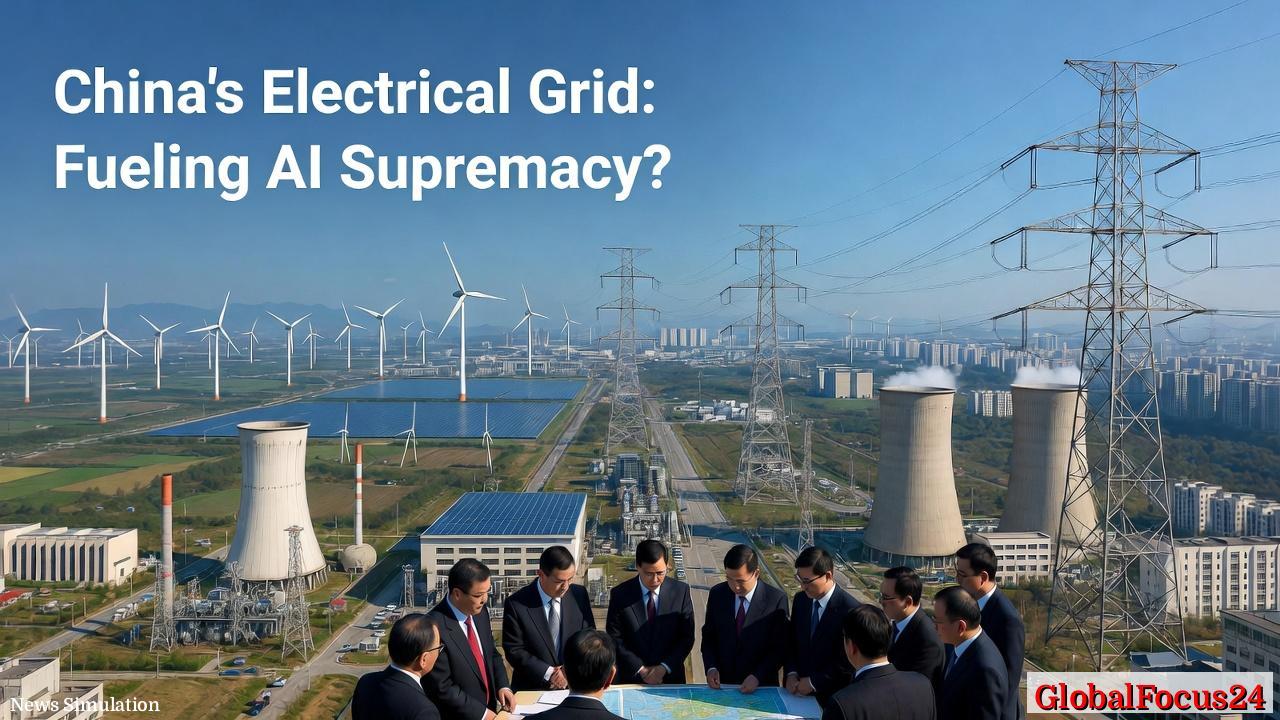
China’s Surging Electrical Grid Powers the Nation’s Artificial Intelligence Ambitions
Unprecedented Energy Growth Fuels China’s AI Push
China’s electric grid—the largest and most rapidly expanding in the world—is reshaping the global balance of technological power. With a massive oversupply of inexpensive energy, Beijing is betting heavily that cheap electricity can offset its disadvantages in semiconductor technology and drive the next era of artificial intelligence dominance. The nation’s aggressive grid expansion has become both an energy and a strategic asset, empowering Chinese companies to advance in everything from generative video tools to cutting-edge neural networks.
The energy backdrop tells the story. In just one year, China added more than 500 gigawatts of generation capacity, reaching a staggering total of about 3,800 gigawatts. That figure is more than twice that of the United States. Over the next five years, Chinese planners expect an even greater leap—adding energy infrastructure equal to roughly six times America’s planned capacity increases. This immense base of power, increasingly fed by renewables, nuclear energy, and selectively by coal, is emerging as the foundation for an artificial intelligence ecosystem aimed at global supremacy.
The Triad of AI Development
Artificial intelligence today is often described as a layered structure: applications like chatbots and image-generation tools sit at the top; the large language and vision models that power them form the middle; and at the base lies compute infrastructure—semiconductors, data centers, and, crucially, power. By rapidly expanding its electrical grid, China is strengthening the very bottom layer of this hierarchy. Leaders in Beijing view this as essential to national competitiveness, particularly as U.S. export controls continue to restrict access to advanced chips.
At the application level, Chinese firms are displaying formidable progress. ByteDance, known globally for its video platform, has recently launched a new video-generation app that uses generative AI to produce sophisticated short-form content. DeepSeek, another rising player, plans to release a large language model that industry observers expect to rival some Western benchmarks. Meanwhile, Huawei, whose chipmaking ambitions were once thought limited by sanctions, is preparing to roll out a homegrown AI processor optimized for domestic data centers.
Taken together, these initiatives represent all layers of the AI “cake”—from power to hardware to software—suggesting that China’s broad and integrated strategy could erode America’s head start in commercial AI deployment.
The Power Advantage: Data Centers at Half the Cost
Electric power is the lifeblood of artificial intelligence. The training of large models such as language systems or generative video networks consumes enormous quantities of energy. A single advanced model can require tens of megawatt-hours per training session—on par with what small industrial plants consume. In this context, China’s energy economics confer a remarkable advantage.
Electricity prices for industrial-scale data centers in China average about three U.S. cents per kilowatt-hour. In the United States, equivalent facilities often pay between six and eight cents, depending on region and load. Because China’s power tariffs for households are set separately, the country avoids the political friction that can accompany energy-hungry computing infrastructure in Western democracies. The result is a system where enormous AI server farms can thrive without triggering public backlash over higher bills or climate concerns.
Lower energy costs directly translate to lower training costs for AI models. As U.S. companies confront rising power rates and capacity constraints, Chinese firms are leveraging their grid’s scalability to experiment with larger, more complex systems. Some experts believe this could allow China to gain ground not by outperforming Western chip technology, but by simply running more computational cycles at a lower total cost.
Renewable Expansion and Energy Security
China’s rapid grid growth is not solely a matter of scale. It also reflects a deliberate shift toward diversification and modernization. The nation leads the world in renewable energy installations, with wind and solar power growing at breathtaking speed. Provincial investment reports indicate that renewables now account for a majority of new generation capacity. Alongside this expansion, China is also home to half of the world’s nuclear reactors currently under construction, a sign of its intent to maintain reliable baseload power as renewable adoption grows.
Despite progress in renewables, coal-fired power remains part of China’s energy equation. While many Western nations have moved to retire coal plants, China continues to build new stations, often located near industrial zones and data centers that rely on steady power. Officials argue that this blended energy approach ensures resilience during peak demand periods and helps smooth out the intermittency of wind and solar supply.
In economic terms, this diversification mirrors China’s approach to manufacturing—favoring redundancy and capacity even at the expense of short-term efficiency. The combination of renewable scaling, steady coal output, and nuclear investment forms a robust infrastructure platform for artificial intelligence, electric vehicles, and advanced industrial technologies.
Historical Context: Powering Growth for Decades
China’s pursuit of power wealth has deep roots. Over the past four decades, electricity expansion has underpinned every phase of the country’s industrial ascent—from factory electrification in the 1980s to high-speed rail in the 2000s. The current focus on digital power consumption marks a natural evolution of that long-term policy of energy-driven modernization.
In the early 2000s, state planners declared electricity generation capacity a national priority. By 2010, the country had surpassed both the United States and the European Union in total installed capacity. That momentum never slowed. Even during the global energy transition, while many countries debated how to phase out fossil fuels, China focused on scaling capacity across all sources, ensuring no emerging sector would be constrained by insufficient power.
This legacy means that when new technological demands emerge—such as the sudden explosion of AI workloads—the grid can adapt and expand, often faster than those in Western economies, where infrastructure faces permitting limits, regulatory scrutiny, and competing political interests.
Economic Implications and Global Ripples
The economic implications of China’s cheap power are vast. Data center operators estimate that energy constitutes between 30% and 50% of total operating expenses. If Chinese facilities pay half the rates of their American counterparts, the cost of large-scale AI computing in China could fall dramatically below global norms. This affordability has already begun to attract investment from domestic cloud providers and provincial governments eager to build “AI clusters” around cheap electricity hubs in Inner Mongolia, Sichuan, and Gansu.
Such regions are becoming digital equivalents of industrial zones. Where earlier generations of policy favored export manufacturing, the new strategy centers on exporting AI services, analytics, and content generation. By co-locating energy and AI infrastructure, these zones promise faster computation cycles, reduced latency, and massive data-handling capacity—all vital to advancing machine learning research.
Globally, the energy-driven strategy could influence the economics of AI development. If Chinese firms can produce comparable or superior models for less cost, Western providers may face pricing pressure. Already, multinational tech companies have voiced concern over China’s capacity to scale cheaper cloud offerings, which could appeal to global clients looking for lower-cost AI solutions.
Regional Comparisons: East Versus West
Energy inequity between regions is emerging as a surprising factor in tech competition. In the United States, restrictive permitting processes and aging infrastructure have slowed grid upgrades. Data centers in fast-growing AI clusters such as Virginia and Oregon are encountering tight power availability, prompting utilities to warn of shortages. Europe faces even steeper costs, driven by natural gas prices and carbon pricing mechanisms designed to accelerate decarbonization.
By contrast, China’s state-controlled energy system allows for rapid alignment between industrial policy and utility investment. When Beijing declares artificial intelligence a national priority, provincial grids respond with capacity increases rather than budget reviews. This coordination gives the country strategic flexibility that market-driven economies often lack.
Japan and South Korea, while technologically advanced, pay significantly higher rates for electricity due to import dependency and geographic limitations. Southeast Asian neighbors, meanwhile, are following China’s example by investing in large-scale hydropower and solar farms to attract data center projects from global firms seeking low-cost alternatives.
Balancing Innovation and Sustainability
China’s dual ambition—sustaining cheap energy while reducing carbon intensity—poses a significant challenge. Despite impressive renewable figures, overall emissions remain high due to coal’s continuing role. However, many analysts note that China’s clean energy fleet is expanding fast enough that, over time, the carbon footprint of AI infrastructure could trend downward even as capacity rises.
Government policy has begun targeting “green computing,” encouraging operators to prioritize renewable sourcing and efficient cooling systems. Some new data centers are being built alongside wind farms and hydroelectric projects to guarantee clean inputs. This approach aims to ensure that China’s AI rise does not conflict with its commitments to carbon reduction under international agreements.
The Road Ahead: Powering the Machine Future
As the global economy pivots toward intelligent automation, China’s power infrastructure has become a decisive advantage. The combination of abundant, affordable energy and coordinated technological planning creates a feedback loop: more energy enables more computation, which in turn drives more innovation, economic output, and international influence.
For American and European companies, the fear is not only that China will close the AI gap but that it may set new cost and scale standards others struggle to match. The technological race is no longer only about who builds the smartest chips or the largest models—it is also about who can power them most efficiently.
In this equation, China’s grid stands as both a symbol and a tool of its national ambition: a massive, humming network spanning deserts, cities, and highlands, generating not just electricity but momentum for a new kind of global power.