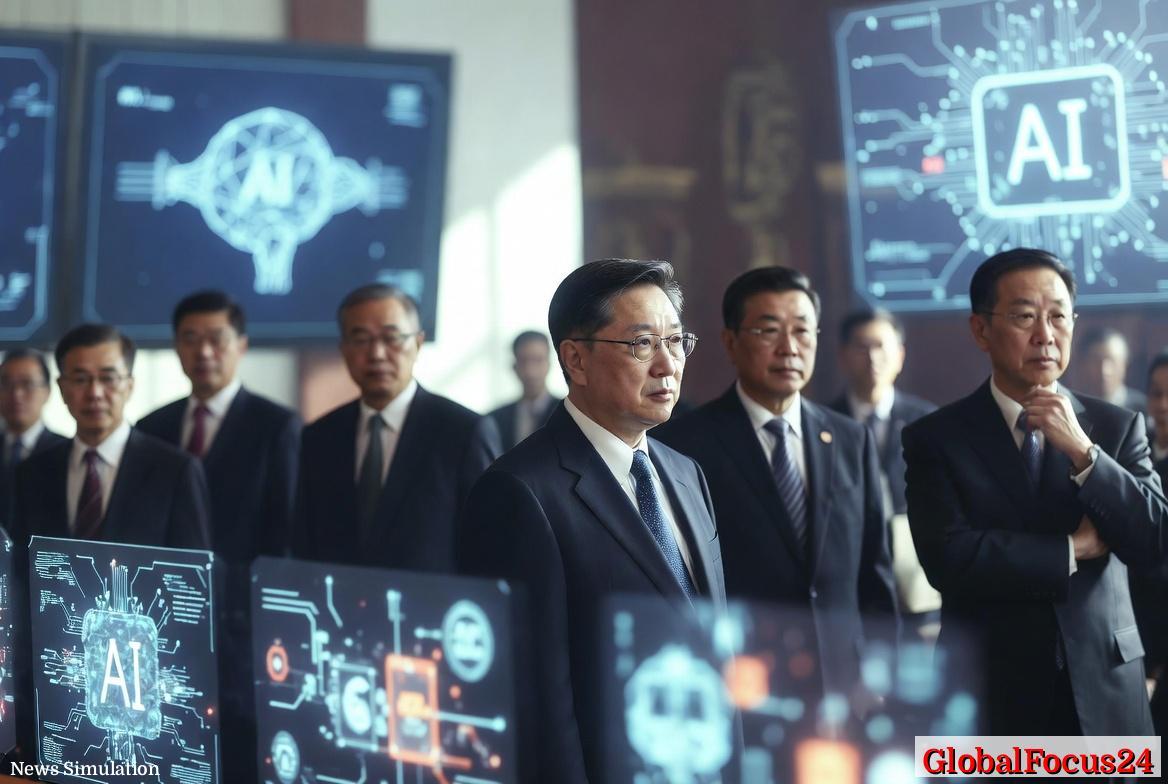
China Balances AI Ambitions With Political and Economic Risks
China’s Push for Homegrown Artificial Intelligence
China has made artificial intelligence a cornerstone of its long-term economic and technological strategy, investing heavily in domestic firms to reduce reliance on foreign innovation and to compete directly with the United States. From major technology hubs in Beijing, Shenzhen, and Hangzhou to a growing network of research institutes and startups, the country has rapidly scaled its AI capabilities across sectors including finance, manufacturing, healthcare, and defense.
Government-backed initiatives, generous funding programs, and favorable regulatory conditions have helped accelerate the rise of local AI champions. Companies specializing in large language models, autonomous systems, and data analytics have expanded quickly, supported by access to vast datasets and a strong engineering talent base.
Yet alongside this rapid growth, Chinese leadership faces a complex dilemma: how to encourage innovation while maintaining economic stability, social cohesion, and centralized political control.
Historical Context: Technology and State Oversight
China’s cautious approach to emerging technologies reflects decades of balancing economic liberalization with strict governance. Since the economic reforms of the late 1970s, the country has embraced market-driven growth while retaining tight oversight over industries deemed strategically important.
The rise of the internet in the 1990s and early 2000s offered an early example of this balancing act. Domestic technology giants flourished under protective policies that limited foreign competition, but they also operated within a framework of content controls and regulatory supervision.
Artificial intelligence represents a more complex challenge. Unlike earlier digital platforms, AI systems can generate content, automate decision-making, and influence economic structures at scale. This raises new concerns about unpredictability, information control, and systemic risk.
Economic Impact: Productivity Gains and Job Disruption
AI development promises significant economic benefits for China, particularly as the country seeks to transition from labor-intensive manufacturing to high-value industries. Automation and intelligent systems have the potential to boost productivity, reduce operational costs, and support innovation across supply chains.
Key areas of impact include:
- Manufacturing: AI-powered robotics and predictive maintenance are improving efficiency in factories, especially in coastal industrial regions.
- Healthcare: Machine learning models are assisting in diagnostics and resource allocation, particularly in densely populated urban centers.
- Finance: Algorithmic systems are enhancing risk assessment, fraud detection, and customer service.
- Logistics: Autonomous delivery systems and smart warehousing are reshaping e-commerce operations.
However, these gains come with significant labor implications. China’s workforce, particularly in manufacturing and administrative roles, faces increasing pressure from automation. Analysts estimate that millions of jobs could be affected over the next decade, especially in routine and repetitive occupations.
This raises concerns about unemployment, income inequality, and the need for large-scale workforce retraining. While new AI-related roles are emerging, they often require advanced technical skills, creating a gap that may be difficult to bridge quickly.
National Security Concerns and Data Control
Beyond economic considerations, artificial intelligence has become deeply intertwined with national security. Chinese authorities view AI as a critical component of future military and intelligence capabilities, as well as a tool for maintaining domestic stability.
At the same time, advanced AI systems introduce new vulnerabilities. Large language models and generative technologies can produce unpredictable outputs, raising concerns about misinformation, unauthorized data usage, and potential misuse.
To address these risks, regulators have introduced guidelines governing AI development and deployment. These include requirements for content moderation, data security, and alignment with state-defined standards. Companies are expected to ensure that their systems adhere to strict operational boundaries.
This regulatory environment reflects a broader concern: maintaining control over information flows while still enabling technological progress. Striking that balance remains a central challenge for policymakers.
The Global Technology Race
China’s AI ambitions cannot be separated from its strategic competition with the United States and other advanced economies. Both countries are investing heavily in AI research, semiconductor development, and digital infrastructure, viewing these areas as critical to future economic and geopolitical influence.
While the United States maintains advantages in foundational research and cutting-edge chip design, China has leveraged its scale, data availability, and government coordination to close the gap in several areas. Domestic firms have made rapid progress in natural language processing, computer vision, and applied AI solutions.
However, export restrictions on advanced semiconductors have created bottlenecks for Chinese companies, particularly in training large-scale AI models. In response, China has accelerated efforts to develop its own chip industry, though achieving full self-sufficiency remains a complex and long-term goal.
Regional comparisons highlight differing approaches:
- United States: Emphasizes private-sector innovation, open research ecosystems, and global collaboration, though increasingly coupled with national security restrictions.
- European Union: Focuses on regulatory frameworks, ethical standards, and data privacy, often prioritizing risk mitigation over rapid deployment.
- China: Combines state planning, industrial policy, and centralized oversight to drive rapid adoption while maintaining control.
Each model presents trade-offs between innovation speed, regulatory certainty, and societal impact.
Public Reaction and Industry Response
Within China, public awareness of AI has grown alongside its integration into daily life. From virtual assistants and recommendation algorithms to facial recognition systems, AI technologies are increasingly visible in urban environments.
Reactions are mixed. Many consumers embrace the convenience and efficiency offered by AI-powered services, particularly in areas like online shopping, transportation, and digital payments. At the same time, concerns about privacy, job security, and algorithmic transparency are becoming more prominent.
Industry leaders are also navigating a complex landscape. While government support has enabled rapid growth, regulatory scrutiny has increased in recent years. Companies must balance innovation with compliance, ensuring that their products align with evolving guidelines.
Some firms have adopted a cautious approach, focusing on enterprise applications and controlled deployments rather than open-ended consumer platforms. Others continue to push technological boundaries, investing heavily in research and development despite uncertainties.
Structural Challenges and Future Outlook
China’s pursuit of AI leadership faces several structural challenges that extend beyond regulation and labor dynamics.
One key issue is talent development. While the country produces a large number of engineering graduates, competition for top-tier AI researchers remains intense. Many leading experts have international experience, and attracting or retaining such talent is critical for sustaining innovation.
Another challenge lies in data governance. AI systems rely on high-quality, diverse datasets, but ensuring data accuracy, security, and ethical use is increasingly complex. Balancing accessibility with protection will be essential for long-term growth.
Infrastructure constraints also play a role. Advanced AI models require significant computational resources, and limitations in high-performance chips could slow progress if not addressed.
Despite these obstacles, China’s commitment to AI remains strong. Government plans continue to prioritize the sector as a driver of economic transformation, with significant investments in research, education, and industrial integration.
A Delicate Balancing Act
China’s approach to artificial intelligence reflects a broader tension between ambition and control. On one hand, the country seeks to lead in a technology that is reshaping global industries and redefining economic competitiveness. On the other, it must manage the societal and political implications of that transformation.
The outcome will likely depend on how effectively policymakers can navigate competing priorities: fostering innovation while preserving stability, encouraging growth while mitigating risk, and advancing global competitiveness without undermining domestic cohesion.
As AI continues to evolve, China’s strategy will remain a key factor shaping not only its own economic future but also the broader trajectory of technological development worldwide.