China Approves World’s First Commercial Brain-Computer Interface for Paralyzed Patients
A New Milestone in Neural Technology
In a groundbreaking development for medical technology, China has authorized the world’s first brain-computer interface (BCI) for commercial use outside clinical trials. The device, known as NEO, was developed by Neuracle Medical Technology in Shanghai and approved last week by the National Medical Products Administration (NMPA). This innovation marks a historic moment for neurotechnology, offering individuals with severe paralysis a pathway to regain partial mobility and independence.
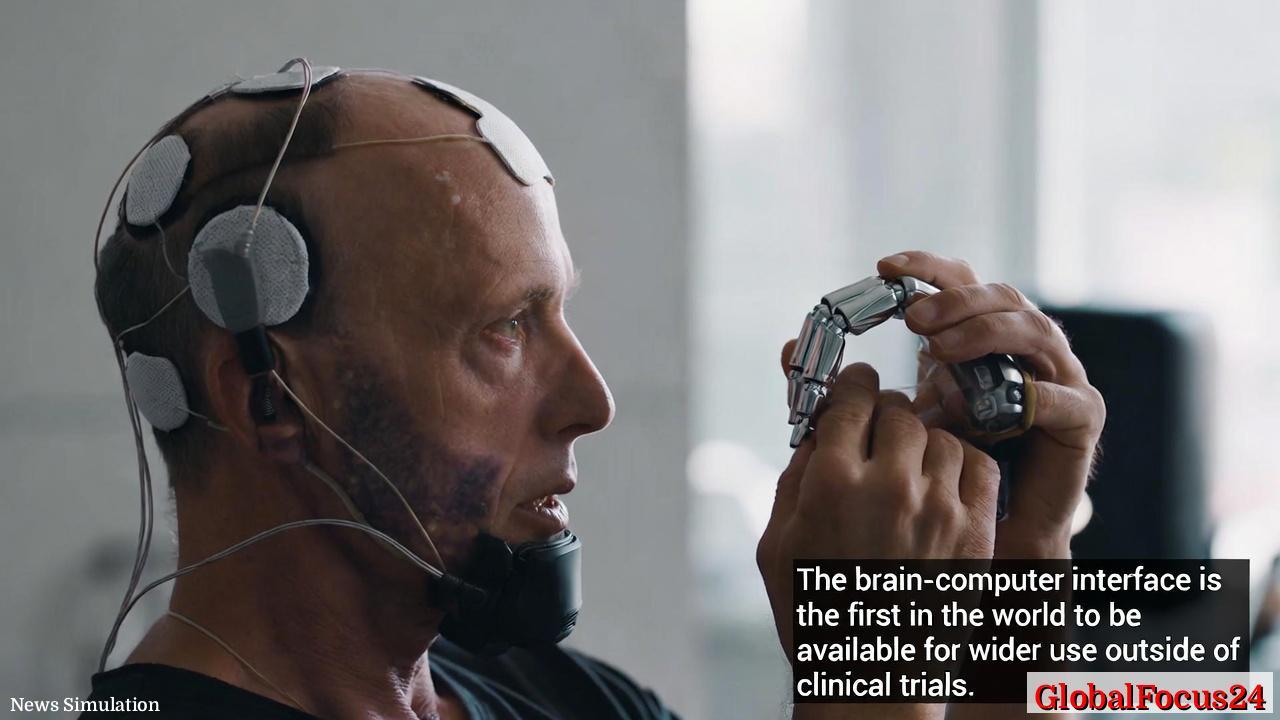
NEO enables users who are paralyzed from spinal cord injuries to control a soft robotic hand through direct brain signals. The approval positions China at the forefront of practical BCI applications, bridging neuroscience, robotics, and rehabilitation medicine in a way that was until now confined to research labs.
How the NEO Brain Implant Works
The NEO system consists of a coin-sized implant embedded in the skull, fitted with eight electrodes placed over one hemisphere of the brain. These electrodes detect neural activity when the user imagines moving their opposite hand. The device transmits this data to an external computer, which decodes the signals and translates them into precise movements in a robotic glove worn by the user.
This setup allows patients to perform actions like grasping utensils, holding cups, or touching surfaces—simple tasks that are often impossible after a cervical spinal cord injury. The robotic glove’s soft design provides gentle, adaptive feedback, which improves comfort while enhancing functionality.
Clinical results are striking: across trials involving 32 participants, all regained some movement control using the glove system. One participant who used the implant for nine months achieved independent eating and drinking—milestones that significantly elevate quality of life. The device demonstrated consistent stability and signal reliability for up to 18 months, addressing a long-standing challenge in the BCI field: long-term data retention and efficacy.
Transforming Life After Spinal Cord Injury
Every year, thousands of people worldwide suffer severe spinal cord injuries that lead to tetraplegia, or paralysis of all four limbs. Traditional rehabilitation offers limited outcomes once the spinal cord is permanently damaged. BCIs like NEO present a new kind of therapy—not by stimulating muscles directly, but by bypassing the injured pathways altogether.
By converting brain activity into digital instructions, NEO effectively reopens a communication channel between mind and body, even if the original biological connection is lost. Neurologists and rehabilitation specialists describe this as a major leap forward in restoring functional independence.
While exoskeletons and robotic aids have existed for years, what distinguishes NEO is its direct neural control, removing the need for physical input or residual muscle movement. It eliminates intermediary steps, thereby enhancing dexterity, intuitiveness, and immediacy—key factors in achieving real-world usability.
Clinical Validation and Long-Term Evidence
The approval follows extensive safety and efficacy trials conducted across multiple hospitals and rehabilitation centers in China. Participants were monitored not only for their ability to control the robotic hand but also for neurological side effects, infection risks, and implant durability. No serious adverse reactions were reported during the testing period, and the electrode-array maintained stable signal quality throughout.
This continuity is critical. In many past BCI trials worldwide, signal drift—the gradual weakening or distortion of brain signal recordings—has limited clinical feasibility. NEO’s stronger biocompatibility appears to prevent this degradation, offering stable operation across a full year and a half of use.
By generating a continuous stream of validated patient data over an extended period, Neuracle has built one of the most comprehensive safety datasets in BCI development history—a prerequisite for regulatory greenlights in any major market.
Economic and Industry Impact
China’s authorization of NEO represents more than a medical achievement. It could kick-start a new industry segment focused on neural rehabilitation devices, merging the existing medical robotics sector with the fast-growing field of brain-computer technologies.
Market analysts predict that commercial BCI systems could evolve into a multi-billion-dollar market by the 2030s, especially as aging populations drive greater demand for assistive technology. China, with its vast healthcare infrastructure and strong manufacturing capabilities, is well positioned to capitalize on that growth.
The national government has already designated neuroprosthetics and brain-interface research as strategic priorities under its broader innovation and health technology agenda. Domestic firms such as Neuracle and NeuroX are now racing to secure early leadership in a field that could parallel the rise of biotechnology two decades ago.
Furthermore, the medical device export sector may see a major boost as international regulators evaluate China’s safety protocols. If other countries accept NEO’s data under mutual recognition frameworks, the technology could soon enter markets across Asia and Europe, expanding its global significance.
Historical Context: A Global Pursuit Reaches Application Stage
Efforts to link the human brain directly with external machines date back to the late 1960s, when early experiments at the University of California, Los Angeles, recorded neural signals to control basic interfaces. In the decades that followed, academic pioneers from the United States, Germany, and Japan refined noninvasive EEG-based systems and later invasive cortical implants.
However, nearly all of these remained research prototypes. Even recent publicized implants from private companies have stayed within the bounds of clinical or experimental trials. China’s NEO approval therefore represents the first time a fully implanted BCI has moved from lab settings to authorized medical use among real-world patients.
The country’s rapid regulatory process and significant state backing have allowed it to leapfrog Western initiatives that often face slower clinical and ethical review cycles. In this sense, the NEO authorization mirrors earlier breakthroughs in gene editing and stem cell therapies, where China’s flexible framework enabled faster deployment of advanced biomedical tools.
Comparisons With Global Efforts
In the United States, brain-computer interface startups—most prominently Neuralink, Synchron, and Blackrock Neurotech—have made notable strides in developing wireless neural implants. Yet their devices remain in tightly controlled human trials. Neuralink, for instance, announced its first human implant last year, but widespread medical use may still be several years away pending FDA approval and long-term testing.
European companies like CortiCare and Mindmaze focus on noninvasive or wearable BCIs, which offer simpler regulatory pathways but lower signal fidelity. Japan and South Korea, meanwhile, continue to emphasize robotic exoskeletons as a complement to neural control systems.
Against this backdrop, China’s move is not just technologically impressive—it’s symbolically powerful, demonstrating the country’s readiness to translate frontier neuroscience into real therapeutic products. Experts note that this could accelerate international competition and cooperation in neuroengineering, potentially speeding up innovations that benefit patients worldwide.
Ethical and Social Considerations
The integration of BCIs into everyday medical care inevitably raises questions about safety, privacy, and data governance. Brain signal recordings contain highly personal information, and their secure handling will be crucial as devices like NEO become more widespread. Additionally, long-term implant maintenance, upgrade protocols, and affordability will shape who can realistically access this advanced technology.
Neuracle has stated that patient data will be encrypted and stored within secure hospital networks, and that all decoding software operates on tightly controlled, offline systems. Still, global observers emphasize the need for transparent regulations to protect users as adoption spreads.
Public reaction within China has been largely optimistic, especially in rehabilitation communities where patients with limited mobility welcome any opportunity to regain daily independence. On Chinese social media platforms, footage of users grasping objects with the robotic glove has prompted widespread amazement and hope.
The Path Forward for Brain-Computer Interfaces
Experts expect that NEO’s commercial launch will accelerate research into bidirectional BCIs, where the system not only reads neural activity but also delivers tactile feedback to the brain, crafting a more natural sense of touch. Future iterations may shrink the implant or integrate wireless charging and signal transmission to remove external wiring altogether.
Moreover, success in paralysis rehabilitation could expand the technology’s reach into stroke recovery, neurodegenerative diseases, and potentially prosthetic limb control for amputees. Each of these conditions represents a major global health burden, and early access to reliable BCIs could transform patient outcomes.
China’s approval of NEO ultimately stands as a defining moment in brain-computer interface history—the first true bridge between human thought and machine action built for practical use. While challenges remain in cost, scaling, and regulation, the achievement offers a glimpse of a future where digital extensions of the human nervous system move from science fiction into medical reality.