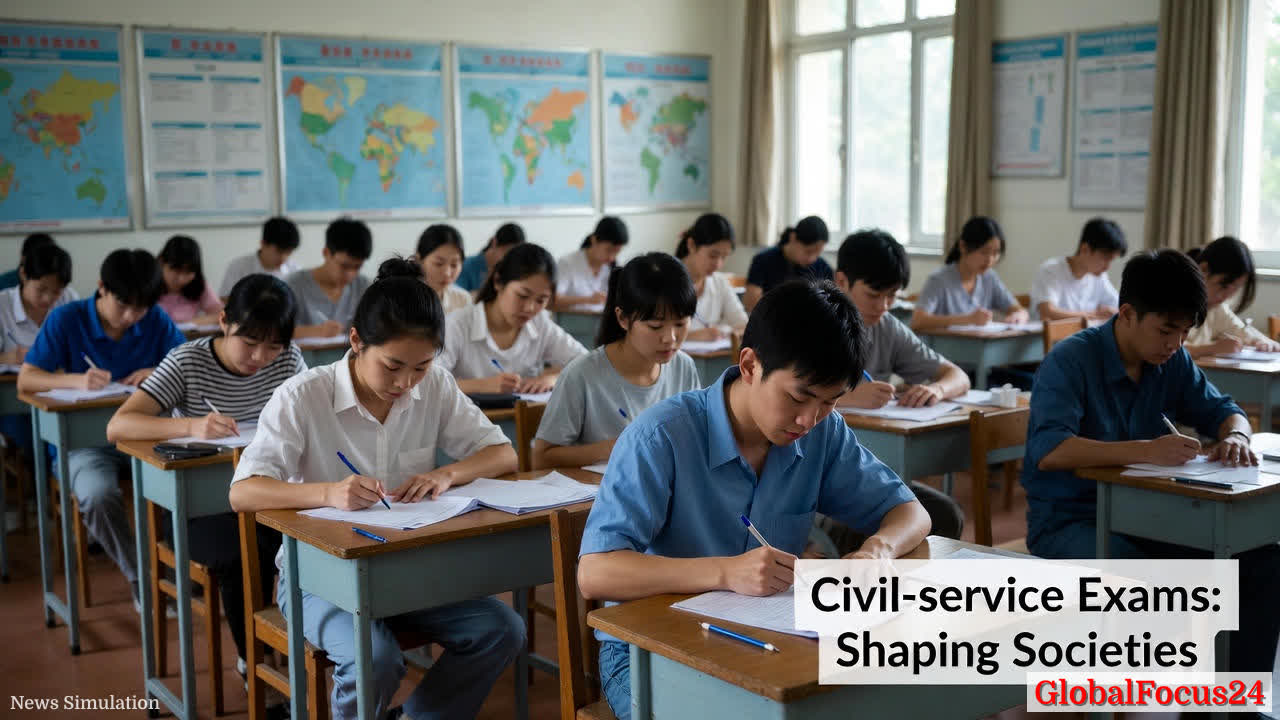
Why Civil-Service Exams Shape Society: Lessons from China and India
A recent report sheds renewed light on the enduring role of civil-service examinations in two of the world’s most populous nations, illustrating how these high-stakes tests influence career pathways, education systems, and broader social dynamics. Across generations, exam-driven selection has become a defining feature of governance, public administration, and social mobility in both China and India. As policymakers and researchers examine current reforms and modernization efforts, the global conversation around merit, equity, and state capability gains fresh momentum.
Historical roots and evolution
In both countries, civil-service examinations emerged from long-standing traditions that linked governance merit to knowledge, rhetoric, and administrative aptitude. In imperial China, the jinshi examination system, perfected over centuries, established a framework wherein scholar-officials earned legitimacy through mastery of Confucian classics, policy analysis, and literary skills. While the imperial era ended in the early 20th century, the ideal of merit-based recruitment persisted in new forms, shaping modern bureaucratic norms.
India’s civil service tradition traces back to colonial administrative apparatus and the later establishment of the Indian Administrative Service as a centralized, merit-based pathway into government service. Since independence, India has punctuated its public administration with standardized examinations, rigorous training, and a hierarchical career ladder designed to cultivate leadership within the state. Both trajectories underscore a consistent belief: public service requires a rigorous, transparent process to identify capable individuals who can navigate complexity, balance competing interests, and implement policy with accountability.
Structural design and current practices
China’s civil-service framework blends broad national exams with provincial and local assessments, creating a funnel that screens candidates for diverse roles—from policy planning to public management. Modern testing emphasizes a blend of quantitative problem-solving, analytical writing, and situational judgment tests, supplemented by interviews and background checks. The system is reinforced by a robust pipeline of university partnerships, standardized curricula, and ongoing professional development. This structure aims to maintain a cohesive civil service with consistent standards across vast regional disparities.
India’s system likewise leans on centralized exams to populate its administrative corps. The Civil Services Examination (CSE), conducted by a national exam body, remains the primary gateway to the Indian Administrative Service (IAS) and allied services. The process combines preliminary objective tests, a comprehensive main examination, and a rigorous interview phase. In recent years, there has been ongoing emphasis on expanding access, modernizing assessment formats, and addressing concerns about equity, coaching culture, and regional representation. The result is a dynamic, sometimes contentious, landscape where meritocracy is pursued amid significant urban-rural diversity.
Economic implications and labor-market effects
The economic stakes of civil-service exams extend beyond individual careers. A well-functioning civil service can improve policy implementation, public service delivery, and governance efficiency, all of which influence macroeconomic stability and growth. In both China and India, the ability to attract and retain skilled administrators supports large-scale development programs, infrastructure investments, and social welfare initiatives. Exam-driven recruitment, when coupled with ongoing training, creates a workforce capable of executing complex reforms in areas such as urban planning, healthcare, education, and environmental management.
A key economic consideration is the cost of preparation and the opportunity costs for aspirants. In both countries, the ascent through exams can require years of focused study, often accompanied by coaching networks, which can be expensive and favor those with greater resources or educational continuity. This dynamic raises questions about equitable access to public service careers and, in turn, about social mobility. Policymakers have experimented with scholarship programs, reservation policies, and targeted outreach to broaden participation, with varying degrees of success. The broader objective remains a public sector that reflects the country’s demographic and regional diversity while delivering tangible public goods.
Regional comparisons and development indicators
Despite shared heritage, regional disparities shape the experience and outcomes of civil-service examinations. In China, the scale of province-level administration means that local exam outcomes can influence regional governance capacity, budgetary control, and implementation speed. Provinces with robust higher education ecosystems often feed a steady stream of qualified candidates, enabling more agile local governance. Conversely, areas with educational gaps may face longer cycles of recruitment and slower policy execution, underscoring the importance of complementary training programs and career development pathways.
India presents a comparably complex mosaic, where state-level variations in examination preparation infrastructure, language diversity, and administrative needs intersect with a national standardization framework. Some states invest heavily in preparatory facilities and mentorship networks, while others struggle with limited access to coaching or fewer opportunities to demonstrate merit at scale. The result is a civil service that, while unified in its aspirational mandate, must navigate the realities of vast linguistic, cultural, and socioeconomic diversity. Comparative analyses often highlight that successful public administration in both countries hinges on aligning merit-based selection with ongoing capacity-building and performance-based accountability.
Public perception and social impact
Public reaction to civil-service examinations often centers on merit, opportunity, and prestige. In both countries, societal admiration for civil servants persists, rooted in perceptions of stability, influence, and the ability to shape national trajectories. However, the exam-centric model also invites scrutiny: debates about equality of access, transparency in scoring, and the influence of coaching industries on outcomes. In response, policymakers have pursued reforms designed to improve transparency, reduce undue coaching influence, and expand alternative routes to public service. Yet, the tension between maintaining rigorous standards and ensuring broad-based participation remains a defining feature of the discourse.
The role of technology and data in assessment
Advances in technology are reshaping how civil-service qualifications are evaluated. Computer-based testing, online proctoring, and data-driven analytics are increasingly used to enhance test security, scoring fairness, and candidate experience. Simulation-based assessments and work-sample tasks offer a more nuanced view of a candidate’s ability to handle real-world public-management challenges. For both China and India, adopting these tools supports more precise measurement of competencies, from policy analysis and stakeholder engagement to program evaluation and ethical decision-making.
Policy reforms and future prospects
Looking ahead, several reform themes are shaping the evolution of civil-service examinations. First, there is a push toward greater integration of domain-specific knowledge with generalist competencies, ensuring that public administrators can tackle cross-cutting issues such as climate resilience, public health, and digital governance. Second, efforts to democratize access—through targeted outreach, language inclusion, and financial support—are intended to broaden the applicant base and improve social equity. Third, enhancements in training and mentoring post-selection aim to reduce turnover, accelerate impact, and cultivate leadership within the civil service.
Regional experiences offer instructive contrasts. In China, ongoing reforms emphasize standardized national benchmarks while preserving local adaptability, ensuring consistency without stifling regional responsiveness. In India, the emphasis on cadre flexibility, field immersion, and capacity-building reflects a recognition that public administration success depends not only on initial selection but on sustained professional development and accountability mechanisms.
Societal significance and public interest
Civil-service examinations are more than gateways to jobs; they are instruments that shape how governance is perceived and experienced. The exams influence educational aspirations, encourage rigorous study cultures, and reward analytical thinking and disciplined work habits. They also affect regional economic development by determining leadership pools for administrative units that implement investment plans, regulate markets, and deliver essential services.
From a global perspective, the persistence of exam-based recruitment in large, diverse democracies underscores a broader question: how best to balance merit, equity, and accountability in public administration. As nations confront aging populations, technological disruption, and increasingly complex policy challenges, the capacity to attract and retain competent public servants becomes a core determinant of resilience and prosperity. The experiences of China and India offer valuable case studies in designing assessment regimes that support reliable talent pipelines while addressing interconnected social and economic objectives.
Conclusion and synthesis
Civil-service examinations in China and India continue to influence the architecture of governance, education, and social mobility. The enduring appeal of merit-based selection lies in its promise of competence, impartiality, and national cohesion. Yet the challenges—ensuring equal access, maintaining transparency, and aligning recruitment with broader development goals—require ongoing attention and thoughtful reform. By combining rigorous assessment with robust training, equitable outreach, and accountability, both countries aim to build administrative capacity capable of delivering results for diverse populations in a rapidly changing world.
Public administrators, educators, and policymakers will watch closely how exam reforms translate into tangible improvements in public service delivery. As China and India navigate the balance between tradition and modernization, the civil-service examination remains a central instrument in shaping not only who governs but how governance evolves to meet the needs of citizens today and tomorrow.