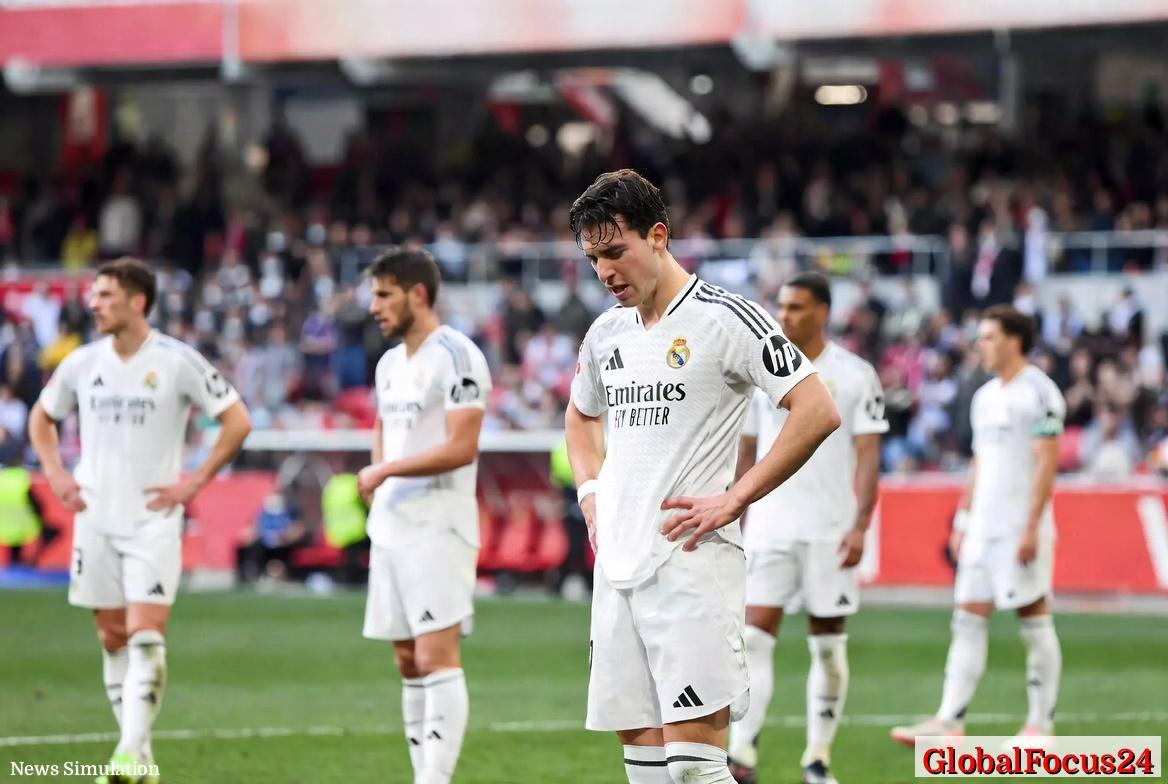
Real Madrid Exit Champions League After Late Bayern Munich Surge in Controversial Quarter-Final Clash
Dramatic Night at Allianz Arena Ends Madrid’s European Campaign
Real Madrid were eliminated from the UEFA Champions League quarter-finals following a dramatic 4-3 defeat to Bayern Munich in the second leg at the Allianz Arena, sealing a 6-4 aggregate victory for the German side. The match, already finely balanced heading into the final stages, was ultimately defined by a contentious red card and a late Bayern scoring burst that swung the tie decisively.
With both teams locked at 3-3 on the night and level on aggregate deep into the second half, the contest appeared destined for extra time. Instead, a series of pivotal moments — including the dismissal of Eduardo Camavinga and two late Bayern goals — reshaped the outcome in a matter of minutes, ending Real Madrid’s pursuit of another European title.
Turning Point: Camavinga’s Dismissal Sparks Chaos
The decisive moment arrived in the 86th minute when Real Madrid midfielder Eduardo Camavinga was shown a second yellow card by Slovenian referee Slavko Vincic. Camavinga had entered the match as a substitute in the 62nd minute and was already on a booking after pulling back Jamal Musiala during a Bayern counterattack.
His second caution came after a trip on Harry Kane, followed by what officials interpreted as delaying the restart — dribbling the ball away and handling it. The decision triggered immediate protests from Real Madrid players, who surrounded the referee in disbelief as the magnitude of the moment became clear.
The dismissal reduced Madrid to ten men at a critical juncture, fundamentally altering the dynamics of the match. Within minutes, Bayern Munich capitalized on their numerical advantage.
Bayern’s Late Goals Seal the Tie
Bayern Munich struck twice in rapid succession to eliminate the Spanish giants. Luis Diaz found the net in the 89th minute, exploiting defensive gaps that emerged after Camavinga’s dismissal. Then, in the fourth minute of added time, Michael Olise delivered the decisive blow, scoring to extend Bayern’s lead and put the tie beyond reach.
The Allianz Arena erupted as Bayern completed a comeback that had seemed uncertain just moments earlier. The late goals underscored Bayern’s ability to seize critical opportunities under pressure, a hallmark of their European pedigree.
Player Reactions Highlight Frustration
The aftermath of the red card and the late goals sparked visible frustration among Real Madrid players. Kylian Mbappe, Jude Bellingham, and Arda Guler were among those who confronted the referee immediately after the decision.
Bellingham later described the call as “a joke” while speaking in the mixed zone, reflecting the sentiment shared by several teammates. Defender Eder Militao labeled the decision an “injustice,” while Antonio Rudiger expressed disbelief, telling reporters that the situation spoke for itself.
Tensions remained high even after the final whistle. Arda Guler was sent off following continued protests, and unused substitute Dani Carvajal was seen shouting toward match officials from the sidelines, highlighting the emotional intensity surrounding the conclusion.
Coaching Perspective: A Tie Decided by Margins
Head coach Alvaro Arbeloa emphasized the impact of the red card on the outcome of the match. In his post-match remarks, he suggested that the dismissal effectively ended Real Madrid’s chances of progressing.
According to Arbeloa, the nature of the sending-off was difficult to comprehend given the context of the match. He pointed to the timing and circumstances as factors that left his team feeling that the tie slipped away due to elements beyond their control.
His comments reflected a broader sense of frustration within the squad, particularly given how evenly matched the teams had been across both legs.
Historical Context: European Giants Collide Again
Encounters between Real Madrid and Bayern Munich have long been among the most storied in Champions League history. The two clubs have combined for more than a dozen European titles and have faced each other in numerous knockout ties over the decades.
Historically, Real Madrid have often held the upper hand in recent meetings, particularly during their dominant run in the late 2010s. However, Bayern Munich’s victory in this quarter-final adds another chapter to a rivalry defined by fine margins and dramatic moments.
Matches between these sides frequently hinge on individual brilliance or controversial decisions, and this latest clash was no exception. The intensity and unpredictability of the tie reinforced why it remains one of European football’s marquee matchups.
Economic Impact of Champions League Exit
Real Madrid’s elimination carries significant financial implications. Progression to the semi-finals of the Champions League brings substantial revenue through prize money, broadcasting rights, and matchday income.
By exiting at the quarter-final stage, the club misses out on:
- Additional prize earnings associated with advancing further in the competition.
- Increased global exposure that boosts commercial partnerships and sponsorship value.
- Higher matchday revenue from hosting additional high-profile fixtures at the Santiago Bernabeu.
For Bayern Munich, the victory not only enhances sporting prestige but also strengthens their financial position. Continued participation in the latter stages of the Champions League typically correlates with increased revenue streams and global brand visibility.
Regional Comparisons: Bundesliga vs La Liga Performance
The result also contributes to the ongoing comparison between Europe’s top leagues. Bayern Munich’s success reinforces the Bundesliga’s reputation for producing competitive teams capable of challenging traditional powerhouses from La Liga and the Premier League.
In recent seasons, Spanish clubs have maintained a strong presence in European competitions, with Real Madrid in particular serving as a dominant force. However, this defeat highlights the narrowing gap between leagues, as German clubs continue to invest in talent and tactical development.
Bayern’s ability to overcome Real Madrid in a high-stakes knockout tie underscores the depth and resilience of Bundesliga contenders. It also reflects a broader trend of increased parity across Europe’s elite competitions.
Tactical Breakdown: Momentum Shift in Final Minutes
From a tactical standpoint, the match was finely balanced until the closing stages. Real Madrid demonstrated control and composure for much of the second half, managing Bayern’s attacking threats effectively while creating scoring opportunities of their own.
However, the red card disrupted their defensive structure. Reduced to ten men, Madrid struggled to maintain shape and organization, particularly against Bayern’s pace on the wings.
Bayern capitalized by increasing pressure in wide areas, stretching Madrid’s defense and creating space for late runs into the box. The goals from Diaz and Olise were the direct result of this shift in momentum, as Bayern exploited numerical superiority with clinical efficiency.
Public Reaction and Media Coverage
The match generated widespread reaction across the football world, with particular focus on the refereeing decisions that influenced the outcome. Spanish media outlets prominently highlighted the controversy, echoing the sentiments expressed by players and coaching staff.
Fans took to social media to debate the fairness of the red card, with opinions divided between those who viewed it as a strict but valid application of the rules and those who believed it was overly harsh given the context.
The intensity of the reaction reflects the high stakes of Champions League knockout matches, where single decisions can determine the fate of entire campaigns.
Looking Ahead: Implications for Both Clubs
For Real Madrid, the focus now shifts to domestic competitions and rebuilding momentum after a disappointing European exit. The club will need to regroup quickly, addressing both tactical and psychological aspects as they aim to finish the season strongly.
Bayern Munich, meanwhile, advance with renewed confidence. Their ability to deliver under pressure and capitalize on decisive moments positions them as strong contenders for the title.
As the Champions League progresses, this quarter-final will be remembered not only for its dramatic conclusion but also for the controversy and intensity that defined it — a reminder of the fine margins that separate triumph from elimination at the highest level of European football.